

Consumer Reports Says This Popular Honda Hybrid Might Not Save You Money On Gas
There was a time not too long ago when a "hybrid car" meant a specific type of small vehicle aimed at maximum fuel efficiency above all else. The early 2000s versions of the Toyota Prius and the funky and fascinating first-gen Honda Insight come to mind, and these were cars that screamed "efficiency" just by looking at them.
Today, though, hybrid powertrains can be found in vehicles ranging from supercars to full-size pickup trucks. Many mainstream models, like Toyota's ultra-popular Camry and RAV4, have moved to hybrid-only powertrains with their latest iterations. Typically boasting more power and better features, the modern hybrid is often about more than just good fuel economy, but many buyers are still drawn to hybrids because of the potential to save money at the pump.
But how much money do you actually save with a hybrid? That's a question whose answer can vary widely. For its part, Consumer Reports has singled out the Honda Accord Hybrid as an example of a hybrid that isn't quite a great option for saving money. This is not to say that the Accord is a bad choice, or that Honda's hybrid powertrain is lacking, but simply that you'll want to take a close look at the Accord Hybrid's math if your primary goal is to reduce costs.
Spend more to save more?
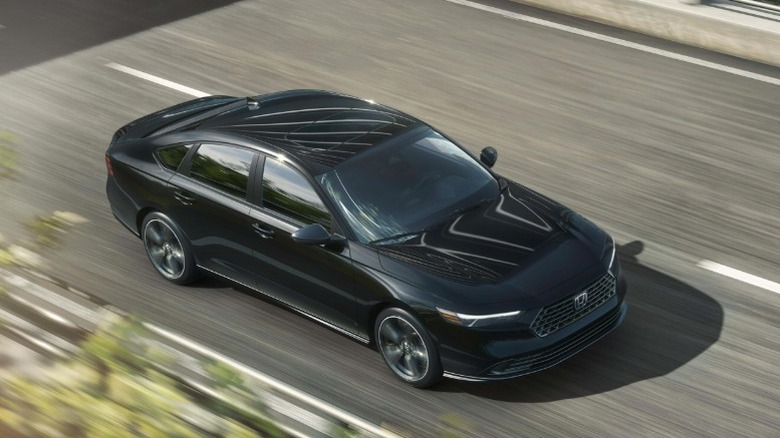
By most accounts, the modern Honda Accord does an excellent job carrying on the model's longstanding reputation for mid-sized sedan excellence. Our own review of the current Accord Hybrid found that it delivered a great mix of fuel efficiency, spaciousness, and driving dynamics at a reasonable price. However, while we liked it, we did question whether the hybrid Accord was worth the price premium over the non-hybrid version.
And that's exactly why Consumer Reports isn't recommending the Accord Hybrid as a money-saving proposition. The entry-level 2026 Accord LX, powered by a 1.5-liter turbocharged four-cylinder engine, has an MSRP of $29,590 with an EPA rating of 32 MPG combined. The cheapest Accord Hybrid, the Sport, has an MSRP of $34,990 (both prices after $1,195 destination) and has an EPA combined rating of 44 MPG.
You will indeed spend less money on fuel with the hybrid, but whether those savings are worth the extra $5,000-plus purchase price is the issue. How much the hybrid actually saves you will depend on both the cost of fuel in your area and the number of miles you drive. The higher both of those numbers are, the sooner the hybrid will pay for itself.
Making the math work
Consumer Reports estimates that it would take about 13 years of driving before the Accord Hybrid would justify its fuel-savings advantage over a less-expensive non-hybrid model. Thus, it ranks poorly in terms of pure money savings. However, if you drive a lot in an area with high gas prices, the hybrid could make more financial sense.
But there's a lot more to a hybrid than purely saving money at the gas pump. The Accord Hybrid not only gets better fuel economy than its non-hybrid counterpart, but it's also more powerful and better equipped, as the top-end trim levels are hybrid-only. Likewise, there's also a strong chance the hybrid will retain its value better when it comes time to sell.
If your only concern is getting the cheapest midsize sedan to own and drive, though, you might be better off with the much cheaper non-hybrid Accord. Or you can consider the Accord's primary rival, the Toyota Camry, which now has a hybrid powertrain across the lineup. The base model 2026 Camry LE, for example, starts at $30,295 (including $1,195 destination) and has an EPA combined fuel economy rating of 51 MPG, making it more fuel efficient and significantly cheaper to buy than a comparable Accord Hybrid. The Accord Hybrid is still a fantastic sedan, of course, but it might not be the ideal choice for saving money in the short term.