

Does Turning On Airplane Mode Make Your Phone Charge Faster?
Modern-day smartphones are crammed with so many features that it's not uncommon for their batteries to exceed 4,000 or 5,000 mAh. While these large batteries can deliver day-long battery life, they may also take longer to charge. Despite fast charging technology largely solving this issue, disasters like the Samsung Galaxy Note 7's battery fires keep manufacturers on their toes. However, smartphone charging times have become a key selling point worldwide, and a phone that goes from 0 to 80% in under 30 minutes does make a qualitative difference in our lives. It is no surprise, therefore, that smartphone charging times are heavily advertised despite concerns about their long-term effects on smartphone batteries.
While sticking to manufacturer-recommended charging bricks and good charging practices is all it takes to get the most out of a modern smartphone battery, users often seek out methods to charge their phones as quickly as possible. One method users have tried is to charge the phone with airplane mode enabled. The logic here is simple: Disabling the smartphone's cellular radio and Wi-Fi antennas should, on paper, lead to a slight decrease in charging times. CNET tested this in 2014 and found that Airplane Mode cut 4 minutes off a full charge and 11 minutes from a 50% charge.
We ran a small test of our own to check these claims and confirmed CNET's decade-old findings. However, while charging a phone in airplane mode may slightly improve charging times, the savings aren't significant enough for most users to make it a habit.
Charging smartphones in airplane mode is technically faster, but practically pointless
To determine whether charging a phone with airplane mode enabled makes a significant difference, we subjected a Samsung Galaxy S24 Ultra to several rounds of testing. The tests were simple. Discharge the phone to 0%, connect it to a charger, and use a stopwatch to measure how long it takes to reach 100%. In all the tests, we switched the phone on when it reached 1%. For the airplane mode tests, we also enabled airplane mode after switching it on. We used Nothing's CMF Power 65W GaN charger for all tests, and all were conducted at similar ambient temperatures (roughly 77 degrees Fahrenheit).
We consistently achieved shorter charging times with the phone in airplane mode. The shortest time we recoded for a full 0-100% charge in airplane mode was 1 hour and 2 minutes. In comparison, the shortest the phone took to charge with full access to mobile data and Wi-Fi was 1 hour and 9 minutes, a difference of just 6 minutes. We repeated these tests over several weeks and obtained similar results, with the gap between the two charging styles consistently hovering between 4 and 7 minutes.
Now, while these results mirror what CNET achieved during its testing, the key takeaway from this exercise was that the whole effort of turning on airplane mode only gives users a roughly 5-minute advantage on average. Unless someone is in a perpetual hurry, this entire exercise appears to be somewhat futile. It's an even worse deal when you consider that airplane mode stops one from receiving any calls or messages while charging.
Airplane mode helps — until ambient temperature gets involved
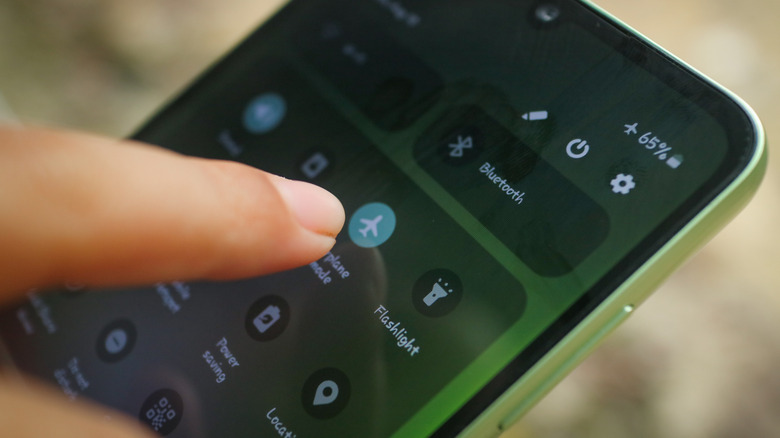
While our charging test results aligned with the notion that airplane mode does have a positive impact on charging speeds, there are several circumstances in which this may not be true. Results may also vary across phone models, the type of charger used, and, more importantly, the ambient temperature at which the phone is being charged.
Early on in our testing, we encountered a few instances where the Samsung Galaxy S24 Ultra took noticeably longer to go from 0-100% in airplane mode. In one test, the phone was still showing an additional 5 minutes to reach 100% even after 1 hour and 21 minutes. There were other occasions when the phone took nearly an hour and 14 minutes to reach 100% despite being in airplane mode the entire time. Each time, we noticed that the ambient temperature was higher than average, between 89 and 92 degrees Fahrenheit. The phone was also significantly hotter during these tests.
As outlined earlier, these aberrations were noted during the initial days of testing. Given that ambient temperature affects charging times, we then decided to conduct the remaining tests in a controlled-temperature environment. Only after switching to a constant, comfortable temperature were we able to consistently eke out the shorter charging times we discussed earlier. In effect, the phone only delivered consistent charging speeds at ideal temperatures. Given that the average user may not always have access to the best possible charging conditions, real-world charging speeds will almost certainly vary between users, airplane mode or not — doubly so if they're still holding on to bad smartphone charging habits.