

How Fast Can You Drive With Snow Chains?
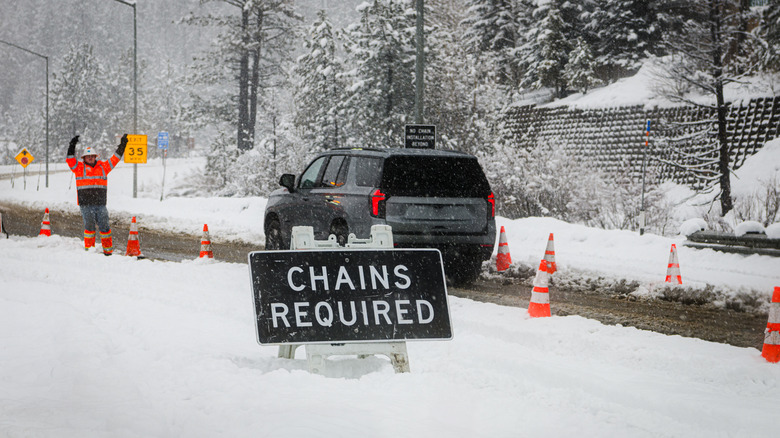
Living in a snowy climate not only offers breathtaking views but can also provide moments of glorious fun, from riding in a horse-drawn sleigh across the countryside to careening down a hill on skis or a snowboard with reckless abandon. On the flipside, there's a lot of work that comes with living in the fluffy white stuff. Not only do you have to shovel it from your sidewalks and driveway, but if you're going somewhere to careen blissfully down the mountain, you'll more than likely need to strap up your car's wheels with snow chains (even if you have AWD), which, even under ideal conditions, is rarely a fun experience.
Once you've finished with wrestling on the chains — and getting soaked in the process– you're not getting to your final destination anytime soon. At least not as long as those chains are still wrapped around your tires. Most snow chain manufacturers recommend a maximum speed of 30mph, but some states (like California) can limit it to just 25mph along certain stretches of road. The official website for the Big Bear Lake Visitor Center in California even suggests going as slow as 20mph, which proves you'll need to keep your head on a swivel for posted speed limit signs just to keep yourself on the right side of the law.
Safety is, of course, the primary reason for the lower speeds. Going over 30mph might cause the chains to break and subsequently result in severe damage to the immediate areas surrounding the wheels.
Be cautious to avoid slip sliding away
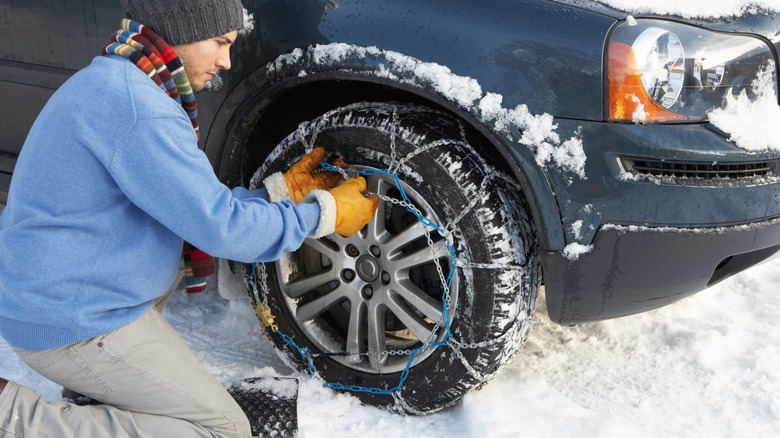
Many states (i.e., Delaware, Illinois, Michigan, and Rhode Island) have some basic law that, in general terms, says something akin to "tire chains or snow tires may be used by any vehicle when required for safety due to snow, rain, or other slippery conditions." Others, such as California, Colorado, Ohio, and Massachusetts, go far more in-depth and outline exactly what time of year they're needed and when they're required. Still others, like Florida, Hawaii, Missouri, and Vermont, don't even bother with chain laws. Instead, they leave it up to drivers to use their best judgment about when and where they're needed.
After installation, it's a good idea to drive on them for about 100 feet then reinspect them to ensure they're properly secured. You should never drive on dry pavement, doing so will not only increase wear and tear on the chains but also damage the road surface. If possible, avoid hitting potholes, as the impact could loosen the chains or, worse, cause them to break free and wreak havoc to your vehicle.
It's also important to drive carefully and smoothly. Accelerating too quickly can make the tires spin on the slick surface (which can put considerable stress on the chains). Breaking softly will keep the wheels from locking up and the vehicle from skidding across the road, which again can create enough pressure on the chains to snap. Having the proper tires and/or chains is but one of many winter car mistakes many drivers make. Ultimately, stay alert, go slow, and always check with your local transportation department for the exact laws.