

'Increased Risk Of Crash': Toyota Recalls 160K Tundra Trucks
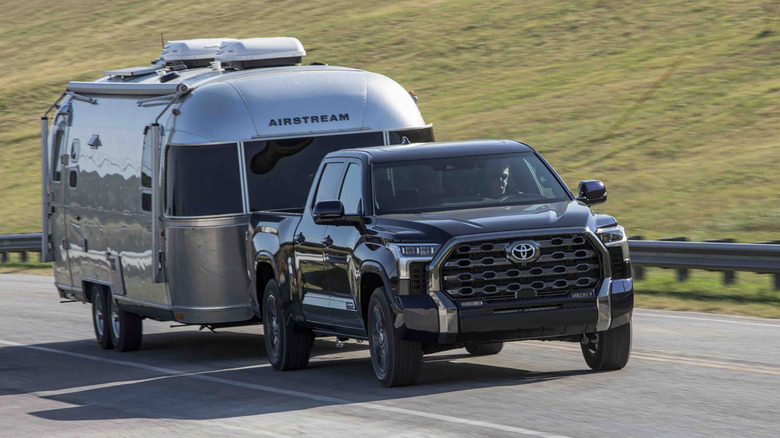
For around 20 years, the Toyota Tundra has been seen as a bastion of pickup truck reliability, with the truck regularly ranking among the most reliable vehicles that Toyota sells and one of the longest-lasting pickup trucks on the road in general.
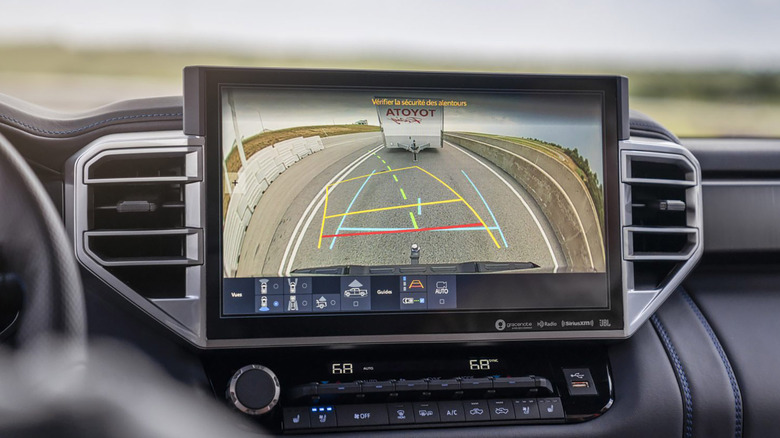
The latest iteration of the Tundra, however, has picked up a few chinks in its reliability armor over recent years. Toyota has seen some fairly significant engine issues with its new 3.4-liter twin-turbocharged engine, which has been subject to multiple recalls for potential engine failures. And now Toyota has issued a new recall for over 160,000 Tundras , this time for a safety issue with the rear-view camera, which could potentially lead to crashes.
And while there's indeed a significant safety risk involved, fortunately for both Toyota and current Tundra owners, the issue is more of a software glitch than a serious mechanical failure — and one that should be able to be easily remedied once the recall notices go out. This is also not the first time that Toyota has issued a recall for non-functioning rear cameras, which have become an increasingly common component for recalls across the auto industry.
When a glitch becomes a safety hazard
Generally, nobody wants to find out that their vehicle is subject to a recall, especially one that could increase the odds of an accident. But if you happen to own a Tundra, you can at least rest assured that this new recall is of notably less severity than the ongoing recalls concerning potential catastrophic engine failures in the Tundra and other Toyota and Lexus SUVs.
This latest safety recall covers 162,000 model-year 2024 and 2025 Tundra and Tundra Hybrid pickups, which Toyota says could have a malfunctioning camera display. While in reverse, the display screen from the camera could either become frozen or display a black image, blinding the driver to the rearward view.
Though it may sound like a relatively minor annoyance, it's easy to see how a non-functioning rear-view camera could make an accident more likely. More importantly, this also means the vehicle does not comply with federal safety standards, which have mandated rear-view cameras on all new vehicles sold since 2018. As for a fix, it sounds like this one should be relatively easy. Toyota says dealers should simply be able to update the 'Parking Assist ECU' software, with no physical components needing to be repaired or replaced.
An easy fix?
It's unclear whether this is the exact same software glitch, but Toyota had already issued a recall in the fall of 2025 for nearly 400,000 Tundras and Sequoia SUVs for a nearly identical issue where the rear-view camera image would not display. For the latest recall, Toyota says it will notify owners of the affected vehicles by the end of March 2026. From there, they can schedule an appointment at their local dealer to have the camera software updated — free of charge, of course.
While drivers got along fine for decades without having rear-view cameras, using their mirrors and cranking their heads back to see behind them, many of today's drivers are highly dependent on modern backup cameras and parking sensors. If you've ever gotten into an older car that doesn't have a rear-view camera, you might not realize how jarring it can be after being spoiled by them. And the problem would be even more dangerous when trying to back up in a large, full-size pickup like the Tundra.
Is this recall another issue that will downgrade the Tundra's overall reputation? Likely not in a significant way. The good thing for current Tundra owners (or potential Tundra buyers) is that this recall doesn't seem to suggest there's anything uniquely failure-prone about Toyota's backup camera or software system. Numerous brands have been hit in recent years with similar issues, including a massive Ford camera recall, which has required over 1.4 million vehicles to be fixed.