

These 3 US Navy Zumwalt-Class Destroyers Will Be Armed To The Nines
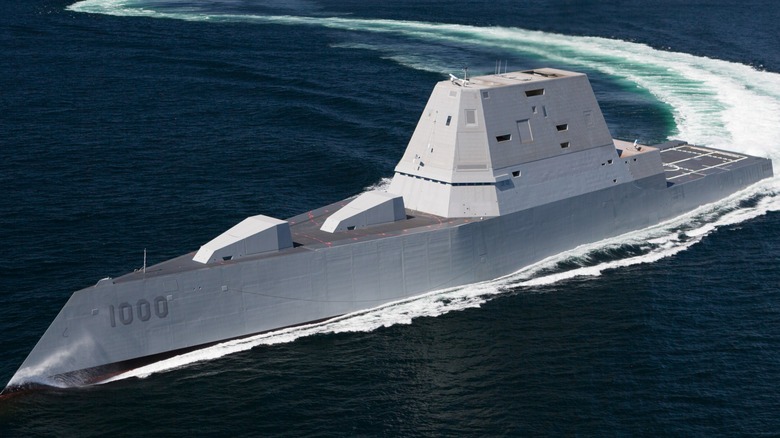
The United States Navy developed the Zumwalt-class destroyer, which is the largest destroyer ever built, planning for a fleet of 32 vessels. The first of these, the USS Zumwalt (DDG-1000), was commissioned into service in October 2016, and thus far, only the USS Michael Monsoor (DDG-1001) and USS Lyndon B. Johnson (DDG-1002) have been launched. The Navy unceremoniously canceled the program, limiting the service branch to only three of the stealth ships, but that doesn't mean the existing vessels aren't fully supported.
The primary guns on the ships when they first launched included two powerful and deadly . These fully-automated weapon systems boast a range of 95.5 miles and can fire upon littoral and inland targets for anti-surface warfare. The highly lethal AGS is certainly impressive, but following a three-year refit that ended in late 2025, they were stripped and replaced with a much deadlier , which is happening to all three Zumwalt-class destroyers.
The alteration to the Zumwalt to make the installation possible was no easy task, as it took three years to fully remove the AGS, build the necessary infrastructure for the CPS, and install them. Various software systems and computer hardware also required modifications, so switching these out wasn't quick or inexpensive. Still, while the AGS is certainly lethal, the CPS offers significantly greater lethality and additional targeting options that its predecessor couldn't achieve, making sure that the Navy's Zumwalt-class destroyers are armed to the nines.
The Conventional Prompt Strike system adds hypersonic offensive capabilities to Zumwalt-class destroyers
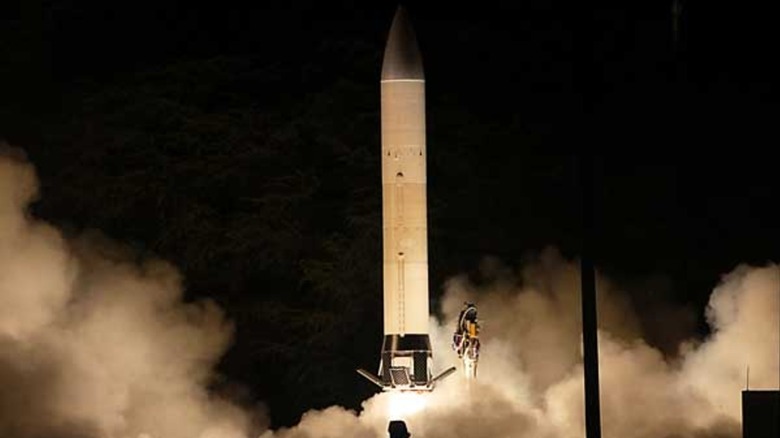
The U.S. isn't a singular weapon system, as it's a program describing a weapon capable of delivering precision-guided munitions anywhere in the world within an hour. In terms of the new systems installed on the USS Zumwalt and its sister ships, these installed in the forward housing area. The configuration of launch tubes is almost identical to the one designed for the Block V Virginia-class submarines. Each Zumwalt-class destroyer will now support 12 CPS missiles, which makes them exponentially more lethal than they were with the AGSs.
While the Navy isn't handing out flyers detailing the exact specifications of its newly-installed CPS missiles, the overall program does supply some information. CPS missiles are conventional (non-nuclear), boost-glide hypersonic weapons. with a Common Hypersonic Glide Body (CHGB), which houses a kinetic energy projectile warhead. Installing them aboard Zumwalt-class destroyers marks Phase 2 of the CPS program, while further phases will see them installed on future Virginia-class fast-attack subs.
, meaning they can reach speeds in excess of Mach 5 (3,836 mph). This makes them difficult to shoot down, and it increases their destructive power through greater kinetic energy. The range of these missiles is unclear, though the CHGB increases a missile's range considerably, allowing for deep strikes far from the shore. They also boast against enemy air defenses via their speed and time in the air over a target area.