

DeWalt Vs Milwaukee: Which Brand Makes The Most Powerful Impact Drill?
We may receive a commission on purchases made from links.
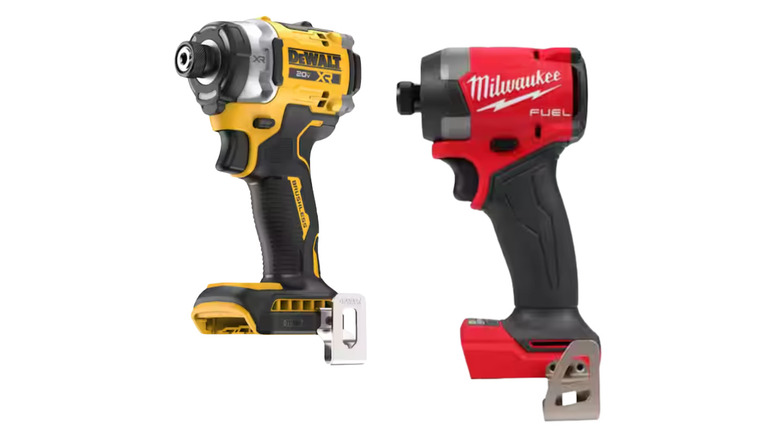
It can be tough to select the right tool for the job, especially when you're choosing between two major brands. Getting the most for your money is just one part of the equation, as the tool's power can make a big difference as well. For example, if you're looking for the most powerful impact drill between DeWalt and Milwaukee, the 20V Max XR 1/4-inch 3-Speed High Torque Impact Driver from DeWalt is the clear winner.
This drill, identified by the model number DCF860B, delivers up to 2,500 in-pounds of maximum torque. It's DeWalt's most powerful impact driver, giving you the ability to drive even the toughest fasteners with less effort compared to other models. It features a brushless motor, and 3-speed mode selector so you can change the speed and torque for different tasks. According to DeWalt, the DCF860B is designed with a focus on demanding jobs where maximum output is required without sacrificing user control.
In contrast, the most powerful Milwaukee option is the M18 Fuel 1/4-inch Hex Impact Driver, which is built to deliver up to 2,000 in-pounds of maximum torque. Classified as 2653-20 (often seen as 2953-20 in some listings), this M18 driver is different from the Milwaukee M12 version. It runs on the Powerstate brushless motor, which is designed for efficiency and cool operation under heavier loads. Milwaukee defines the 2653-20's focus as more of a balanced power delivery, with an emphasis on consistency and overall performance no matter the task.
Practical uses of impact drivers versus spec sheets
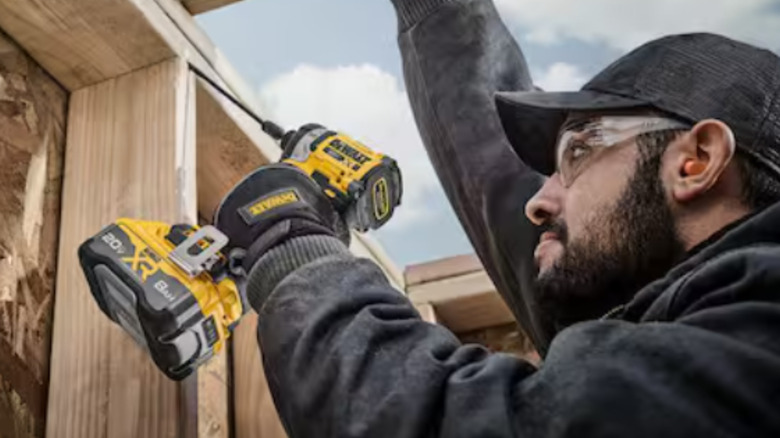
While the DeWalt 20V Max XR Impact Driver is more powerful than the Milwaukee M18 Fuel Hex Impact Driver according to manufacturer specifications, real-world use may vary. During independent tool tests, the Milwaukee driver, which measured lower in peak torque, completed some tasks faster than the DeWalt driver. That's why it's always important to think about the amount of power required for the task versus how quickly you need that work completed.
It comes down to how impact drivers apply power in real time. Drivers use a hammer-and-anvil setup, which delivers power much differently than a regular drill. As the bit makes surface contact and that surface resists, the driver applies quick bursts of torque repeatedly instead of one steady rotation. That's why factors like impact speed and how often those impacts occur play an important part in how quickly a fastener is driven. As a result, a driver with lower-rated peak torque can complete certain tasks faster. But it all hinges on how the power is delivered.
Impact rate and rotational speed can also affect how impact drivers perform, meaning that a tool with adjustable torque or fine speed control can work differently than expected. Plus, many drivers don't have multiple speed or power settings, making them less effective in scenarios where controlled power is needed. Knowing when to use an impact driver and understanding how it can differ based on the situation makes a difference in overall results.