

GM's Cross-Fire Engines Are Called 'Cease-Fire' For A Reason
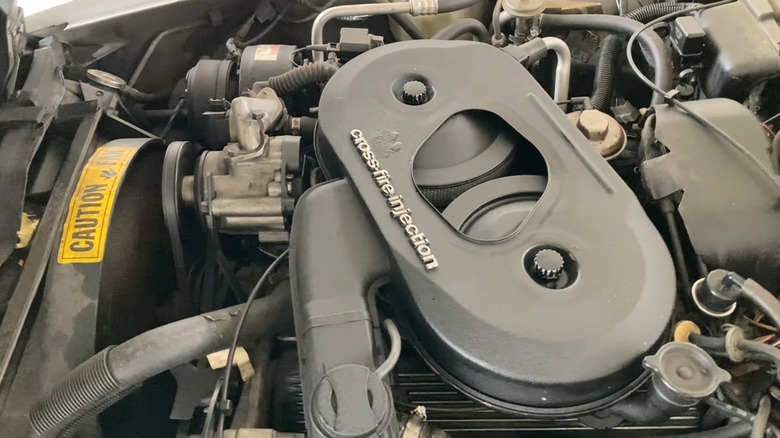
GM has developed many powerful engines over the years, with classics like the supercharged 600-plus-hp LS9 and the 400-odd-hp LS3 among the best-known. But the automaker's record is far from perfect, with powerplants like the Iron Duke inline-4 and the 2007 Chevy Suburban's Vortec 5300 often considered some of GM's worst-ever engines. Another engine that ranks among GM's most-disliked offerings is the Cross-Fire V8 from the early 1980s, also known by the unfortunate nickname of "Cease-Fire."
The Cross-Fire V8 debuted in the 1982 Corvette and represented two major landmarks for GM. It was the company's first fuel-injected engine since 1965, and the first time a Corvette had come with electronic fuel injection. However, the V8 wasn't some fancy, clean-sheet design: instead, it was something of a parts bin special, combining a low-profile Trans-Am intake with dual Rochester throttle bodies — the latter only because GM didn't have a single throttle body with enough flow for the intake. Either way, the result was an engine that fit under the upcoming Corvette's lower hood and would, in theory, offer better fuel economy thanks to electronic fuel injection (EFI).
Power wasn't all that great: the 5.7-liter version in the 'Vette made 205 hp, while the 5.0-liter Cross-Fire available as an option in the Chevy Camaro and Pontiac Firebird made 165 hp. To make things worse, owners didn't see many of the supposed fuel economy benefits of EFI, either. This was due to the Cross-Fire's intake, which was not designed for everyday driving. To compensate, engineers had to pump extra fuel into the intake to supply enough to all cylinders, and that, in turn, limited fuel economy improvements to a mere 5 highway mpg.
The Cross-Fire was slow and short-lived
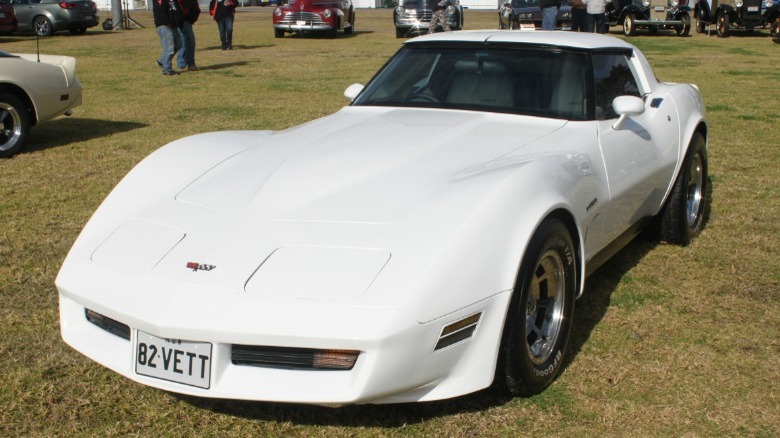
In the Cross-Fire V8's defense, the engine itself wasn't all bad: the 1982 Corvette's new V8, while not all that powerful, was decent enough at its job and an improvement over the previous engine in terms of overall drivability. What it wasn't, though, was fast.
Car and Driver pitted an '82 Corvette against one from 1962 and recorded a 2-second gap in 0-60 mph times in favor of the older car. The '62 'Vette hit 60 mph in 6.2 seconds, while the 1982 model took a positively glacial 8.2 seconds to hit the same milestone. Quarter-mile times were much the same, too, with the 1962 Corvette crossing the line in 14.4 seconds at 98 mph while its fuel-injected successor needed 15.9 seconds.
To make things worse, modifying the Cross-Fire V8 for more performance was mostly out of the question, at least in the early days. There weren't really any aftermarket parts available, and port-matching was out of the equation. Thankfully for fans of performance V8 motoring, the Cross-Fire engine was short-lived: GM dropped the Cross-Fire V8 in favor of one with tuned port injection (TPI) in 1985. GM's TPI engines had injectors for each cylinder plus an all-new intake setup, and the result was a much healthier 230 hp and 330 lb-ft of torque in the C4 Corvette.