

What's The Difference Between American And European V8 Engines?
When it comes to V8 engines, it's only natural to think of American cars first. After all, American carmakers are responsible for some of the greatest V8 engines of all time, and when it comes to the numbers, the USA has produced more V8s than any other country. The numbers aren't even close, with GM alone having produced well over 100 million small-block V8 engines since the 1950s.
But America is not the only place where V8s are made, nor are American carmakers the only ones capable of building a popular or well-respected V8 engine. While the production volume might not be anything near that of America, European carmakers have built more than their fair share of excellent V8s over the years, powering everything from lightweight Italian exotics to massive British luxury sedans.
So how do American and European V8s differ? The answer to the question will depend a lot on specifically which brand or which type of V8 you are talking about, and some modern American V8s are much more 'European-like' than others. At certain points, American and European automakers have even borrowed each other's engine designs, including the Buick/Rover V8 and the Jaguar-based V8 used in the 2000s Ford Thunderbird. But rather than individual specs for any given engine, the broader, zoomed-out view is where you'll find the biggest differences between American and European V8 philosophies.
V8s for work and play
America and Europe have been building V8s for generations, with many different designs and types across those lineages. There have been significant evolutions in technology, including moves from carburetors to fuel injection and, for some brands, a move from overhead valve designs to overhead cam. For the sake of comparison, we'll keep the focus here primarily on modern gasoline (rather than diesel) V8 offerings to show how the two regions put their own spin on this engine type.
It's also important to point out that both regions have seen a shift away from V8s in recent years, with automakers pivoting to smaller-displacement, turbocharged engines in many types of vehicles. Traditionally, production volume, displacement, and complexity have been the biggest differentiators between American and European V8s, with the American engines typically being larger, simpler, and more working-class in nature. Yes, some American V8s, like the twin-turbocharged, DOHC V8 in the C8 Corvette ZR1 are high-tech marvels, but volume-wise, most American V8s are the more utilitarian engines in pickup trucks and SUVs.
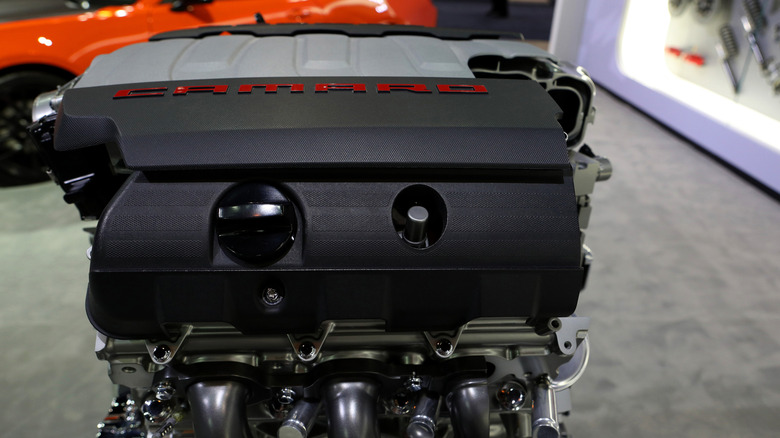
The majority of the American engines are naturally aspirated workhorses, with displacements ranging anywhere from 5- to over 7 liters. The V8s in Ford's F-150 pickups use an overhead cam design, while GM truck V8s and RAM's HEMI V8 engines use a traditional overhead valve design. Most European automakers, meanwhile, moved away from overhead valve V8s decades ago. Modern European V8s are typically smaller in displacement, paired with forced induction and used in luxury vehicles or sports cars.
Displacement vs technology

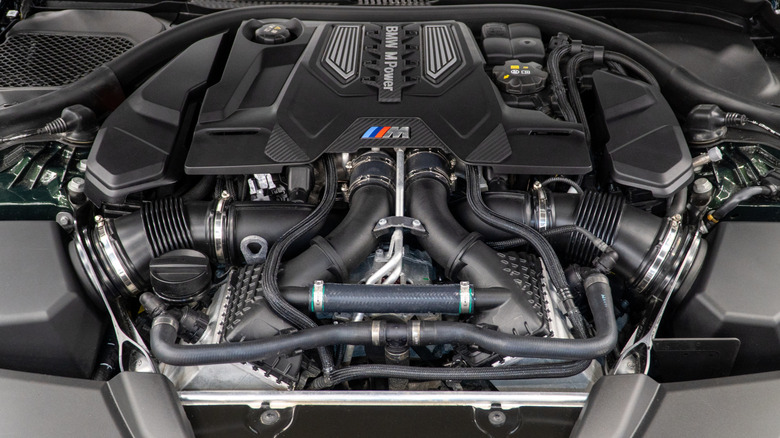
If you wanted to pick two different modern V8 engines that starkly illustrate the differences in common American vs. European strategies, look at Ford's 'Godzilla' V8 next to BMW's S68 V8. The Godzilla engine is a massive 7.3-liter naturally aspirated, overhead valve, workhorse of a V8 designed for use in Ford's Super Duty pickup trucks. It's basically a modern incarnation of the old school pushrod big blocks from the '60s and '70s. In contrast, the BMW S68 is a much smaller, 4.4-liter, DOHC, twin-turbocharged V8 that was engineered to power high-performance luxury sedans and SUVs.
Apart from having eight cylinders aligned in a 'V' configuration and being designed for the 2020s, the Godzilla and S68 share nothing in common, and they were engineered for completely different tasks. Then again, the aforementioned Corvette ZR-1 engine shows that the Americans are capable of building niche V8s that are every bit as exotic and high-tech as their European counterparts.
Things can change very quickly in the auto industry, and there's already a sense that the V8 engine could be seeing a revival in the coming years as automakers dial back some of their plans for electrification. Time will tell what sort of impact this has on the future of the V8 engine on both sides of the Atlantic.