

Why Some People Use WD-40 On Their Car During Winter
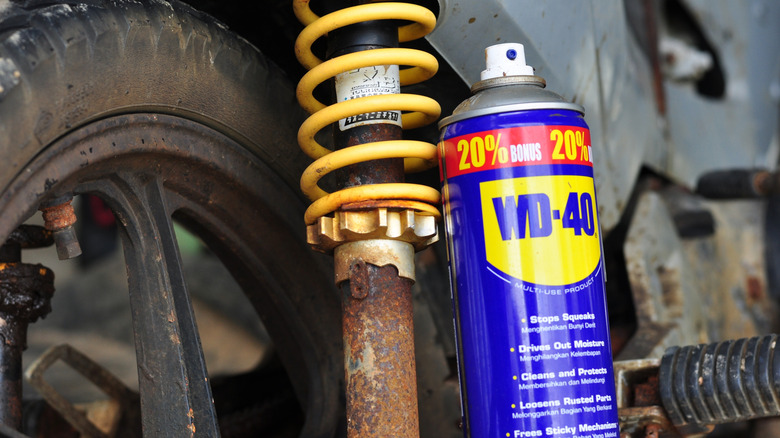
If there's one type of lubricant or maybe even a general liquid that's ubiquitous and often believed to be able to fix literally anything, it's WD-40. Although everyone calls it WD-40, that's only the brand name. It stands for Water Displacement, 40th formula, and it's actually what's known as penetrating oil. In other words, it's designed to be sprayed in spots with rusty metal and tight clearances, effectively helping with the removal of rusty bolts or similar items.
While this is WD-40's intended use, people use it for just about everything else as well. The most common use is, as a lot of you already know, greasing up squeaky things to get rid of said squeaks. There are also tons of jokes on the internet about using WD-40 to grease up a squeaky serpentine belt in a car's engine, which you should absolutely never do.
Speaking of cars and WD-40, this famous penetrating oil can actually be very beneficial for your car in the winter, and that's for a few different reasons. The biggest of those, by far, is using WD-40 to temporarily rustproof your car's undercarriage to protect it from road salt.
WD-40 is very effective against road salt
Just about every area that gets frequent snow and ice has to deal with road salt, which is poured onto the road to get rid of the ice and make it safer to drive on. The downside of road salt is that it reacts with the metal on your car's undercarriage, and that means rust.
Helpfully, WD-40 can help remedy this, at least temporarily. Spraying a little bit of WD-40 creates a protective layer against road salt in icy conditions, which in turn protects the undercarriage from rust. Road salt is one of the most well-known creators of iron oxide, so a little bit of WD-40 on your undercarriage goes a long way. If you do want to go this route, WD-40 has a specific product just for this purpose — the Rust Inhibitor.
Another common WD-40 hack for the winter is to spray your rubber door seals. Far too often, doors can freeze in sub-zero temperatures, and the locks can also freeze, which will make getting into your car on a cold day a little bit of a nuisance.
Spraying a little bit of the magic stuff in your door locks and the rubber seals will protect them both from freezing, allowing you to get in your car normally, even in single-digit temperatures. If you have an old-school off-roader with locking wheel hubs, WD-40 can help out if they're stuck. It's important to note that you should use the silicone WD-40 spray for rubber seals, and not the regular one. This is just a handful of the many, many WD-40 hacks out there, but these apply specifically to winter conditions. A little bit of this spray goes a long way.