

'Super' Battleship USS Texas Relocating With A Major Facelift In 2026
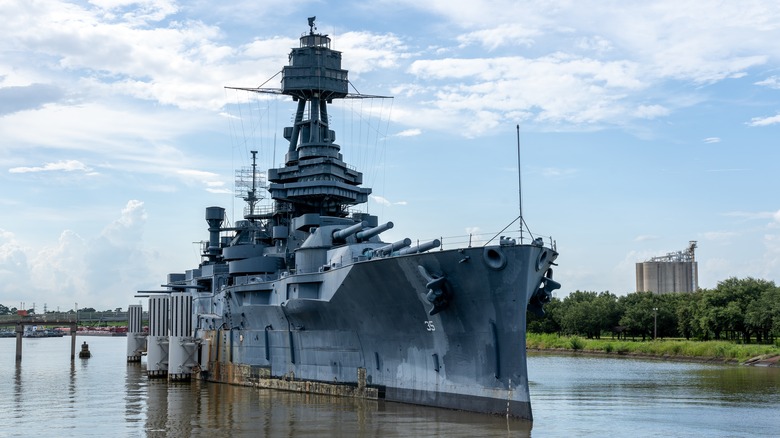
Though the American battleship has long since been overshadowed as the U.S. Navy's most prolific and strategically important warship by the aircraft carrier, World War II-era battleships will forever be a crucial part of naval history. Fortunately for fans of American military and naval history, there are several U.S. battleships open to the public across the United States, where these classic vessels can be toured and appreciated.
The first of these museum battleships was the USS Texas (BB-35), which has been owned and operated by the State of Texas as a memorial since the late 1940s. With a history that predates other battleships like the Missouri and Iowa, the Texas is America's only surviving warship to have fought in both World Wars. And now, after years of uncertainty, the future of this historic vessel is looking bright, with work underway to move the ship to a new permanent home at the Port of Galveston.
And when the new and improved USS Texas Museum opens, it won't just be displayed as an old and dilapidated relic. Instead, it will be a ship that will have undergone a thorough and costly $75 million restoration process to bring it back to its full, period-correct, World War II glory.
A veteran of two World Wars
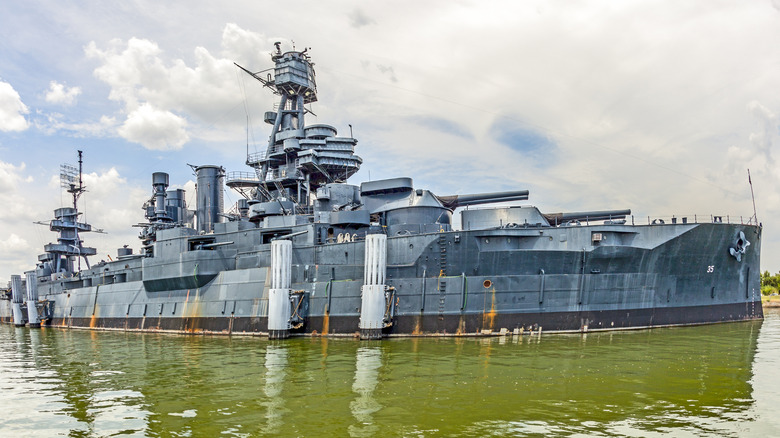
Most of America's battleship museums are ships of the Iowa Class, which were commissioned during World War II and served into the 1990s. The Texas represents a much older era of battleships that played a pivotal role in both major theaters of World War II. Commissioned in 1914 as one of the U.S. Navy's two New York-class ships (which the Scientific American referred to as "super dreadnoughts"), the Texas quickly went into service supporting American interests during the Mexican Revolution. After the United States entered World War I, the Texas went to the North Sea, where it served as part of the historic Grand Fleet that oversaw the surrender of the Germans.
The Texas was modernized in the years between the wars, before again entering combat service in the Atlantic when World War II broke out. The USS Texas first supported the Allies during the North Africa campaign, then attacked German targets and supported the Allied Invasion force at Omaha Beach on D-Day in 1944. The ship would return to the U.S. for more modernizations before being sent to the Pacific Theater to fight the Japanese during the American invasions of Iwo Jima and Okinawa.
Finally, the Texas ended its naval service by bringing American soldiers and sailors home during Operation Magic Carpet Ride in the months following the war. With newer battleships in the fleet and an increased focus on carriers, the aging ship was decommissioned and donated to the State of Texas in 1948.
Restoration and relocation
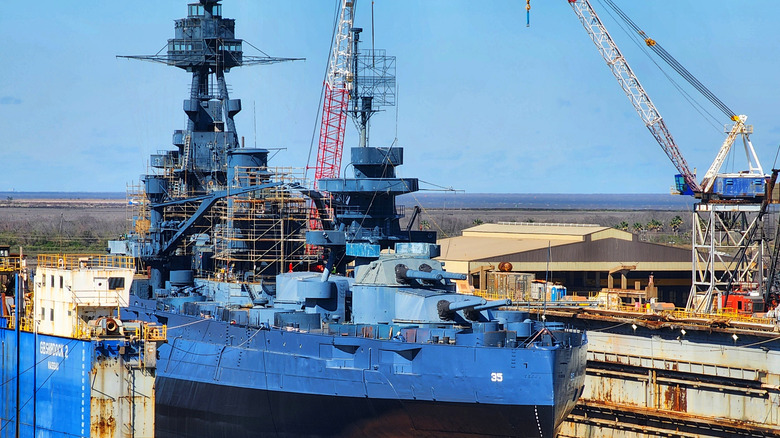
The USS Texas was the first American battleship to become a permanent museum, located at the San Jacinto Battleground State Historic Site. After decades on display and, with the ship's condition deteriorating, the Texas was moved to dry dock in 2022 to begin a series of repairs and renovations. Not only are these renovations addressing serious structural issues that would cause the ship to take on water, but the Texas is also receiving a full restoration with rebuilt structures, a new wooden deck, and fresh paint throughout to preserve the atmosphere of its combat days. So far, the process has required over 400,000 hours of labor, with over 700 tons of steel being replaced.
With the extensive four-plus-year restoration nearing completion at the start of 2026, the ship has secured its new home at Pier 15 in Galveston, where plans are underway for dredging, a permanent mooring, and brand new shoreside facilities to complete the museum. The Battleship Texas Foundation hopes to have the ship in place and the museum open to the public in late 2026 or early 2027. When the new and improved USS Texas Museum reopens, it will join the Aircraft Carrier USS Lexington Museum in Corpus Christi as one of the must-visit spots for military history on the Texas Gulf Coast.