

Toyota Built A Hemi Engine 60 Years Ago – And Almost No One Remembers
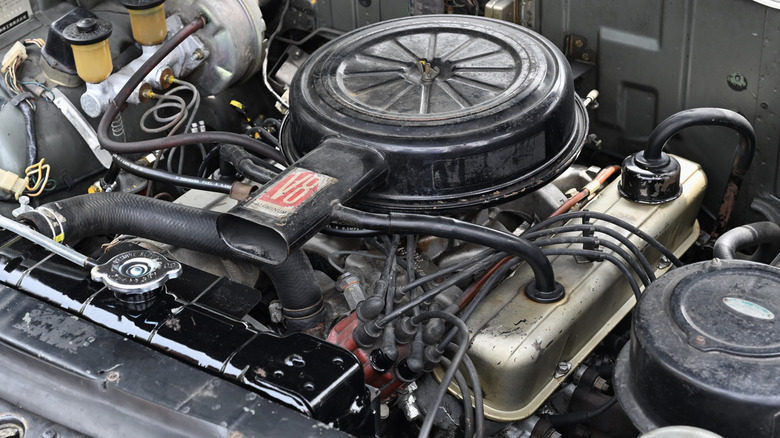
When you think of a hemi engine, it's almost certainly one of Chrysler's legendary HEMI V8s that comes to mind first. Depending on your age, it might be one of the classic HEMI variants from the '50s and '60s, or the contemporary variant used in modern Dodge muscle cars and RAM pickup trucks. But a lot of enthusiasts likely know that Chrysler was not the only car company to build engines with hemispherical combustion chambers.
Even though they were never produced in large numbers, both Ford and Chevrolet experimented with their own hemispherical head designs while building racing engines in the 1960s. And what might seem even crazier is that at the same time, on the other side of the planet, Toyota was rolling out brand new cars with its own hemi V8s onto the streets of Japan.
You'd be forgiven if you don't know about Toyota's 1960s hemi, though, because, unlike so many other Toyota engines, this one wasn't designed to take over the world through its export markets. Instead, this old-school Toyota V8 was designed specifically for high-end luxury sedans in the Japanese domestic market, namely the Toyota Century. The company kept building these V8s all the way through the 1990s, too, decades after Chrysler had stopped producing its original HEMI engine. Toyota would also use similar hemispherical combustion chambers on smaller engines, which would become much more familiar to enthusiasts around the world.
The ultimate JDM luxury car
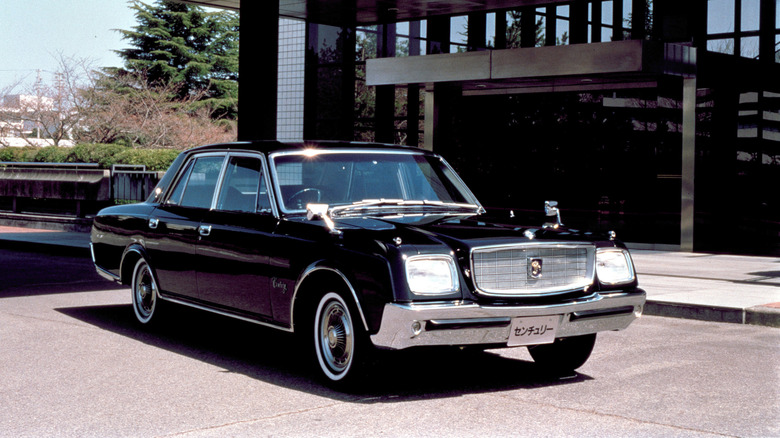
1964 was a big year for Japan. It was the year of the Tokyo Olympics, as well as the year that the country's state-of-the-art Shinkansen bullet train started running. Japan's first mass-produced V8 engine, the Toyota V-series, also debuted in 1964, designed for the upscale Crown Eight luxury sedan. While Toyota making its own V8 engine was already a significant achievement, what made this all-aluminum 2.6-liter, overhead-valve V8 even more interesting were its hemispherical heads, which Toyota co-developed with Yamaha.
In 1967, the Crown Eight was replaced by a brand new, much more ambitious luxury sedan, the Toyota Century. Less a car to drive and more a car to be driven in, the luxurious Century would use the V-series hemi V8 for three decades, with Toyota making the engine larger and more powerful while introducing updates like electronic fuel injection. In its final iteration from 1982, the Century's V8 displaced 4.0 liters.
When it finally came time for the Century to phase out its V8 engine in the mid-1990s, Toyota replaced the V8 with something even more unique: a naturally aspirated V12, the 1GZ-FE. This motor would be Toyota's first and only production V12 engine, never to be offered in any car except for the Century, which remains one of the most opulent and bespoke luxury cars that Toyota has ever built — and one that's recently become its own distinct brand.
Toyota's non-V8 hemis
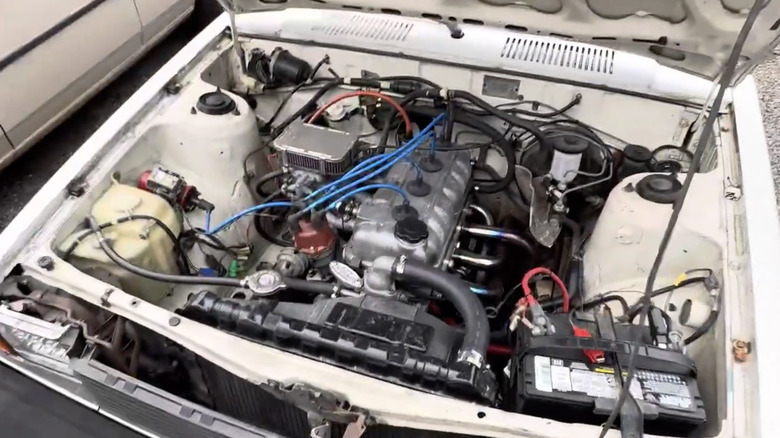
Toyota's Japan-market-only hemi V8 is a fascinating historical footnote, but an engine does not need to be a V8 to be a hemi. In the early '70s, for example, Chrysler had a HEMI-headed inline-6 engine with output that could rival many V8s, but it was only offered in the Australian market. Likewise, Toyota used hemispherical heads on non-V8 engines as well. And it's actually these Toyota hemi engines that North American car enthusiasts are likely more familiar with, powering popular export models like the Toyota Corolla and Celica during the 1970s and early '80s.
Four-cylinder, OHV Toyota Hemi engines like the 3T were akin to a V-series Toyota V8 that had been cut in half. These little four-cylinder engines were known to be quite potent for their size, could be modified for more power, and would help pave the way for numerous, small-displacement, high-output Toyota engines to come.
Meanwhile, on the V8 side of things, the Toyota hemi lineage would end in the 1990s, though it's interesting that the Century continued to use this older OHV engine for many years after Toyota had introduced the newer, more modern DOHC 1UZ V8 used in the Lexus LS400 and other models. In the years that followed, Toyota's V8s would only get more powerful and more impressive, culminating in the 472-hp 5.0-liter V8 that powers the current Lexus IS 500.