

Your License Plate May Be Too Old Even If It Hasn't Expired Yet
The rigmarole of ensuring your vehicle's registration is up to date is something every car owner goes through, because all 50 states in the U.S. (and the District of Columbia) require it. Not all states do it annually, though; some go every other year, or even every three or four years. Meanwhile, Arizona has a five-year option depending on the type of vehicle you're registering.
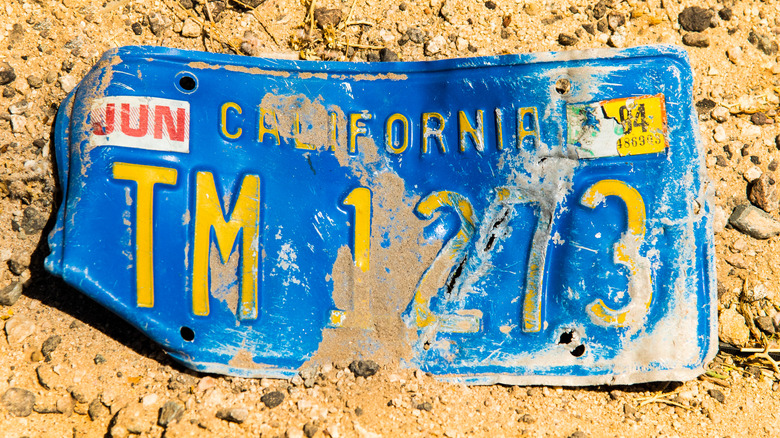
Part of this process involves placing stickers of some kind (e.g., the month or year) on your vehicle's license plate. Speaking of, when was the last time you actually looked at the condition of yours? Unless you went the extra mile and personalized one, you probably got it, stuck it on, and forgot all about it. The thing is, you need to keep tabs on it, because if it shows any signs of deterioration (blistering, peeling, discoloration, loss of reflectivity, etc.) and becomes illegible — to police, automated license plate readers, traffic cameras, or toll readers — you're just asking to be pulled over and fined.
Every state requires a license plate to be easily readable at all times, so it's imperative to keep them clean and well-maintained. Many also establish parameters for how far away legibility needs to be. For example, both California and Pennsylvania require a minimum distance of 50 feet. Florida, on the other hand, says 100 feet. Nevada also has a 100-foot requirement, but that increases to 110 feet at night when lit by standard headlights. The point is, every state does things differently, so you'll need to check your local statutes to make sure your plate is good.
Check the state of your plate
Fines also vary from state to state. Pennsylvania will charge you a $100 fine for violating the legibility law, while California's fine is upwards of $200. Additionally, each state handles supplemental fees differently. Pennsylvania doesn't have a replacement fee, but Wisconsin charges an additional $12, while California adds an extra $27, and Florida hits you for $28. New York has a similar fee ($25), but adds another $3.75 for a new registration. And if you want the same plate number on the new one, it'll cost an extra $20. Again, it all depends on exactly where you live.
And then there's this: most states don't want plates to be covered with anything, whether it be transparent, smoked, or tinted. Florida doesn't allow anything that might alter or hide the plate, including a frame. Doing so can get you a fine of up to $500 or 60 days in jail. What's more, anyone who sells a device that hides or modifies a plate (sometimes called "flippers") can be fined $1,000 and spend a year in jail. In California, transparent or clear plate covers are illegal because the glare can make a plate unreadable. Altering — or trying to create a handmade license plate — will get you a fine of up to $250.
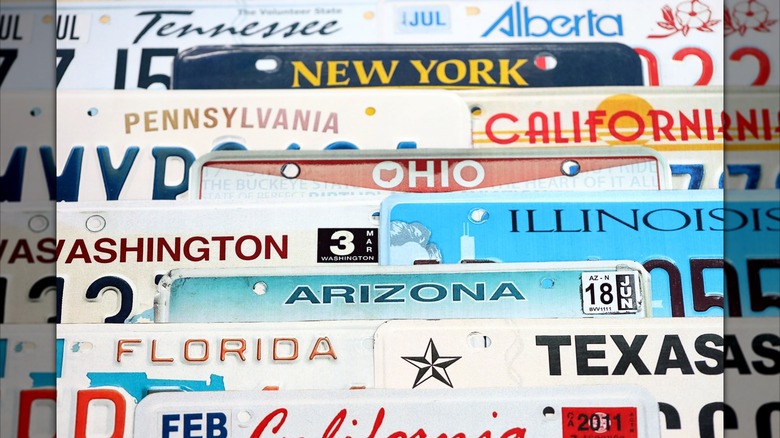
As of 2025, 29 states, including California, Hawaii, Texas, and Massachusetts, require front and rear plates, while the other 21, such as Alaska, Arizona, Florida, and Indiana, require only rear plates. So if you have two on your vehicle, you now have double the work (and cost) to worry about.