

US Navy's P-8 Poseidon Jet Makes Rare Mission Appearance Over Miami
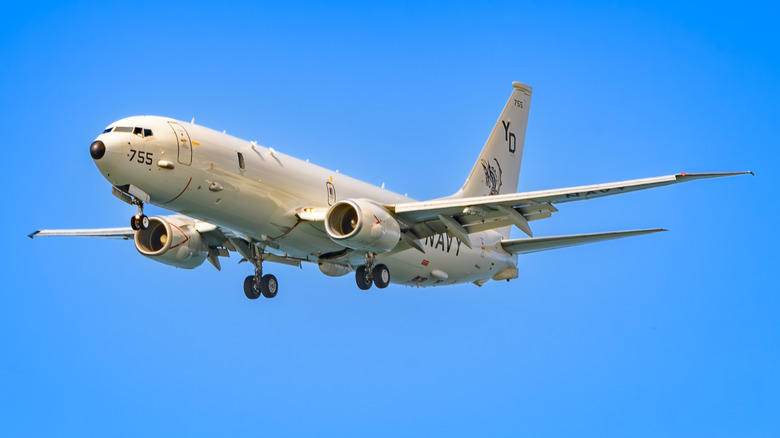
The sight of military planes flying overhead in the United States is a common occurrence, especially if you regularly attend airshows or live near an active airfield. If you live in Miami, you may have seen the U.S. Navy's P-8 Poseidon jet in flight on January 19, 2026. The flight provided incident awareness assessment (IAA) support for the U.S. Secret Service as President Trump attended the College Football Playoff National Championship game at Hard Rock Stadium.
Typically, the pricey Boeing P-8 Poseidon doesn't operate over major U.S. cities. Since it's a Navy jet, it's primarily used for maritime patrol missions. In fact, P-8s usually just monitor oceans and the country's coastal regions, rather than flying over a populated area. Though the January 19th event could be considered a domestic security mission, there's been no formal statement from any government agency regarding why this specific maritime jet was used.
Though flying over the mainland isn't generally what P-8s do, its multi-mission capability and suite of sensors make it ideal for IAA, covering large distances while collecting and sharing data in real time. Though the jet's onboard systems are engineered for maritime activity, its ability to remain in the air for long periods of time actually makes it an ideal solution for domestic flights. However, there's no way to know if the P-8 Poseidon will be used for similar domestic missions moving forward.
US allies are strengthening their fleets with the P-8 Poseidon
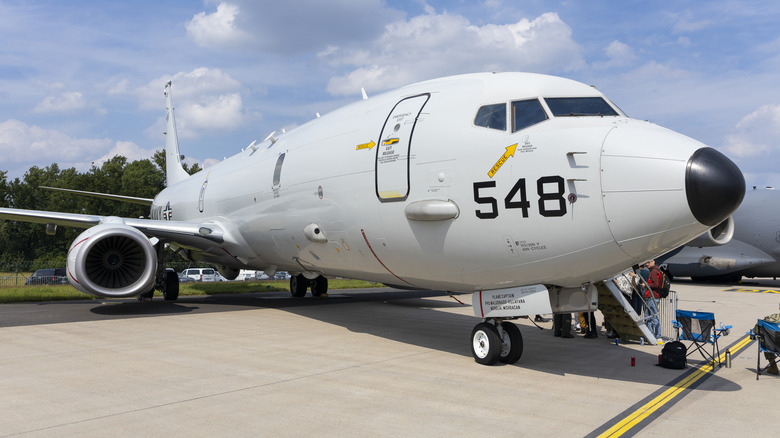
The U.S. Navy's Boeing P-8A Poseidon, powered by the most popular jet engine found on many planes, has flown over the mainland before, most notably in early 2025. The P-8 flew reconnaissance missions along the U.S.-Mexico border, conducting surveillance for the Department of Homeland Security. This was a rare event, as any of Poseidon's movements outside of training and various anti-submarine missions aren't typically publicly documented.
The P-8A Poseidon jet, which has features that make it so much scarier than it looks, also made headlines in late January of 2026, when it was revealed that up to four of them would be sold to the country of Singapore. The deal also included weapons and mission systems, all of which are meant to replace the nation's older maritime patrol fleet. The move benefits the U.S. as well, as Singapore is an ally for coastal support. The sale was approved by the U.S. State Department and is worth just over $2.3 billion.
Singapore's planned acquisition came just weeks after the U.S. approved a major Poseidon deal with Denmark. That arrangement, worth an estimated $1.8 billion, includes up to three P-8A Poseidon jets, complete with related systems, training, and support. These two examples show the increasing interest among U.S. allies for long-range maritime aircraft, and the overall need of those countries to modernize their naval fleets.