

Swapping Your Engine Could Lead To This Weird Mechanical Issue
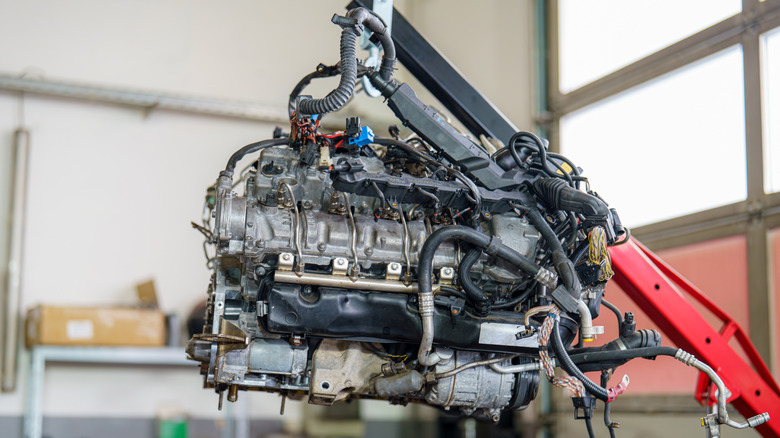
If you've ever had a vehicle that needed another engine, you may have just cut your losses and found something else to drive. After all, replacing a motor can actually cost more than what your car's worth, so in the end, it might make better sense to just move on. But if you do swap out the motor, which is legal in the U.S. with some caveats, you might have a weird leak of pink fluid once the work is done.
This fluid can also appear reddish in color, and it's probably either transmission fluid, coolant, or a mixture of both. These leaks can happen if the seals or gaskets inside the engine aren't installed properly. The only way to prevent this is to ensure you're using quality parts beforehand. While a multicolored leak can be comical, it's actually a serious problem, and if you don't find its source, your recently swapped engine could overheat. This can lead to possible transmission trouble.
Fluid leaks themselves are actually pretty common after a motor change, and can also include engine oil or power-steering fluid. If you don't see any leaks right away, but smell burning oil or have excessive tailpipe smoke, your gaskets might even be damaged. So, in addition to checking the seals and gaskets before installation, it's also important to check all hoses as well. After the engine swap, maintain all fluid levels and keep your eyes open for any leaks. That way, you can catch any problems early on.
The complexities of an engine swap

Fluid leaks aren't the only issue that can arise after an engine swap, as there can be electrical problems as well. Your "Check Engine" light may suddenly come on, pointing to various problems inside your motor. It could be your fuel injection system, or perhaps it's something else altogether. The best way to diagnose the issue is with an OBDII scanner, a diagnostic tool that can work whether it's cheap or pricey. The scanner should reveal what's going on inside your swapped engine.
But whether it's the electrical or mechanical system, everything must work together to ensure the motor functions properly. This means that all components must be fully connected, and each individual part must be compatible with the replacement engine. Since there's so much going on, even the most experienced DIYer can miss important details, despite how many must-have Home Depot tools they own. Those details can mean the difference between a successful switch and a series of costly problems.
That's why many people use a professional garage to handle the engine swap instead. A full-time mechanic would likely have the right tools for the job, and more importantly, the right experience to do it. Though the cost can be hefty, the investment might be worth it. But if you go this route, be sure to get a full engine inspection and estimate upfront. Though the number could go up, at least you'll have an idea of what you're getting yourself into.