

Hidden In A University Closet Was An Important Relic Experts Thought Was Lost Forever
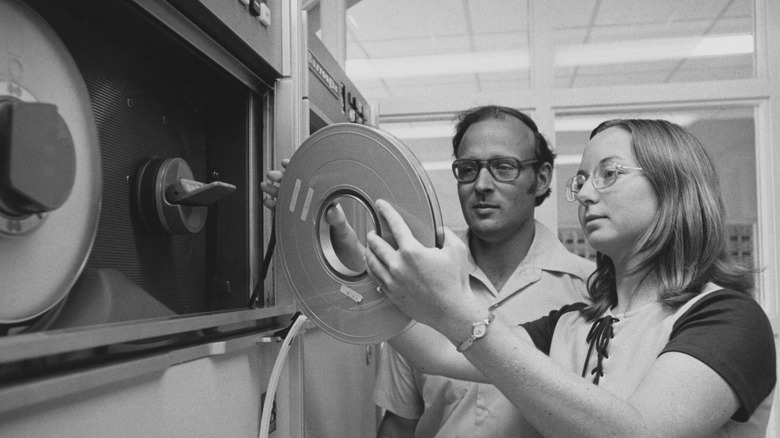
When we think of important historical discoveries, many of us probably imagine big archaeological finds, such as the LiDAR-assisted discovery of two mountain cities in eastern Uzbekistan in 2024. But the much more recent (and urban) history of computers means that it's entirely possible to discover significant computing artifacts in otherwise mundane places — such as a university closet.
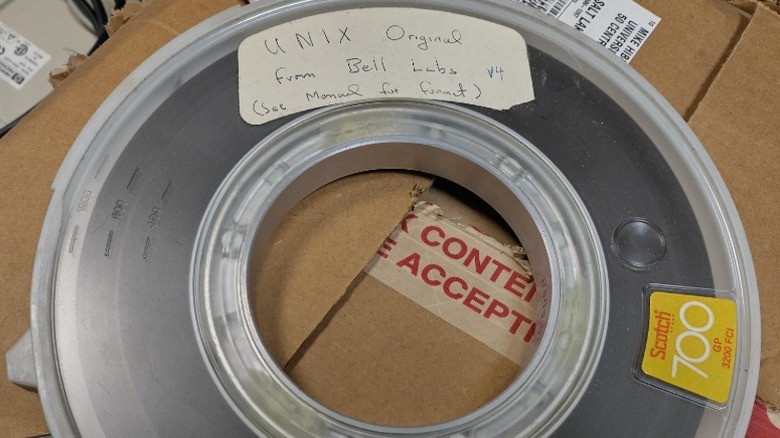
That's exactly what happened in July 2025, when staff at the University of Utah found a spool of magnetic tape while cleaning up a storage room. That in itself isn't anything to get excited about, but what caught their eye was the label, which indicated that it housed a copy of Bell Labs' Unix Version 4 (Unix V4). The first big announcement of the discovery was by Robert Ricci, a research professor at the university's Kahlert School of Computing. Ricci posted about it on Mastodon in November 2025 and, somewhat predictably, caused a bit of a stir.
Of course, a label doesn't tell the whole story, and this discovery would have been all for naught had the tape not actually contained a copy of the operating system. Thankfully, it did: the recovery process revealed that the tape did indeed hold a copy of Unix V4 — massively important, considering that there are allegedly no other copies extant. Not only that, but the tape also contained the source code and kernel, making it an even more valuable find.
Why is Unix version 4 so important?
Finding the only known surviving copy of an operating system would be quite massive in and of itself, but Unix V4 is important for several other reasons beyond its rarity. This version of Unix was the first one written primarily in the C programming language. This was the first step in allowing the OS to be ported to computers other than the PDP-11 on which it was built to run. Furthermore, modern operating systems like Linux and macOS can trace their roots back to Unix, as Robert Ricci points out in a University of Utah press release: "The Unix operating system ... is the precursor to the operating systems that power our computers, smartphones, and servers today."
Ricci also noted that surviving copies of early Unix versions are especially rare since "[m]any of the early versions were only sent to a small number of universities and research institutions." A working copy of Unix V4 isn't just valuable for its rarity or as a historical curiosity, then: it also means that we've been able to preserve an important step in the development of computing as we know it today.
The recovery process was led by Al Kossow of the Computer History Museum (CHM). Kossow used a program called readtape, written by the CHM's Len Shustek, to record the tape's raw analog data, which was then converted into digital data. After some error correction, the CHM uploaded both to archive.org, giving those interested in the history of computing a chance to explore this formative operating system. Given that Linux is now seen as a viable alternative to Windows 11, you could say that this discovery has come at exactly the right time.