

This Is The World's Largest Land Vehicle
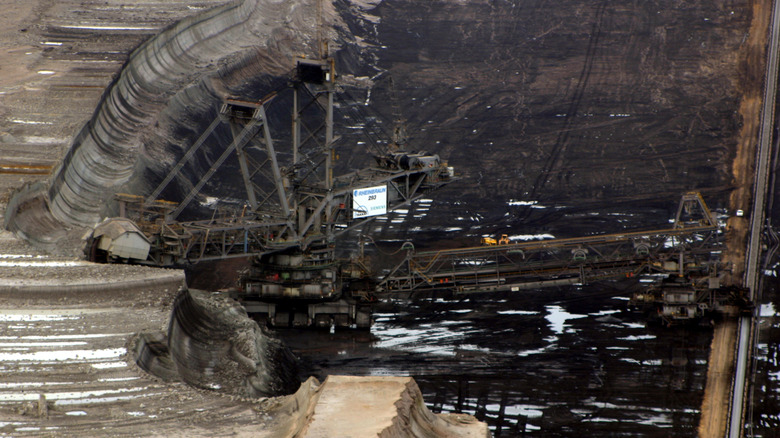
Modern societies require huge amounts of power to function, and to generate that power, huge power stations are needed. Power-hungry countries are increasingly turning to renewable energy — with some renewable energy sources being stranger than others — but coal remains an important fuel across the globe. Digging all that coal out of the ground is far from simple, but German engineers created a way to vastly speed up the process. It's called the Bagger 293, and it's the world's largest land vehicle.
Built by engineering specialist TAKRAF, the Bagger 293 measures 722 ft long and 310 ft high. It's the length of two football fields, but thanks to its tank-like tracks, it can move through mines, leaving tracks no deeper than a human walking through mud. Since it weighs 31.3 million lbs, it also takes the crown as the world's heaviest land vehicle.
The machine was designed to remove huge amounts of soil and rocks, which are known as the overburden, to access the coal underneath the surface. Its excavation wheel can move up to 8.475 million cubic feet of material every day. It operates in a mine in North Rhine-Westphalia, and although it's the biggest excavator of its kind, it's far from the only one. TAKRAF has also built smaller variants that operate in mines in China, India, and other parts of Europe.
How does the Bagger 293 work?
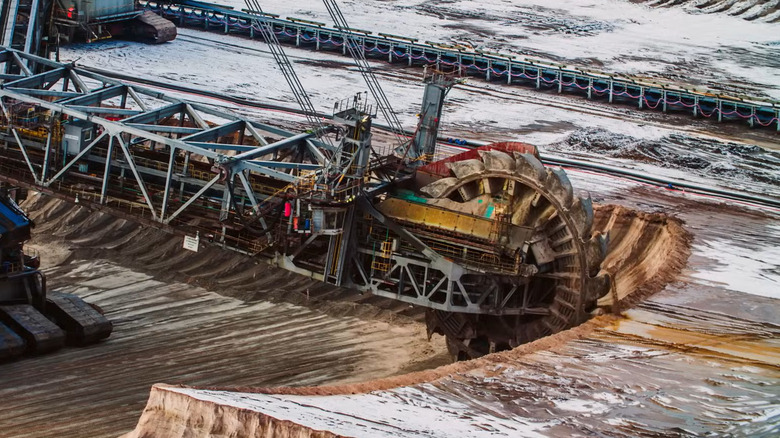
A total of 18 buckets are mounted to the excavation wheel. These buckets collect the soil and rocks, exposing the coal, which can then be extracted. The collected material is tipped onto a conveyor belt that runs along the main arm of the machine. From there, the material can be transported elsewhere without the Bagger 293 needing to stop digging at any point. The machine has been in use since 1995, and it remains an important part of mining operations today.
While there's no sign that German demand for coal will dry up any time soon, Germany has significantly lowered its dependence on the fuel in the years since the Bagger 293 was brought into service. According to the IEA, German CO2 emissions from coal totalled 346 megatons in the year 2000, but by 2023, that output had dropped to 173 megatons. That's a significant decrease, but it still makes Germany the largest consumer of coal in Europe.
Bagger 293 might be the largest, but it's a very long way from being the fastest land vehicle. That honor goes to the Thrust SSC, which set a speed record of 763.035 mph in 1997, two years after the Bagger began operating.