

What Does 'Battery Saver Active' Mean On Your GM's Dashboard?
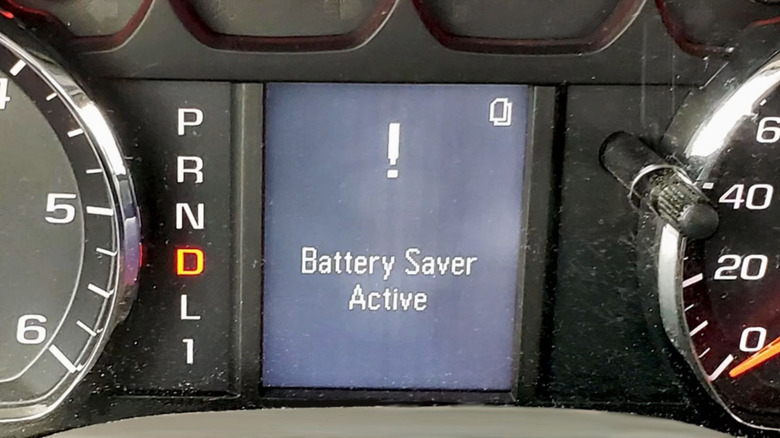
Many modern vehicles come equipped with innovative safety features to consider for your next car. For automakers, it's about protecting owners, as well as other drivers on the road. For example, one of GM's safety systems is Electric Power Management (EPM), which kicks in when a vehicle's battery voltage drops below normal levels. When the EPM system engages, certain features are reduced in an attempt to save battery power. The driver is alerted to this event by a warning light on the vehicle's dashboard that reads "battery saver active."
GM has addressed the battery saver alert in owner's manuals, noting that some vehicle features are actually disabled altogether once the system is enabled. The automaker does recommend turning off any unnecessary features, including interior lamps, headlights, or both. If the EPM system remains engaged while your vehicle is stopped and your headlights or interior lights are on, they will eventually cut off on their own. GM also lists other vehicle accessories you should turn off as well, including climate controls, communications equipment, and windshield wipers. This is all in an effort to conserve battery power.
Of course, if you're using some of these features while in movement when the battery saver light comes on, especially your headlights, you shouldn't turn them off. Doing so may put yourself and others in immediate jeopardy. Your best course of action is to either replace the battery or take your vehicle in for service as soon as possible.
GM's energy management systems
Battery saver systems aren't uncommon in modern vehicles, as GM is only one automaker that has integrated them into some of its models. Overall, these systems can be triggered by a weak battery, faulty electrical connections, or a malfunctioning alternator, which could trigger a dashboard warning light that often gets ignored. By prioritizing a vehicle's essential systems and reducing power to less important accessories, the battery saver decreases the battery's workload.
GM's specific battery saver system, EPM, actually does much more than just shift power, as it's also recharging the battery in the process. But it can adjust voltage in the other direction as well, to keep the battery from overcharging. EPM can even regulate power distribution while a vehicle is sitting still by adjusting the idle speed. By the time the driver sees a warning light, the EPM system has already done quite a bit of work to keep everything running smoothly.
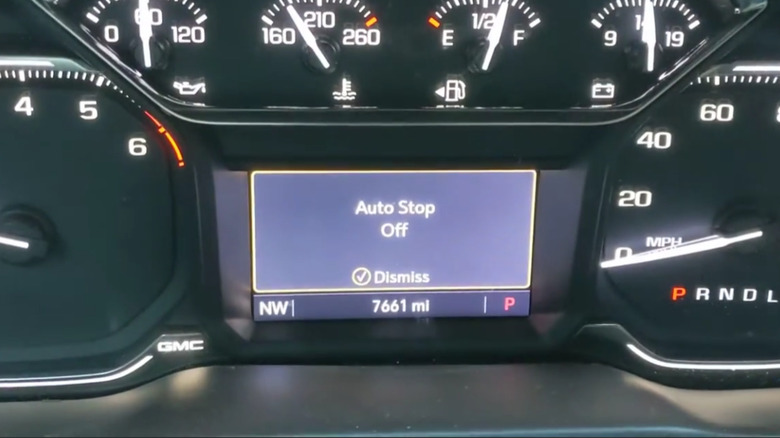
Another example of GM's energy management is the Auto Stop/Start system. This system, which many drivers are avoiding, temporarily turns off the engine when the vehicle comes to a full stop. This can even happen at a red light, and once the driver releases the brake, the engine restarts. Stop/start could become annoying during city driving, but the feature can be manually turned off at any time. Though this system focuses on conserving fuel, it's also designed to closely monitor the battery to determine when an engine restart is necessary.