

4 Niche Craftsman Tools (And What They're Used For)
If you're new to the tool world and want to build out a collection of the essentials, there are numerous brands to consider. One such brand is Craftsman, which has been around for ages and covers pretty much all the bases you'd need, including some tools that rival brand Ryobi doesn't. The tenured brand doesn't solely deal in the basics like screwdrivers, power drills, and hammers. Instead, just as there are Craftsman home improvement products you may not know existed, there are some pretty niche tools from the brand that have flown under most folks' radars.
Of course, the definition of niche can vary from person to person. In the context of Craftsman's tools, this means that some individuals may find a tool to be rather niche, while others use it every day and know it like the back of their hand. Therefore, it should be understood that the Craftsman items covered here are considered those that the average tool-user may find odd or highly specific. You likely won't find these when digging through just any random toolbox. With that said, Craftsman has produced some rather specialized tools over the years that have very specific use-cases. Here are some of the most interesting examples, what they're for, and how they work.
Not everyone needs a Craftsman riveter
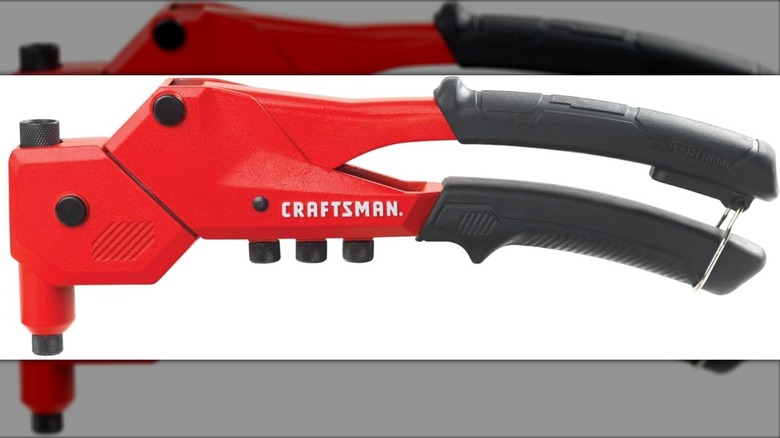
Unless you or someone you know has worked with metal extensively, you're probably not overly familiar with riveters. These tools come in all shapes and sizes, with larger ones used in the construction of aircraft, like the best fighter jets and planes of all time, automobiles, and more. They join large pieces of metal together without the use of bolts or screws. For smaller, less heavy-duty applications, Craftsman has developed two different handheld riveter models: the Craftsman right angle riveter and the Craftsman swivel head riveter. As their names imply, one installs rivets at a single orientation, while the swivel head version allows for riveting at a right angle or head-on.
So, how exactly do Craftsman or any other brand's hand riveters work? With the properly sized rivets and the correct bit attached, the user loads a rivet into the top of the riveter. One then slides the rivet through a hole in the pieces of metal intended to be connected, with the riveter operator then opening and closing the handle as many times as needed. This movement pulls the rivet toward the riveter and squishes it down, crushing the rivet and sandwiching the pieces of metal together. The remaining rivet stem is then removed and discarded. This process creates a very strong bond that can theoretically be broken, but not without a lot of effort.
Only certain uses are familiar with Craftsman's ball joint separator
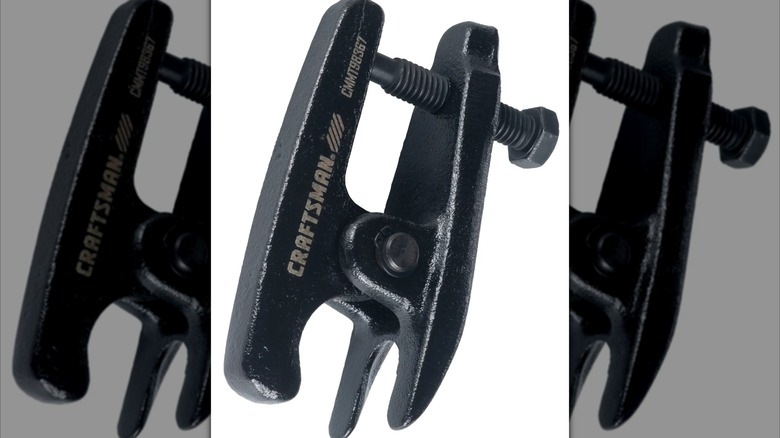
As anyone who has worked on cars can attest, sometimes the only way to get a job done right is to use a specialized tool. Though automotive repair isn't the core of its product lineup, Craftsman has some niche products designed solely for working on cars. One example is the Craftsman auto ball joint separator, which is a key tool for any sort of suspension work. A ball joint separator is arguably the best way to separate ball joints without damaging them, which isn't that easily done by hand or with general tools. This tool is also adjustable, allowing it to be used on ball joints of differing sizes.
As far as the use of a Craftsman ball joint separator, it's actually rather straightforward. With the tire removed, the nut on top of the tie rod loosened, and the lubricant applied to the separator's forked end, you'll then slide the separator's forks over the joint's boot. The concave side of the forks should be resting against the boot. At this point, tighten the bolt on the opposite end of the separator, carefully turning until you hear a pop. This sound tells you that you've successfully separated the ball joint.
Craftsman's fuel and A/C line disconnect set is for highly specific work
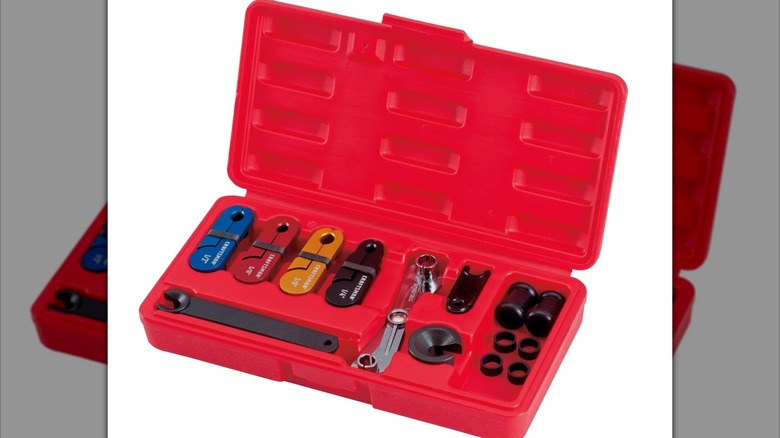
Automotive repair oftentimes calls for highly specific tools that aren't all that versatile, but are quite effective at their assigned task. Another prime example of Craftsman's efforts in this area comes in the form of its auto fuel and air conditioning disconnect set. The product title plainly spells out that this 13-piece kit is intended for A/C and fuel line repairs, with the included tools specifically designed for removing spring-lock and quick-disconnect couplings.
The disconnect tools in this Craftsman kit range in size from 1/4 to 1/2 inch, with most featuring a scissor-like design for easy attachment and use. The idea is for users to clamp the correct disconnect tool around the line just ahead of the fitting, with the protruding end of the tool facing the fitting they want to disengage. The user then slides the tool toward the fitting and applies force in its direction until it releases itself from the line. The tool does this by engaging the prongs or springs within the fitting, which pulling on them by hand wouldn't be able to accomplish.
A Craftsman drywall screwgun isn't in everyone's toolbox
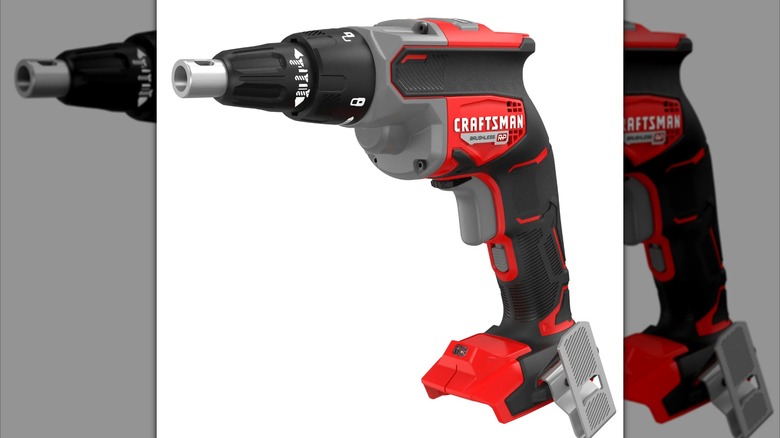
A drill with a proper drywall bit can be adequate when putting up drywall. However, if you're looking for a tool best-suited for this task, a drywall screw gun is arguably your best bet. These power tools are meant for installing screws into drywall, with a higher RPM and an adjustable nose cone to ensure all screws inserted are at the same depth. Craftsman has its own drywall screw gun, the aptly-named Craftsman V20 brushless cordless drywall screw gun, for those wanting to tackle drywall work with the absolute most appropriate tool out there.
Using a drywall screw gun from Craftsman or another brand isn't too complicated, though the construction and function of the drill may take some getting used to. As mentioned, there's a nose cone at the front of the screw gun with a bit that holds the screws within, which needs to be set to your desired depth before getting started. This is done by twisting the dial just behind the cone, lengthening or shortening the bit as needed. You can then use the screw gun as you would a typical drill, with the screw gun's clutch stopping and releasing the screw once it hits the preset depth. Craftsman also sells a collated drywall screwgun attachment for those who want to use collated drywall screws.