

Who Makes Airbus Engines? (It's More Than Just One Company)
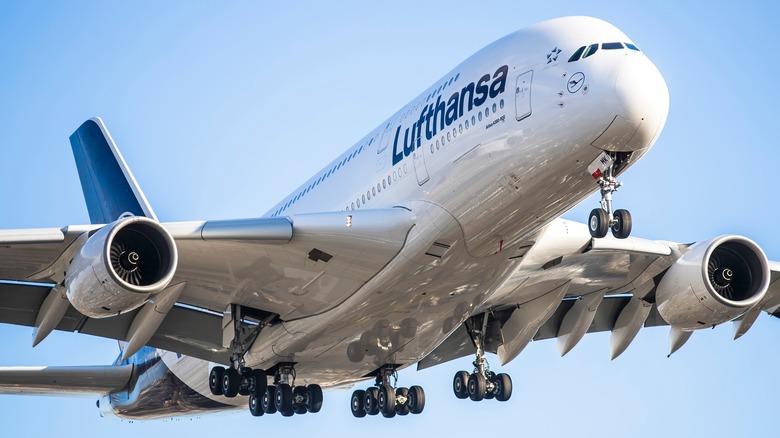
Airbus, like its competitor Boeing, is responsible for producing thousands of aircraft for hundreds of different companies and countries around the world. It's a huge company with a wide repertoire of products that extends beyond military and commercial aircraft. Still, most people know Airbus as the passenger plane manufacturer that isn't Boeing.
The Airbus A320 passenger jet might take the spotlight in Airbus' lineup, but the brand makes four other passenger airliners (and cargo variants) that are each suited for different tasks. Additionally, the company makes four military planes for both offensive and defensive/logistics roles. If that wasn't enough, Airbus also owns a helicopter division, which has a lineup of 18 distinct helicopters split between military and civil use.
With a couple dozen different aircraft to produce and manage, you might be surprised to know that Airbus doesn't make the engines for any of its aircraft. Sure, it has input in the production of each engine that goes into one of its products. However, outside suppliers handle the propulsion tasks for your average Airbus plane or helicopter.
Engines used by Airbus' airliners and commercial planes
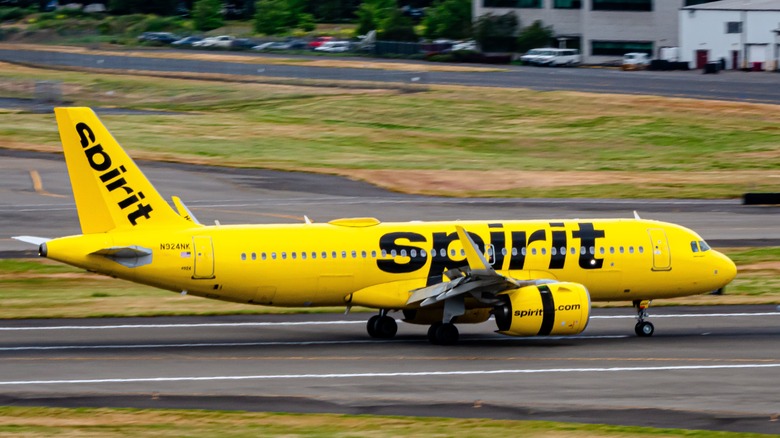
By far the most well-known Airbus models are its airliners and commercial planes. Planes like the Airbus A320 family have now overtaken stalwarts of the segment like the Boeing 737 when it comes to popularity, while the Airbus A380 holds the title of the largest passenger aircraft. The company's powerplants are as varied as its lineup of airliners.
Rolls-Royce (a distinct entity from the luxury car maker) produces engines for a number of different Airbus models. For example, the Rolls-Royce Trent series engine of differing variations powers A330 (and A330neo), A340, A350, and A380 aircraft. Meanwhile, Pratt & Whitney also produce turbofan engines for Airbus, providing the power for the A320ceo family of aircraft, the A220, variations of the A380, the older A300 and A310 planes, and variations of the A320 and A321 cargo models. Lastly, CFM makes engines for the ever-popular A320ceo and even its main competitor, the Boeing 737.
Engines installed in its military aircraft
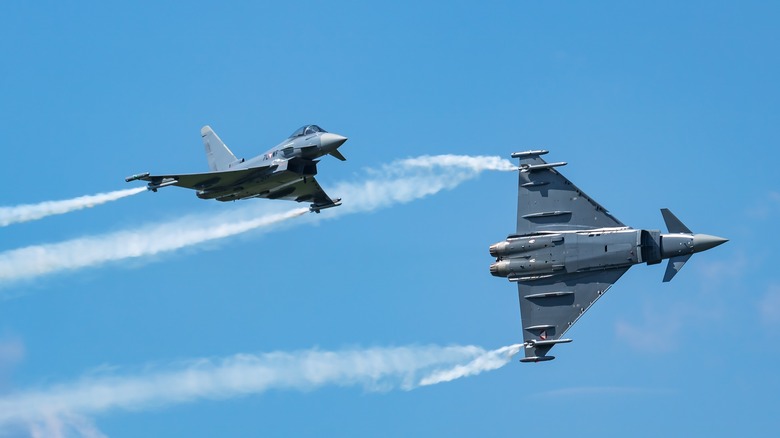
The Eurofighter Typhoon is one of the meanest fighter jets currently in the sky, with a top speed of Mach 2 and the ability to carry air-to-air and air-to-ground missiles. It is powered by a pair of Rolls-Royce EJ200 jet engines. Airbus' answer to more tactical cargo plane needs is the A400M Atlas, which has the ability to take off from unprepared or short runways while carrying up to 25 tons of cargo. Instead of relying on a set of jet engines to fly, the currently serving A400M uses propellors driven by four turboprop Rolls-Royce TP400-D6 engines.
Meanwhile, the A330 MRTT (Multi-Role Tanker Transport) is a military version of the A330 passenger liner. Like the civilian version, it relies on Rolls-Royce Trent engines, specifically the 7000 model. Lastly, there's Airbus' C295 military cargo plane, which can act as a staging ground for paratroopers; a more traditional "beans, band-aids, or bullets" carrier; or as an air-to-air refueling platform. Like the A400M, the C295 is a propellor-driven plane. It's powered by two Pratt & Whitney PW127G turboprop engines.
Engines powering Airbus helicopters
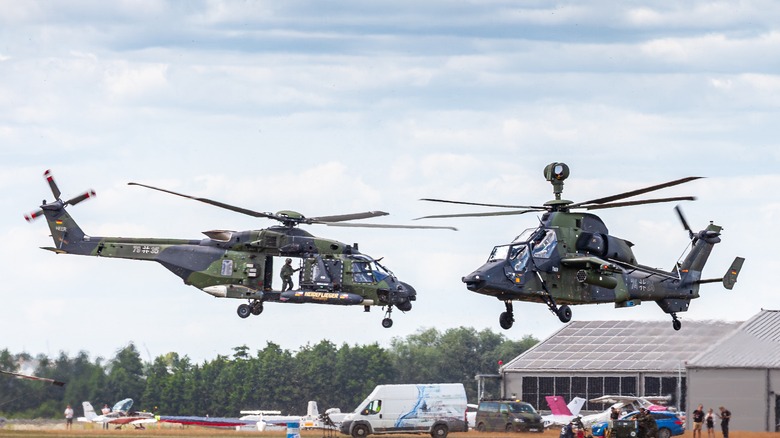
Airbus Helicopters, formerly known as Eurocopter, manufacturers a number of different helicopters for civilian, business, and military use. Much like fixed-wing Airbus models, the helicopter division likes to keep to the same general batch of suppliers. The vast majority of Airbus' rotary wing offerings are powered by Safran engines.
As a French helicopter engine manufacturer, Safran formed a joint venture with General Electric in 1974 that goes by the name of CFM International . CFM should be familiar to aviation fans as it makes a number of different passenger aircraft engines, including some for Airbus.
For the rest of the helicopter lineup, industry staples Rolls-Royce, General Electric, and Pratt & Whitney provide the horsepower. Seeing the same few names on the list of engine suppliers may not be all that exciting, but when it comes to aircraft — especially those in emergency or military roles — you don't want to go too far into left field for engine choices. Reliability is key to mission success.