

Apple iPhone 17 Pro Max Vs Samsung Galaxy S25 Ultra: There's A Clear Winner Here
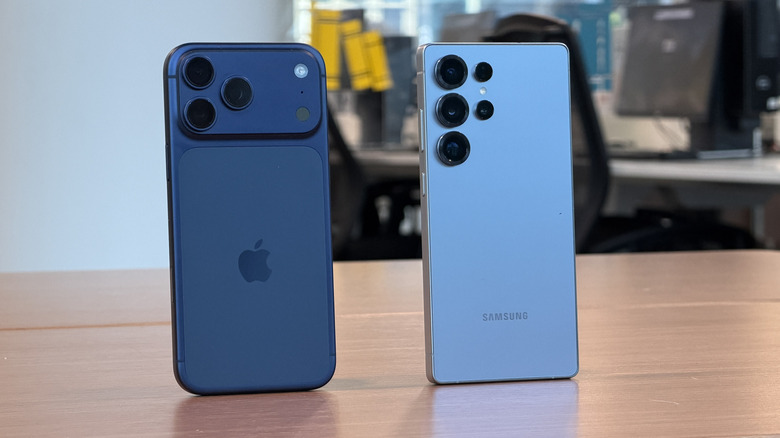
The fight between the iPhone and Android can often more simply be boiled down to a fight between the brands that make them. According to data from Canalys, Apple and Samsung held a market share of 49% and 31%, respectively, in the U.S. as of mid-2025, which doesn't leave a lot of room for competitors. To that end, the top-tier phone for those companies (excluding foldables) is the iPhone 17 Pro Max and the Samsung Galaxy S25 Ultra. As such, you might be wondering how these two large and relatively heavy candy bar phones compare to each other.
Both phones start at 256GB and 12GB ROM/RAM configurations. The iPhone can get up to 2TB in storage, which is twice the amount of the maximum S25 Ultra. However, the S25 Ultra can get up to 16GB of RAM, while the iPhone 17 Pro Max tops out at 12. As of this writing, the base model of the S25 Ultra starts at $1,049.99 while the iPhone 17 Pro Max starts at $1,199, so both are north of the $1,000 price point.
In terms of which phone is better overall, ultimately it's a judgement call. Both phones are excellent, so it mainly comes down to which operating system you prefer. If we were making the call, though, we'd lean toward the Samsung Galaxy S25 Ultra. It currently has a lower price, more camera options, and a few extras that might make it more worthwhile.
The Samsung Galaxy S25 Ultra has better extras
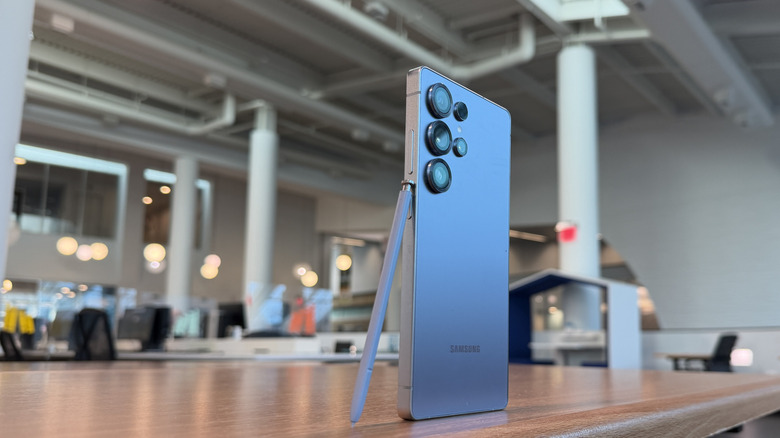
One of the more notable — no pun intended — differences between the two has to be the stylus that rests inside the S25 Ultra's chassis. A stylus can be a game-changer for those who are into it. It gives you precision when selecting smaller UI elements, which is refreshing. It also allows you to use a few cool features, like writing on the screen when it's off to jot down a quick note.
This may be a relic on its way out, but of the two phones, only the Samsung Galaxy S25 Ultra offers a physical SIM slot as well. This allows you to move your phone line easily from one phone to another if you're upgrading or just using a second phone for a time. In the U.S., however, newer Apple phones are limited to eSIM only. Although eSIM functionality has gotten better over the past couple of years as carriers are starting to figure it out, having the option for a physical SIM slot could be appealing.
One last notable point is that the Samsung Galaxy S25 Ultra still has a fingerprint sensor while the iPhone 17 Pro Max uses FaceID. Both are extremely reliable, but each has advantages in certain circumstances. FaceID, for example, requires a straight-on view of your face, so it can be hard to unlock your phone when it's at the wrong angle or if you are wearing clothing or a mask that obstructs your face. Fingerprint sensors work very well in most circumstances, except when your fingers are wet or you're wearing gloves. There are definitely trade-offs, but a fingerprint sensor is more versatile overall.
Its camera is also more versatile
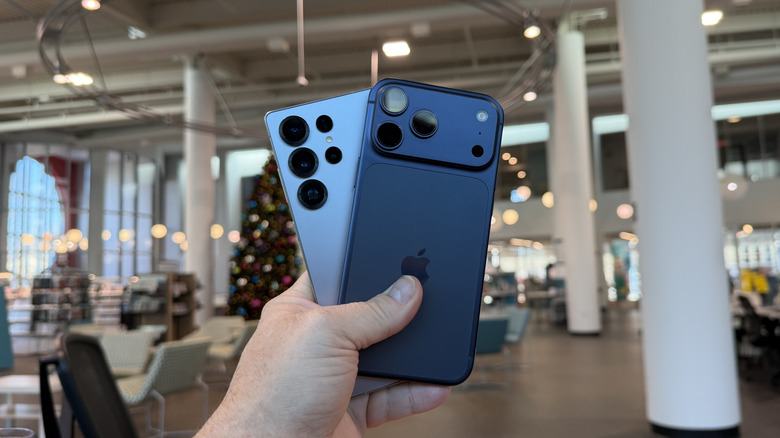
On the camera side of things, both phones offer spectacular cameras. The iPhone has three 48-megapixel cameras for ultrawide, main, and 4x telephoto. Meanwhile, the Samsung Galaxy S25 Ultra has a more unique setup. It has a 200-megapixel main camera, two 50-megapixel cameras for ultrawide and 5x telephoto shots, and a 10-megapixel 3x telephoto lens besides.
The iPhone does have some neat camera features, though. First of all, you can convert normal photos into portrait photos with artificial bokeh behind your subject on an iPhone. Also, Apple's product will give you more color consistency between lenses. The really neat trick is the Camera Control button: a dedicated function you can use to shoot photos and switch between modes or lenses.
As for image quality, both phones are great for point-and-shoot operations. Many phones are dependent on ambient light for great photo quality, and these phones are no exception. Nevertheless, these top-of-the-line phones can compensate very well for poor lighting.