

'Runaway' Supermassive Black Hole Has The Mass Of 20 Million Suns
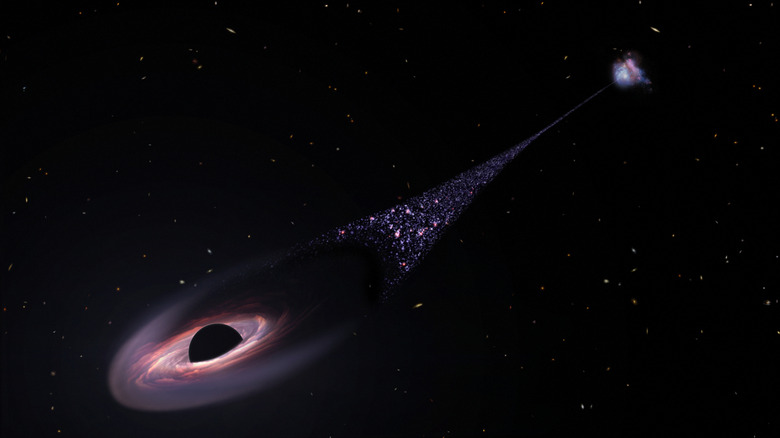
Scientists have discovered the first-ever confirmed "runaway" supermassive black hole (SMBH). The black hole is estimated to have the mass of 20 million suns and is moving away from its original galaxy at a staggering 2.2 million mph, with a predictably huge wake behind it. The discovery was announced by Yale University's Pieter van Dokkum and a team of scientists in a paper titled "JWST Confirmation of a Runaway Supermassive Black Hole via its Supersonic Bow Shock," uploaded to arXiv (an open-access repository for preprint academic articles) in December 2025.
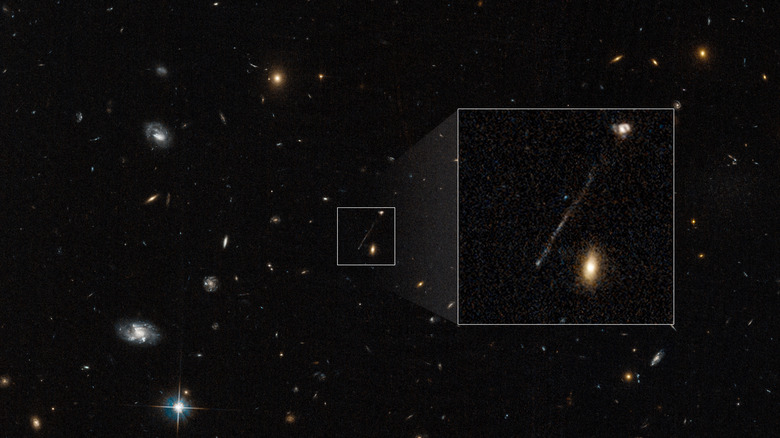
Van Dokkum and fellow scientists first spotted the potential runaway black hole in 2023 when analyzing a Hubble Space Telescope image. The clue? A thin line connected to the center of a galaxy in the image. Speaking to Live Science in 2023, Van Dokkum said that analyzing the line led the team to interpret that it was "seeing a very massive black hole that was ejected from the galaxy, leaving a trail of gas and newly formed stars in its wake." The team's findings were published in The Astrophysical Journal Letters that same year.
However, further study was necessary to confirm that it was indeed a runaway SMBH. For this, the team turned to the James Webb Space Telescope (JWST), which has given us some of the most striking images of our universe to date. The JWST's powerful imaging hardware showed a bow shock present at the front of the SMBH, confirming that the black hole was indeed escaping its galaxy at a rapid pace.
How does a supermassive black hole escape its galaxy?
Supermassive black holes are, in and of themselves, one of the many as-yet unresolved mysteries about black holes. While scientists know they exist and are fairly confident that every galaxy has one, they have yet to find a definitive answer to how they form and grow so big so quickly. There are theories, but there's nothing definitive as of yet.
As for this particular SMBH, the December 2025 paper theorizes that it was set on an escape trajectory via a "velocity kick" from either gravitational-wave recoil or a three-body interaction, with the scientists indicating that the former is the more likely mechanism. Speaking to Live Science, lead author Pieter van Dokkum explained that these so-called velocity kicks can happen when two or more supermassive black holes end up in very close proximity. When this happens, the strong, orbit-altering gravitational pull of each black hole interacts with the other's, culminating in one of the two being booted out into space.
This runaway black hole may not be the only one out there, with the paper naming several other candidates. Of note is a massive black hole in the dwarf galaxy MaNGA 12772-12704, offset from the galaxy's center by about 1 kiloparsec, first reported in a short communication published in Volume 70, Issue 21 of Science Bulletin. Thus far, though, van Dokkum's team is the only one to have confirmation — pending peer review, of course — of a runaway SMBH.