

How NASA Built Its Massive Artemis II Moon Rocket
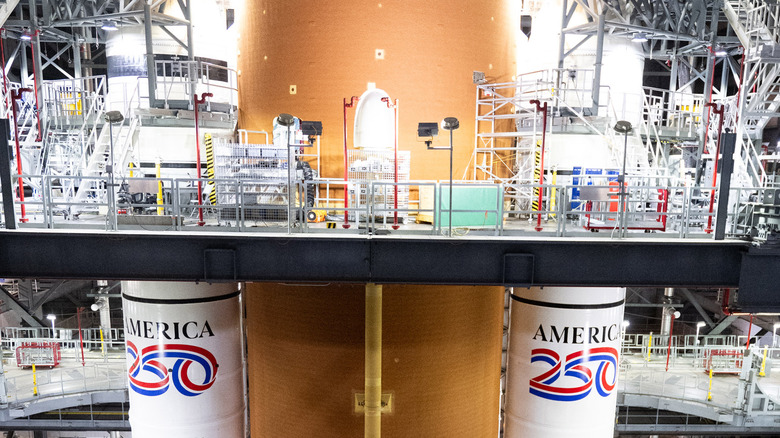
NASA's massive Space Launch System (SLS) Artemis II rocket is an awe-inspiring testament to humanity's ability to think big. The Artemis II core stage stands 212 feet tall and is the largest such rocket that NASA has ever built. But that's only the beginning. At liftoff, the SLS will generate roughly 8.8 million pounds of thrust, with its twin solid rocket boosters providing about 75% of that power during the initial launch stage. No wonder spacecraft are amongst the coolest tech we've sent to space.
Artemis II will be the first mission since the Apollo program ended to allow humans to see the dark side of the moon. However, while the mission will send a team of four astronauts to the moon and back in about 10 days, the journey this massive rocket took to being launch-ready is rather more sedate. In the case of the aforementioned boosters, each is assembled from 10 individual segments, with each manufactured in Utah before making a 1,600-mile rail journey across eight states to NASA's Kennedy Space Center in Florida.
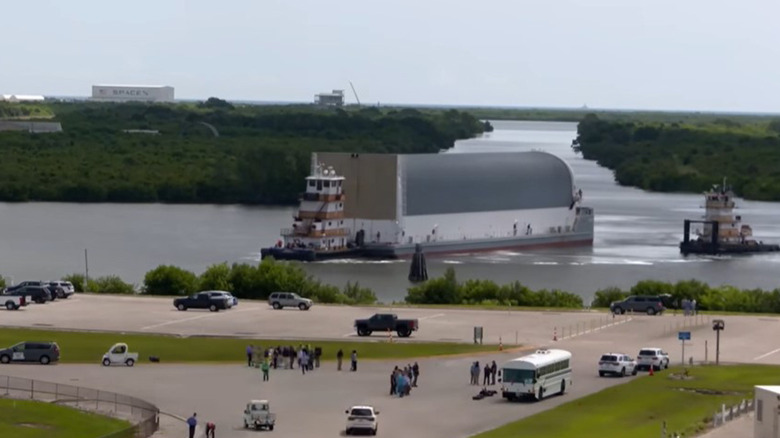
The main core stage takes an equally unhurried journey, although in this case it's transported by barge over 900 miles from NASA's Michoud facility in New Orleans to Kennedy Space Center. Although the program has suffered delays after heat shield issues were discovered following the unmanned Artemis 1 mission, NASA now aims to fly the four-person crew to the moon and back by April 2026 at the latest and potentially as soon as February.
Building NASA's biggest ever launch system
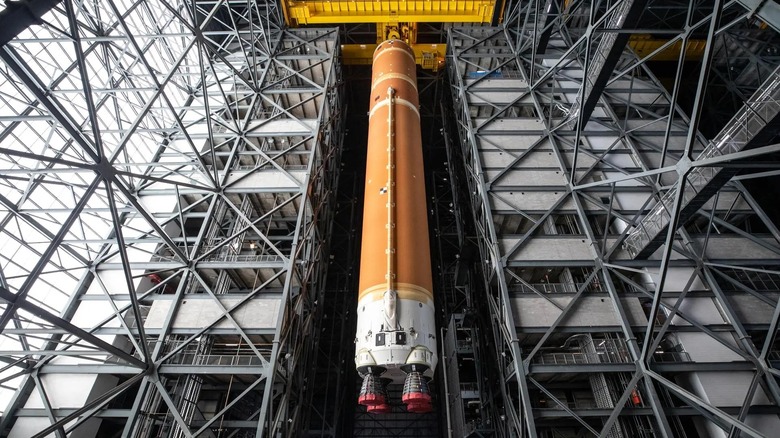
While many rockets, including most Russian rockets and SpaceX's reusable Falcon 9 rocket, are assembled horizontally, the Artemis SLS is assembled vertically at NASA's massive Vehicle Assembly Building (VAB). Assembly begins with the solid rocket boosters (SRB). Crews stack the boosters section by section, alternating between the sides to maintain balance as the SLS grows taller. Each segment is carefully aligned and bolted into place before the next is added, eventually forming two complete five-segment boosters topped with their forward assemblies and nose cones.
Once the solid rocket boosters are fully assembled, the next task is to install the system's core rocket. At this point, it's worth remembering that this stands 212 feet tall and can store a staggering 700,000 gallons of cryogenically stored propellants. To achieve a successful marriage of the SRBs with the core stage, the massive rocket had to be hoisted vertically and lowered into the narrow gap between the SRBs with minimal clearance. Once seated, the core stage becomes the central spine of the vehicle.
Once this not-so-simple matter had been completed, the next phase of the construction saw the NASA team install the launch vehicle stage adapter. This provides both structural support and also helps to protect the avionics and electrical systems. The final stages saw the installation of the Interim Cryogenic Propulsion Stage (the rocket's upper stage) and — topping it off — the all-important Orion spacecraft and its launch abort system were installed.
Why Artemis was delayed
With the rocket completed, NASA is hoping to launch the mission as soon as February 2026, as it takes its next major step in its return to the moon. Unlike Artemis I, which flew without astronauts in 2022, Artemis II will be the first crewed mission of the program. The mission will send four astronauts on a 10-day journey around the moon and back to Earth. The mission will not attempt to land on the moon, but it will represent the furthest that mankind has traveled from the Earth in more than fifty years.
The Artemis II crew is made up of Commander Reid Wiseman, Pilot Victor Glover, and mission specialists Christina Koch and Jeremy Hansen. During the mission, the crew will be checking that all the spacecraft's systems are functioning as expected when the ship is operating in a deep space environment.
The mission was originally scheduled for September 2025, but heat shield issues with the Orion spacecraft were discovered after the otherwise successful Artemis 1 launch returned some stunning close-up shots of the Moon. Although the issue — described as uneven ablation — was not serious enough to endanger the safety of astronauts, NASA played it safe until engineers figured out the root cause of the problem.
Ultimately, although changes to the heat shield are expected for Artemis III, engineers have concluded that changes to the craft's re-entry trajectory will be enough to ensure the astronauts' safety as they slow from nearly 25,000 mph to 325 mph, at which point its parachutes can be deployed.