

Iowa-Class Aircraft Carriers: Why The US Navy Dream Never Came True
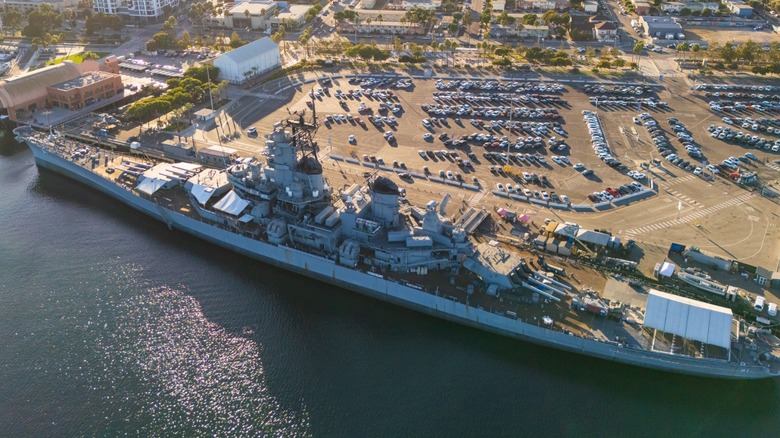
The Iowa-class battleships are one of the most storied warship classes of the U.S. Navy, having been commissioned during the height of World War 2 in 1943. They also saw action in several other conflicts in the latter half of the 20th century, including the Korean War, Vietnam War, and the First Gulf War as part of Operation Desert Storm, with the last of the class, the USS Missouri, being decommissioned in 1992.
Given the length of their service, these ships were updated a few times to ensure that they could face modern threats. One such proposed update was quite interesting, as it suggested turning the battleships into a "battlecarrier." This meant the removal of the ship's aft turrets so they could be replaced with a 320-tube vertical launch system and a flight and hangar deck that could accommodate AV-8B Harrier II jump jets with their incredible capabilities, as well as a mixture of helicopters and the V-22 Osprey. They were also supposed to embark up to 800 marines, turning it into something akin to an amphibious assault ship instead of a full-on aircraft carrier.
However, the U.S. Navy did not push through with the conversion after some study. That's because it was discovered that adding a flight deck to an old battleship was going to be far more expensive than anticipated. Aside from removing everything that was aft of the superstructure, builders would have had to conduct extensive structural modifications to ensure that it could endure the rigors of flight operations. And because such a ship would need crew for both the guns and the air arm, it would also mean needing over 2,000 people to run the entire ship, making it quite expensive to operate.
The U.S. Navy modernized them with missiles and radar instead
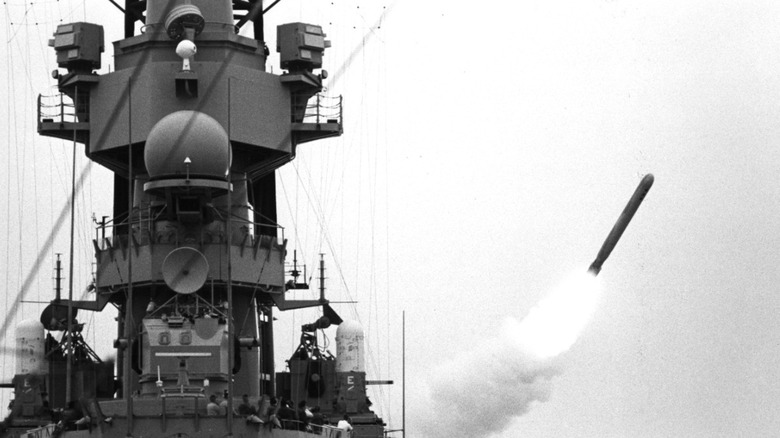
Even though the U.S. Navy did not push through with adding a flight deck on the Iowa-Class battleships, the four vessels still received a substantial upgrade during the 1980s. This effort was part of President Ronald Reagan's plan for a 600-ship navy, with the ships receiving Tomahawk and Harpoon missiles systems to upgrade its offensive capabilities and Phalanx Close-In Weapons System (CIWS) for close-in defense. It was also fitted with radar and fire control systems to allow the ship to fight in a modern battlefield.
The original 16-inch guns on the ships only had a range of about 20 miles, meaning its engagement envelope was previously limited to coastal targets and other naval vessels. The missile system upgrade massively increased the reach of the Iowas to more than 1,800 miles, allowing it to hit distant targets and turning it into a strategic platform.
Unfortunately, USS Iowa, the lead ship of the class, wasn't able to partake in Operation Desert Storm in 1991. This was because one of its gun turrets exploded during a training exercise before the military action, resulting in one of the worst non-combat accidents in the U.S. Navy. Still, her sister ships launched several cruise missiles during the war, hitting targets as far away as Baghdad. Aside from that, they also fired several hundred rounds from their main guns, hitting fixed and mobile targets, including an Iraqi armored column that was hit with a 24-round barrage — the last shots fired in the Gulf War from an American battleship.
Despite the updates, the aging platforms of the Iowas were unable to keep up with more modern ships and technologies. Because of this, they were finally retired in 1992 after serving the U.S. Navy for nearly 50 years.