

This Is Considered One Of The Most Influential Pieces Of Tech To Come Out Of The '80s
The 1980s were a great decade, especially for groundbreaking tech innovations. It gave us consumer electronics like the Sony Walkman, compact discs, and mobile phones, and also introduced medical breakthroughs such as DNA fingerprinting and disposable contact lenses. But it's easy to forget another deeply influential bit of tech that debuted in the '80s: the desktop PC.
While it may be ubiquitous now, the desktop PC was a game-changer for computing. You see, for a good chunk of the 20th century, computers were big, hulking mainframes that occupied entire rooms and, in the case of IBM's mid-1950s computers, had hard drives that weighed around a ton. They were incredibly powerful for their day but were decidedly not for personal use. That would start changing in the 1970s with microcomputers like the Commodore PET, Apple II, and Tandy TRS-80, all of which helped bring computing to the masses, but these were still far from the desktop computers we know today.
That's mostly down to their all-in-one construction, which combined the keyboard, motherboard, and sometimes even the monitor into one unit. The move to a more familiar desktop computer arrangement, with all its strengths — separate peripherals, standardization, an ecosystem of third-party hardware, and, eventually, a graphical user interface — would have to wait until IBM and Apple's offerings in the early 1980s.
The IBM PC defined the open standards we're used to

Personal computers had been around since the '70s, but the big leap happened in 1981, when IBM launched the IBM 5150 Personal Computer. Debuting after a year-long development cycle, the IBM PC was an unassuming beige box that would have an outsized impact on the world of personal computing.
What made the IBM PC such an influential development was how open it was. IBM made the PC's tech specs public, ensuring that any company with the resources could become part of a third-party ecosystem of manufacturers and suppliers. Many took advantage of the ISA (Industry Standard Architecture) expansion slots to begin offering third-party cards that added functionality to users' PCs. Others got in on the computer hardware game, taking advantage of IBM's openness and Microsoft's non-exclusive deal with IBM for the PC's DOS operating system. The non-exclusivity allowed Microsoft to license it to other computer manufacturers, ensuring that PCs from the likes of Compaq, HP, and Dell were compatible with IBM PC hardware and software, fueling the rise of "IBM compatibles" and a PC ecosystem. This also helped MS-DOS to dominate the market by the mid-'80s, laying the groundwork for Microsoft's modern-day prominence.
IBM's openness applied to the peripherals, too. While IBM offered a selection of monitors for the 5150, third-party manufacturers also released CGA monitors that were compatible with the IBM PC and clones, giving owners more choice. The same applied to the keyboard: while the 5150's standard keyboard is truly iconic, buyers could also use ones from companies like KeyTronic if they preferred. If this all sounds familiar, it should: it's what the hardware experience of modern desktop PCs is like today.
Apple's Macintosh and the rise of the GUI
The IBM PC may have laid most of the groundwork for the modern desktop PC experience, but one thing was missing: a mouse. MS-DOS had a text-based command-line interface; thus, the PC didn't really need a mouse — you just typed everything in and navigated using commands. Mice already existed, of course, but it would take a few more years before they would truly become mainstream.
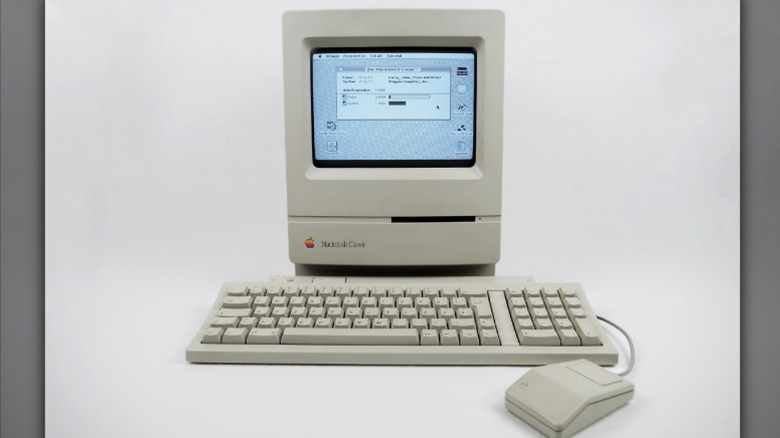
Microsoft launched an IBM-compatible mouse in 1983 alongside Microsoft Word, but it was a flop. Instead, it wasn't until the Apple Macintosh was launched in 1984 that the mouse arguably became an essential part of the desktop computing experience. Now, Apple wasn't the first company to explore the benefits of a GUI, but it was the first one to take the concept and bring it to market in an affordable — well, relatively speaking — manner.
The Mac Classic, as it's commonly known, had a graphical user interface (GUI) — first seen on the Apple Lisa from 1983 — that had many of the elements we now take for granted, including icons for programs, tilable and movable windows, and settings panels. It also came with a word processor and a paint program that let users take advantage of the GUI. Aldus PageMaker and Apple's LaserWriter printer followed soon after, and the combination made the Mac into the de facto desktop publishing machine for most of its life. Microsoft would join the GUI party with Windows 1.0 in 1985. While it wasn't an immediate hit, it laid the groundwork for Windows' evolution into the OS we know today, eventually cementing the mouse-centric GUI as the way to interact with PCs.