

What Kind Of Exterior Lights Are Best For Security? Here's What The Experts Say
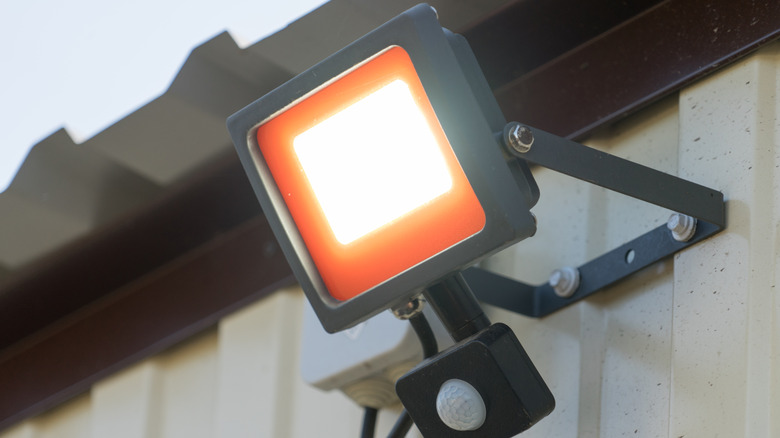
The security of our homes can be dramatically improved with the addition of just a few simple devices. Ring and other brands offer doorbell cameras, through which we can monitor activity near our property. Simple installation, easy-to-use app functionality, and a healthy dose of peace of mind. As valuable as they can be, though, there's more to home security than just a video camera doorbell. Should there be a lot of activity where you live, especially at night, some outdoor lights can be an excellent deterrent.
Bulkhead lights, a mainstay of industrial sites, are hardy options that can work well in regions with unpredictable weather in particular, because they are built to resist harsh conditions. However, spotlight LED models come highly recommended by experts in the lighting and security sectors. There isn't a one-size-fits-all answer, because you may want something larger if you have more secluded areas of your property where intruders could potentially hide. The first consideration, then, is often between halogen or LED lights, and the former does have its pros in that the technology can provide instant illumination and their color rendering is of a broadly higher quality. On the flipside, LED models are up to around 85% more efficient in terms of energy use than their older counterparts.
LED or halogen lights
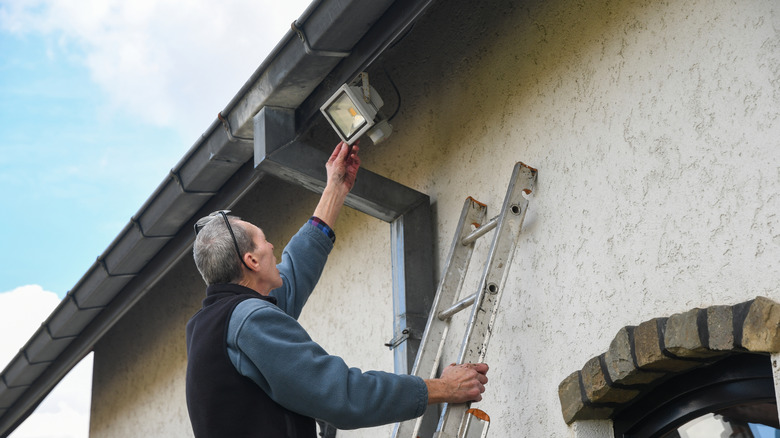
When making the choice between halogen or LED systems for your security lights (the typical dilemma you'll face when choosing between different types), remember how you plan to operate them. With LED being a generally newer technology, it's also unsurprising that they are typically more expensive than halogen versions. The initial outlay for the system may be higher, but over time, LED lights should require less frequent replacement, while also using considerably less energy. The Lightning Superstore technical director Matthew Currington explains just how stark the difference can be, noting to Homes & Gardens that "they have an average life span of 30,000 hours, whereas a normal bulb lasts up to 2000." There's more to their practicality, too: Dan Collier of DC Electrics U.K. tells Which that they also "deal with regular sporadic use much better than the old halogens."
This is particularly important because they will often be set to switch on in response to movement, or to activate and deactivate at intervals pre-set by a timer. Speaking to Better Homes & Gardens, ADT vice president of product management Jimmy Lin suggests, "Integrate motion sensors into your security system that only light up when movement is detected. Motion-sensing lights can deter intruders by putting on a spotlight that is likely to attract attention."
There are a range of motion-activated security lights available at stores such as Harbor Freight. The key is often to have lights that aren't predictable, as a single porch light that was simply on all the time would be. Instead of a deterrent, such a measure could actually make your home more vulnerable, Brinks Home SVP Sara Harshbarger explained to the outlet: "poorly placed lighting can actually have the opposite effect, inadvertently drawing attention to potential entry points for intruders."
The best settings and positioning for exterior security lights
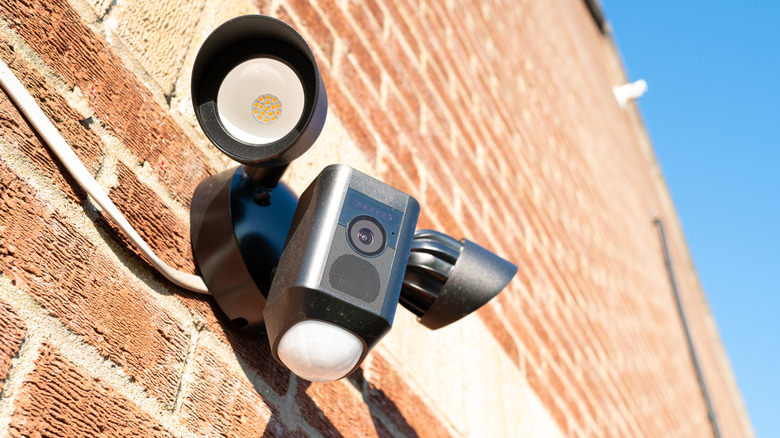
Of course, a lot is dependent on your specific property. If you simply have some decorative solar lights in your backyard, you can place them as you wish, but for security lights to optimally serve their purpose they should also be positioned correctly. Failing to get this right can result in the area you seek to illuminate simply becoming a mess of glare instead, far less likely to be an effective deterrent and possibly even actively obscuring any movement outside your home. You don't want any glare on your doorstep for that reason, but it's still a prominent spot that you'll want your security lights to cover.
As such, Sam Grant of K G Electricals told Which, the ideal way to place them for doorway surveillance is pointing directly at that spot, but off-center, and not from directly above. Specific settings for any sensors will vary depending on your property and how it's situated on the street. Grant adds that, if your home is near to a busy street or sidewalk, the light may be activated frequently as neighbors and anybody else passes by, which might be a nuisance.
Sensors with the functionality to reduce the frequency of activation (10 minute intervals, the expert suggests) will prove very helpful. Certain cameras, such as doorbell cameras, allow the user to finely adjust the angle and strength of the detection used. It's important to take a look at these settings to ensure that your property is illuminated from all the right angles and approaches. As Brinks Home SVP Sara Harshbarger put it to Better Homes & Gardens, "Lighting up pathways such as driveways and sidewalks also adds a layer of visibility that can help deter people and creatures from approaching the home unnoticed."