

How Big Is The Largest Hard Drive You Can Buy Today?

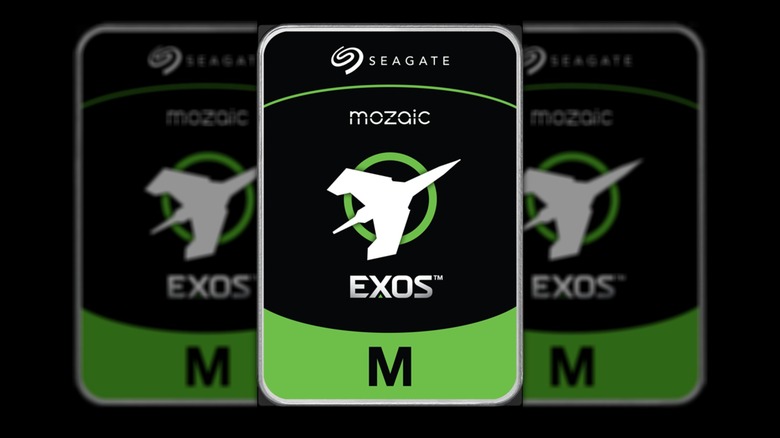
As we generally shift to newer and larger solid-state drives (SSDs), hard drive advancements can fall out of the limelight. However, for some purposes, like big data processes, large hard disk drives (HDDs) can be the most appropriate choice for the job. The largest HDD on the market at the time of writing is Seagate's Exos M ST36000NM003K, offering 36 terabytes (TB) of storage, split across 10 3.6 TB disks. It's currently $799.99 for a new one on ServerPartDeals.com, or from $779.99 to $789.99 for refurbished editions. That works out between $21.66 and $22.22 per terabyte.
Seagate's 36 TB HDD runs using a Serial Advanced Technology Attachment 6 gigabytes per second (SATA 6 Gb/s) interface, and a spindle speed of 7.2K revolutions per minute (RPM). The HDD also belongs to the Exos M range; one of the manufacturer's enterprise ranges designed with heavy-use, high-performance, and scalability in mind. It's not exactly the kind of hard drive you would install into your PC, so much as one made with large-scale professional data solutions and infrastructure in mind.
The Seagate Exos M 36 TB HDD is a part of the company's Mozaic 3+ Platform, which runs on heat-assisted magnetic recording (HAMR) technology. Hard drives that are a part of this platform are largely the same as other HDDs, with a few technical exceptions. One example of this is the unique magnetic layer designed to handle thermal conditions. They also write using a quantum antenna and use a single reader. Another feature that sets them apart is their grain media formula, which improves the efficiency of their areal density, meaning that it can squeeze more terabytes into a smaller space.
Even larger hard drives are on the horizon
Seagate is continuing to develop even larger data storage solutions than their 36 TB HDD, with the purpose of supporting the rapid progression of cloud expansion and artificial intelligence development in mind. Back in early 2025, the company shared that it had managed to achieve storage capacities of 6 TB per disk in laboratory settings. That's almost double the disk capacity used to create the 36 TB HDD.
Assuming Seagate's future HDD also uses 10 disk platters, the same as the 36 TB HDD, then that means that 60 TB HDDs could be coming in the future. The data storage manufacturers have shared that they are "laser-focused" on meeting the demand for large-scale storage solutions set out by tech businesses and users, particularly in the face of growing AI use. With that in mind, it's clear that the technology will be used to put even larger HDDs on the market — even if we need to wait a while for full 60 TB HDDs to arrive.
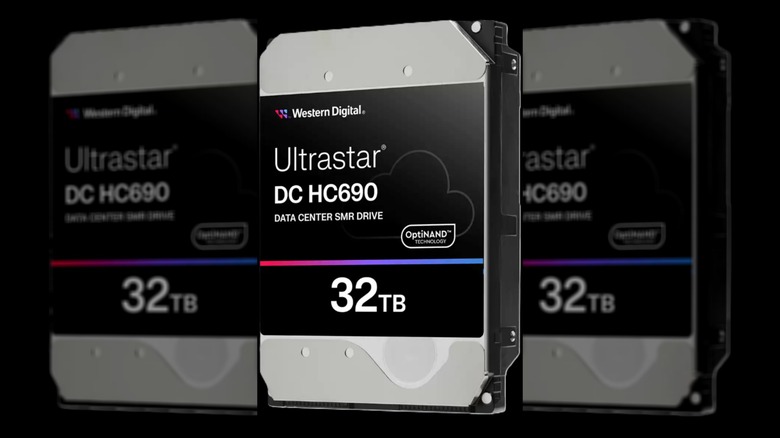
Seagate isn't the only manufacturer focused on developing larger HDDs, either. Other companies, with Western Digital and Toshiba both having created their own large capacity internal HDDs. For example, Western Digital's Ultrastar DC HC690 offers 32 TB of storage split across 11 platters, also targeting the enterprise market. With multiple manufacturers in the race to make the largest HDD, the newest record-breaking HDD could be closer than we think.
What are the largest hard drives used for?
Large-capacity HDDs are mostly used by tech companies, data centres, and other large-scale infrastructure. Having access to ample data storage is a fundamental part of many different areas, including cloud architecture and artificial intelligence. As a result, these massive, many-terabyte hard drives tend to be used mostly in commercial or enterprise settings.
Cloud architecture often relies on the storage solutions offered by HDDs. HDDs are much cheaper than SSDs, which tend to be more expensive per terabyte, meaning that they're more cost-efficient to use on a large scale than their faster counterparts. As a result, HDDs are a popular choice — so much so that, according to Seagate, around 90% of the exabytes held by cloud data centers are actually kept on HDDs. Larger capacity, higher-density HDDs offer these data centres the option of having more data storage at their fingertips without compromising as much on physical space as they would if they were required to use a higher number of smaller storage solutions.
Another use of large-capacity HDDs is AI. AI data centres require a lot of data storage to function and for training purposes. Datasets used to train machine learning processes need to be kept somewhere, for instance, and HDDs offer a cost-efficient option for doing so. HDDs that are integrated with certain types of technology, like Seagate's Mozaic 3+ Platform, can also help to assist with AI applications like interfacing, autonomy, and retrieval augmented generation (RAG).