

LG's New Home Robot Can Do More Than Just Fold Laundry
Though we've yet to see the flying cars that science fiction tales have long-promised, few in the know would argue that technology isn't still advancing at a rapid clip. To that end, if you have been following tech news over the past few years, you know advances in artificial intelligence and robotics have been especially eye-opening, particularly when they're working in tandem. So much so that AI-embodied bots have been setting Guinness world records and even performing complicated feats of dexterity in recent years.
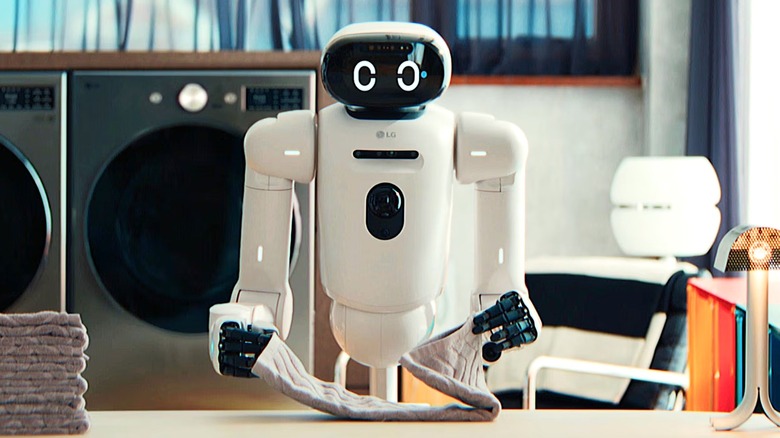
As LG demonstrated during its 2026 CES (Consumer Electronics Show) panel, AI-powered bots may soon be ready to take over certain dreaded household tasks like folding laundry as well. LG had dubbed its AI creation the CLOiD Home Robot, and has essentially positioned the life-size bot as the face of its "Zero Labor Home" platform, which seeks to limit how much time the average homeowner spends performing menial, space-maintaining tasks. It does so, in part, via home integration connection with other compatible LG appliances.
The version of LG's CLOiD bot displayed during the CES panel is a sci-fi creation incarnate, featuring two articulated arms, a torso, and a head with two digital eyes, all affixed to a wheeled base with autonomous navigation. During the panel, LG reps not only displayed its ability to fold laundry, but also a few other household jobs, which included some light baking and vacuuming. It was even able to retrieve and serve a beverage from a refrigerator.
LG's home robot may not be quite ready to hold down the house
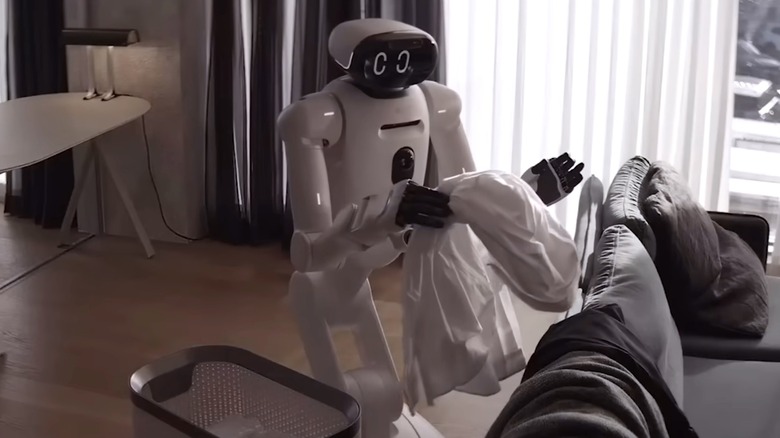
As impressive as CLOiD was in action during its Consumer Electronics Show debut, LG, whose name means different things to different people, did not announce any immediate plans to release its AI-enabled housework robot to the consumer market. That may be because it's still developing the technology behind the bot and the various devices it's intended to connect with.
Moreover, CLOiD may need an upgrade or two to its programming to ensure it performs its assigned tasks more efficiently, as some tech factions in attendance for the demonstration noted that, even as the bot was doing the work, it was doing it quite slowly. For its part, LG was reportedly even hedging a bit on the bot's potential in the consumer market, claiming that CLOiD is instead meant to show the company's interest in developing "home robots with practical functions." Even so, some tech pros note that a major consumer electronics brand's willingness to invest in the AI and robotics market may hint at a major shift in the consumer robotics arena.
Despite CLOiD's perceived slowness, naysayers were still impressed by the bot's abilities at this stage of development. That's particularly true of CLOiD's brain, a smart home hub powered by a voice-based generative AI that can both process commands and communicate with humans via speakers, cameras, sensors, and programmed digital "facial" expressions. Though LG's "Zero Labor Home" is, apparently, still far from a reality, CLOiD may signal that the robotic future is closer than it's ever been.