

Insurance Companies Are Using Drone Images To Cancel Customers' Policy Renewals
If you count yourself among the millions of homeowners in the world, you know that maintaining a valid insurance policy on your property is one of the most important steps you can take to protect yourself. You no doubt also know that selecting the right insurance can be downright nerve-wracking. And even when you rely on discount programs, like the one offered by smart home company Nest, coverage can still cost you a pretty penny.
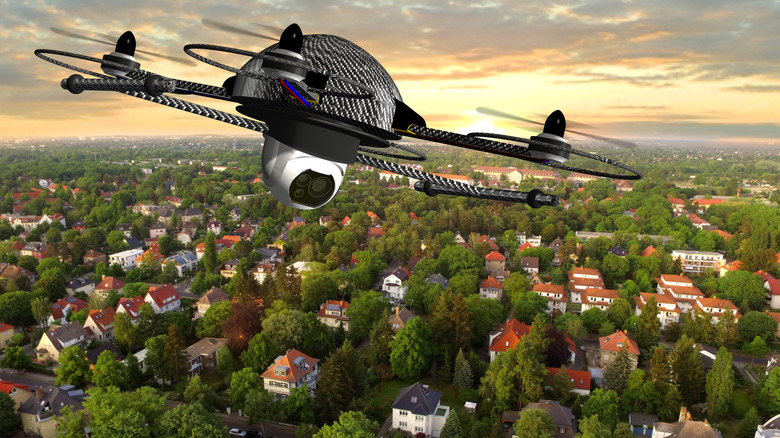
That's why it can be particularly disheartening to hear stories of insurance companies taking extra measures to make things more difficult for homeowners. One such case involves reports of an insurer in California allegedly relying on aerial drone footage to end coverage for one of its customers. That company is CSAA; according to Modesto home owner Joan Van Kuren, the AAA-affiliated insurer decided to not renew her policy after it gathered images of her home via a drone fly-over.
Van Kuren told CBS Sacramento the official reason given by CSAA was that it had found a "substantial increase in hazards" accumulated around her property. The homeowner claims the images she was shown as proof of CSAA's decision were captured via camera-equipped drone, which have become increasingly affordable as the technology becomes more widespread. After being approached by the local CBS affiliate, CSAA has denied the use of a drone, but did confirm the photos were sourced by what it referred to as proprietary aerial imagery. Whatever the case, it would seem that aerial photography is now increasingly being used by insurance companies to make policy decisions.
The legality of drone usage and what to do if your policy comes under siege

There are laws concerning how drones can be utilized in residential areas, leaving some to question the legality of insurers using them for business purposes. Drone operators need to abide by some strict rules to avoid getting in trouble with the Federal Aviation Administration (FAA), but these regulations don't cover privacy concerns. These are often handled on a state-by-state basis; in California, for example, Section 1708.8 of the state's Civil Code was amended in 2015 to make it an illegal invasion of privacy for drone pilots to enter the airspace of a person and capture images of them without their consent. This means that insurers are likely within their legal rights to use aerial photography, provided they're just capturing images of your home and not you personally.
However, there is a modicum of protection for homeowners afraid of insurers dropping them unceremoniously. Insurance companies can only cancel your policy in instances of fraud or nonpayment, which means the most they can do to you is inform you they will not be renewing your current coverage. They can't do so without providing you advance notice of their decision. This gives you the opportunity to either appeal that decision or file a complaint with your local state regulator.
In some cases, your insurer may provide you an opportunity to rectify the issue and continue your coverage. That was just the case with Austin, Texas resident Tracy Gartenmann, who reportedly received aerial images of her home via email from her insurer, along with a notice that she had two months to trim the overgrown trees on her property or risk losing her coverage. Caveats aside, homeowners should officially count themselves on notice about keeping their home and surrounding property in tip-top shape, lest a high-tech aerial machine snap a potentially insurance-killing shot.