

What To Know Before Sleeping Overnight At A Highway Rest Stop
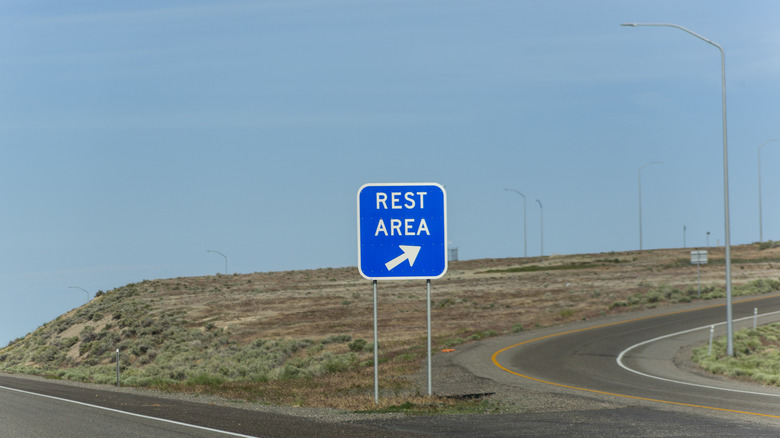
We've all been there: You're doing your best to drive safely at night through areas unknown and, even with coffee and energy drinks, you start to get tired. The natural thing to do would be to pull over safely at a rest stop, park yourself under a streetlight if it's dark, lock your doors, and close your eyes for a short nap. For those who drive recreational vehicles (RVs), places like Home Depot parking lots for overnight parking aren't always a good option, and it would make sense if you assumed rest stops were likewise off-limits. However, in a majority of states, it's 100% legal and encouraged to park at a rest stop over driving while tired.
While many states allow drivers to sleep in their car for a period of time, that time limit changes immensely from state to state. Some states like Florida have laws against sleeping in your vehicle, including one that limits you to just three hours at a time at rest stops. Others, such as North Carolina, discourage long-term stays at rest stops, but state officials have gone on record that they prefer drivers take a break to avoid drowsy driving. The time limit allowed is more concrete in Pennsylvania, where you're limited to just a two-hour stop every 24 hours.
Even in the states that do allow drivers to sleep overnight at rest stops, there are still rules and regulations that drivers need to comply with in order to do this legally. In some areas, you may see signage that announces "no overnight camping." While that sounds like you wouldn't be able to spend the night there in a car or RV, it really means that you're just not allowed to do activities like pitching a tent or sleeping on the ground. In this case, sleeping inside a vehicle typically isn't considered camping.
How to stay safe when spending the night at a rest stop
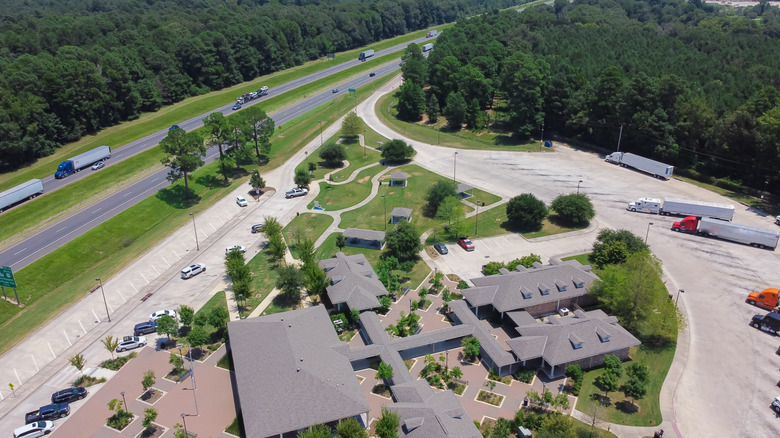
Some people who have never spent the night at a rest stop might assume it's dangerous. There are some dangers, of course, and it's often recommended to choose a hotel or campground when possible. That being said, there are some safety advantages to sleeping at rest stops. There's typically only one way in and out, which might make your vehicle less attractive to potential criminals. A parked vehicle at a rest stop is also pretty noticeable, meaning it would be difficult for a potential criminal to attempt a break-in without being seen. Adding to visibility is the fact that many modern rest stops along highways have video surveillance. Additionally, while it's not true for every rest area, many of them have security on-site that will help deter criminals.
That's not to say that there aren't cons to spending the night at a rest stop, as trying to find a bit of privacy in a very public area can be difficult. Not only can basically anyone look into your vehicle, but the headlights from passing vehicles might end up waking you up or otherwise distracting you. In order to make sure you're as safe as you can be while sleeping at a rest area, consider stopping only at well-lit locations where you have strong cell service. Be sure to not park your vehicle away between large or tall trucks.
Parking further away from the main rest stop building for privacy is a good idea, but don't park in a spot that could leave you too isolated, such as blind corners or thick trees. Additionally, placing shades on your windows can provide you with more privacy and ensure your sleep is undisturbed. You can back your vehicle into a parking spot to ensure it's easy for you to drive away if things go awry. Lastly, if you're feeling uncomfortable in the area you're parked in, leave. It's always best to listen to your intuition.
Why it's not smart to drive tired

While pushing through a drive while you're feeling sleepy may seem like you're toughing it out, it's actually incredibly dangerous, even if you've taken steps to improve your night driving visibility. There have been numerous studies that show driving while tired is actually comparable to drunk driving in terms of how it can affect your driving. Drowsy driving can cause drivers to sway between lanes and make it difficult for drivers to keep a consistent speed.
There was a study done by the National Highway Traffic Safety Administration (NHTSA) that looked at the dangerous effect drowsy driving can have. The 2017 study discovered the drowsy drivers were responsible for more than 91,000 accidents, 50,000 injuries, and almost 800 deaths. NHTSA compared that with fatalities from drunk driving crashes in 2017, which totaled 10,874. That number accounted for nearly 30% of all fatal crashes that year.
According to sleepfoundation.org, people's reaction time, vigilance, hand-eye coordination, and multitasking is comparable to that of someone with a blood-alcohol content 0.05% after around 18 hours of being awake. That increases to 0.08% after 20 hours of wakefulness, which is the legal limit for drivers who have consumed alcohol in several states. Being awake for 24 hours is the equivalent of having a blood alcohol content of 0.1%.