

The Effort To Replace The US Military's Radar Planes Isn't Going To Plan
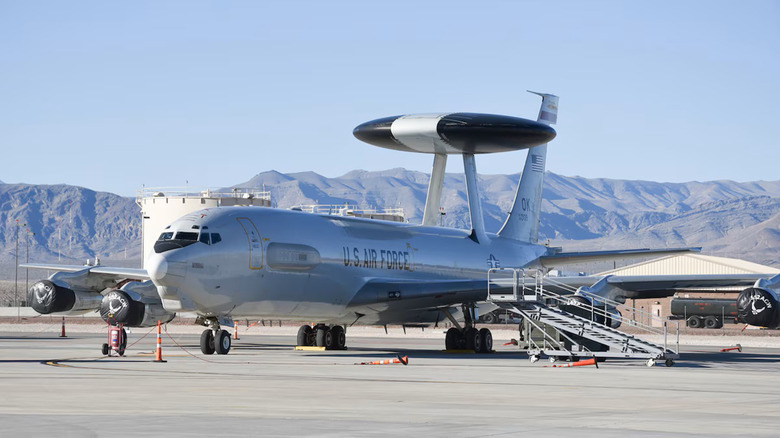
A critical part of the modern battlefield is the radar planes that sit quietly behind the scenes, orchestrating the battlefield and the assets on it. For decades, the US Air Force's E-3 Sentry — or AWACS — has been the mainstay in this role. Unmistakable thanks to its distinctive rotating radar dome mounted above the fuselage, the E-3 acts as an airborne command-and-control center, tracking aircraft and other enemy threats across vast areas while coordinating friendly forces in real time.
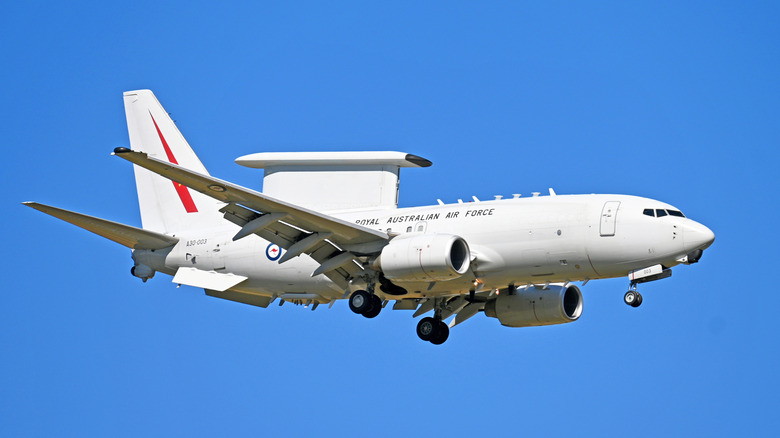
However, the plane — to put it kindly — is creaking with age. The E-3 Sentry is based on a modified version of a Boeing 707/320 commercial airframe, which dates from the 1950s and the dawn of the commercial jet age. And although the last commercial 707 was built in 1978, military airframe production continued until 1992 (interestingly, Japan has four AWACS built on the Boeing 767 airframe). Given its importance and its age, it shouldn't be a surprise to discover that the E-3 Sentry is due to be retired by 2035. The good news is that there's a ready-made replacement in the form of the E-7 Wedgetail. The E-7 is a somewhat strange looking 737 variant that's already in service, with four air forces currently operating the plane, including the UK and Australia.
The bad news is that America is very much having an on/off relationship with the E-7, with the Department of Defense attempting to cancel all US E-7 orders in June 2025, before the effort was blocked by Congress in the recently passed National Defence Authorization Act (NDAA).
The on/off/on plan to replace AWACS
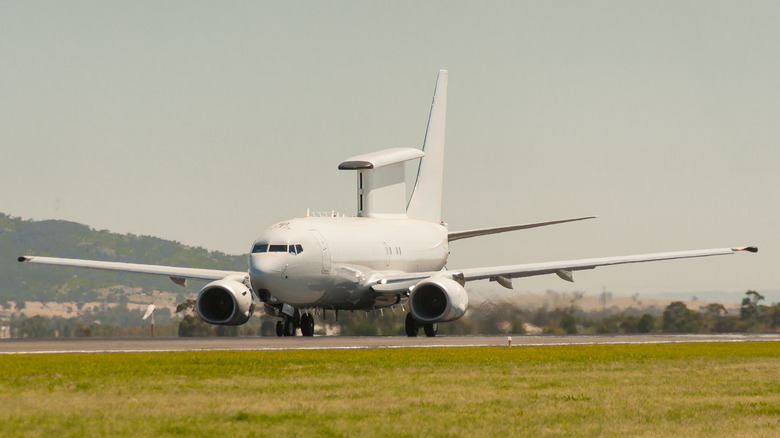
On the face of it, replacing the aging E-3 Sentry looked relatively straightforward. The US Air Force selected the Boeing E-7 Wedgetail as its successor. As noted, this is an aircraft that's already in service with several allied air forces and has proven itself to be effective. The E-7 promised a more modern platform with greater reliability, easier maintenance, and a significantly smaller logistical footprint than the E-3's decades-old design. It also boasts a Northrop Grumman Multi-role Electronically Scanned Array (MESA) radar. This represented a major leap forward, as it offered 360-degree coverage without the requirement for a rotating dome.
The initial Department of Defense decision to cancel the plane was put down to cost overruns, but survivability concerns were also cited. The thinking was that the Navy's less-capable E-2D Advanced Hawkeye plane, a carrier-capable jet that performs a similar role, could act as a replacement, with the ultimate aim of using space-based satellite systems for battle management. However, there were enough red flags in the plan that a letter signed by Air Force leaders, including 16 former four-star generals amongst others, implored Congress to act. Among the concerns raised in the letter were the key points that the space-based program isn't ready yet, and the E-2D — for all its capabilities — is not as powerful as the existing AWACS.
The points raised seemed to have struck a chord, with Congress authorizing the necessary funds and taking steps to prevent the Air Force from terminating the E-7A prototyping contract.
Why airborne battle management is so hard to replace
If building an effective AWACS system was as simple as slapping a huge radar onto a commercial jet and making sure it could fly, then this debate wouldn't be happening. But these aircraft do far more than just scan the skies. They provide persistent, battlefield-wide coverage while carrying crews who can interpret sensor data, manage complex airspace, and make rapid decisions in real time.
The human-in-the-loop element is critical. Airborne battle management aircraft fuse data from multiple sources, coordinate friendly aircraft, manage refueling tracks, and act as mobile communication hubs linking fighters, bombers, ships, and ground forces. Just as importantly, they can do all this over vast areas and remain on station for hours at a time. These are qualities that are difficult to replicate with a single alternative.
Other systems have their own strengths but also clear limitations. Ground-based radar is constrained by geography and also by the curvature of the Earth. While space-based systems lack the technological maturity to completely fill the role. Even highly capable platforms like the E-2D Advanced Hawkeye are designed for carrier operations, trading endurance and coverage area for survivability and deck compatibility. It's also one of the US military aircraft that still use propellers.
Ultimately, the age of the manned "airborne sentry" may not last much longer. UAVs, increasingly distributed systems, AI-enabled battle management, and satellite technology will likely render such planes obsolete. However, there are enough concerns within military circles that we're not quite there, and America still needs its airborne sky sentries for at least a while yet.