

5 Of The Weirdest Things You'll Find At Denver International Airport
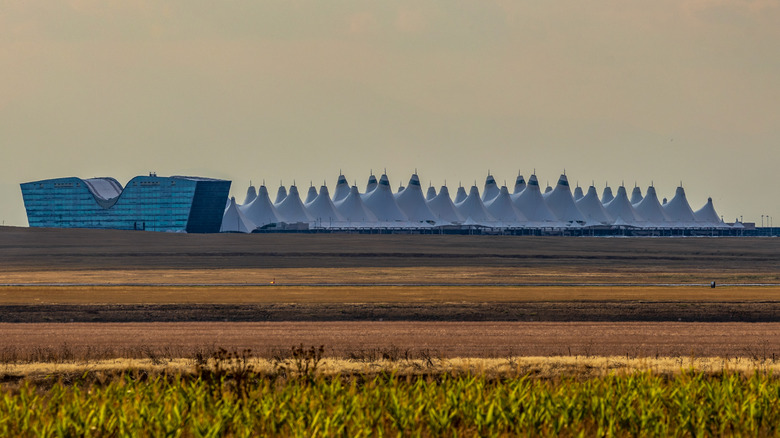
Located about 21 miles east of downtown Denver, Denver International Airport is one of the busiest in the United States. In 2024, Colorado's largest airport saw a record 82.4 million passengers pass through its gates for family outings, ski trips in the Rockies, or an Avalanche game downtown. While that may seem surprising when considering larger cities in the country, seat capacity counts made Denver International Airport (DEN, formerly DIA) the sixth-busiest airport in the world, and it currently ranks as the fourth-busiest in the U.S., beaten only by Dallas Fort Worth, Chicago O'Hare, and reigning champ Atlanta Hartsfield-Jackson.
For sheer property size, however, Denver's airport is untouchable — in fact, Denver International Airport's massive 53-square-mile footprint is larger than the three busier airports in the U.S. combined, plus that of Los Angeles International Airport. One major benefit of building the airport outside the city is its ability to expand, while public transit and multiple highway routes make airport access reasonably easy for locals and visitors alike. Denver's airport is also home to one of the longest runways in the world.
One of the first things you'll notice when flying into the airport is Jeppesen Terminal's unique design, meant to evoke both the mountains Colorado is famous for and the teepees of Indigenous peoples of the region. The large white peaks covering the airport are the first of many unique, fascinating, and downright weird things you'll find when traveling through Denver International Airport.
A giant moustache
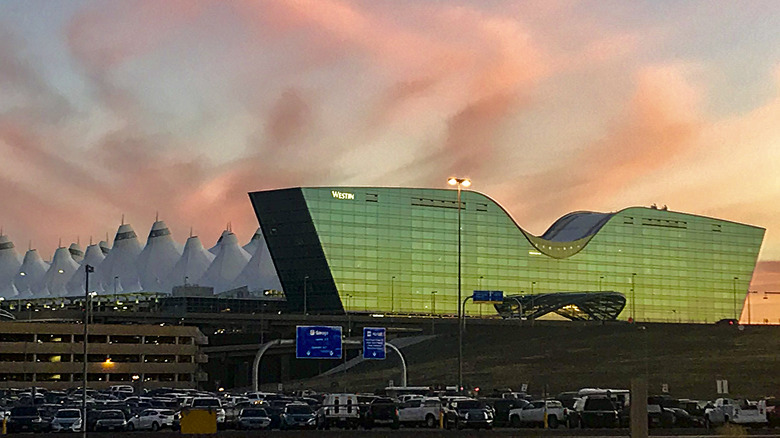
When taking the long trip east toward Denver International Airport via Peña Boulevard, one of the landmarks you'll pass is the Westin Hotel at Denver International Airport. The hotel opened in 2015, nearly 20 years after the airport itself, and it is a striking piece of architecture that was designed to bring to mind a bird in flight. Colorado residents have claimed to see several other shapes in the design, including a half-pipe, a whale's tail, a bow tie, and even a pirate ship. Our personal favorite description, however, is the giant moustache.
That's not to say that the Westin Denver International Airport Hotel is anything but a top-notch place to stay, despite its controversial design. The hotel, which is attached to the airport's main terminal and accessible via a short walk, features easy transportation to downtown Denver via the city's light rail system, three restaurants, and stunning displays of artwork from local Colorado artists. And you won't even notice that you're sleeping in the metaphorical "fur" of a gigantic bit of facial hair from the inside. If you've already saved some money by booking a cheap flight online, why not spend it on a luxury stay?
A pair of gargoyles
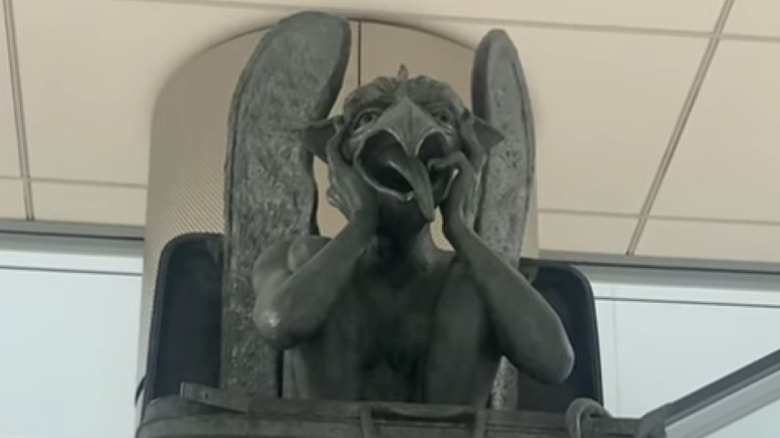
Denver International Airport houses several permanent and temporary art installations and exhibits. One of the smallest and often overlooked pieces of artwork is a couple of gargoyles perched above the east and west baggage claim areas. The gargoyles are seated inside suitcases and reside on columns overlooking the recently remodeled east and west baggage areas to help ensure that travelers' suitcases arrive safely. They are made of cast bronze and were created by Terry Allen, and the pair is collectively titled "Notre Denver."
Historically, gargoyles were often used to protect buildings both literally and figuratively. The famous statues on Paris's Notre Dame cathedral serve as rain management systems and represent the concept of evil while warding off darker spirits. And yes, for the pedantic reader, technically non-rain-rerouting gargoyles are called grotesques ... but good luck getting anyone to go along with that.
A third gargoyle named Greg was added to the roster for a few years during DIA's major remodeling project. This talking, animatronic character interacted with travelers and referenced some of the more outlandish conspiracy theories about the airport, and quickly became a hit among travelers and airport employees alike. Unfortunately, Greg may have fallen victim to the very conspiracies he sought to uncover, as he's nowhere to be found in the airport these days, leaving only the two silent guardians to protect travelers and their belongings — the airport's official Facebook page claims he was created as an April Fool's Day joke.
A killer statue
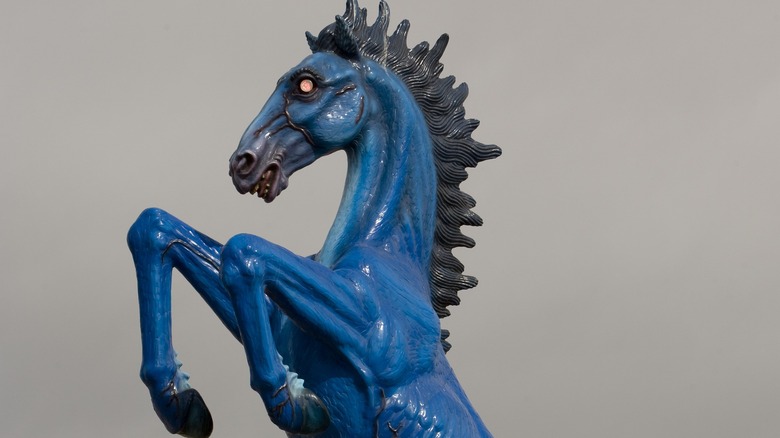
"Mustang" is one of the most notable art installations in or around Denver International Airport, and it's arguably the most famous — or infamous, depending on who you talk to. The 32-foot-tall statue is a muscular blue horse with a flowing mane, posed rearing up on its hind legs. Located just off a curve on Peña Boulevard, the piece is beautiful in the daylight but really earns its reputation the first time you see it after dark while driving away from the airport.
In a tribute to his father, who ran a neon sign shop, artist Luis Jiménez installed bright red LED lights in the statue's eyes, which glow menacingly in the darkness. The horse itself, a grotesque presence in its own right, is known as "Blucifer" among locals for its impressive and terrifying presence.
Oh, and lest we forget, there's an incredibly dark backstory to this statue. Jiménez himself was killed by his own artwork in 2006 when a part came loose in his studio during the piece's construction, fell on the artist, and severed an artery in his leg. Jiménez's studio completed the work after the artist's passing, and "Mustang" was officially unveiled to the public in February 2008, over 15 years after the statue was commissioned.
A series of mysterious tunnels
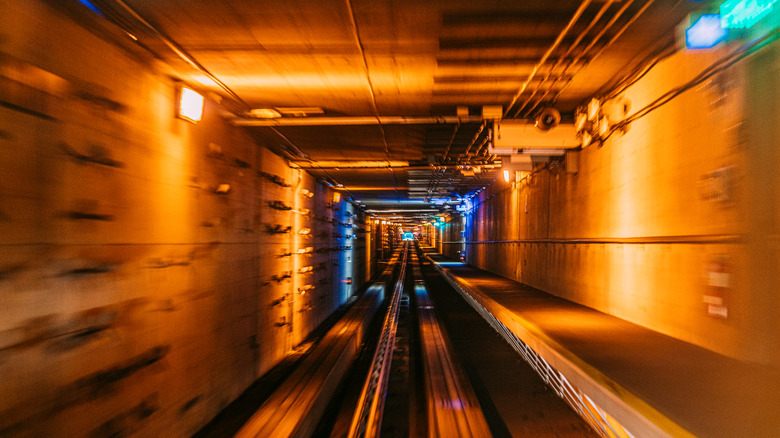
Most airports have some kind of transportation system to get travelers from the main terminal to various concourses — O'Hare's people mover is similar to Chicago's L train system, and Orlando's transit system brings Walt Disney World's monorails to mind. Denver International Airport is no different, providing train service between its Jeppesen Terminal and three main gates. But while those other airport transit systems are built above ground, Colorado's uses a system of underground tunnels to shuttle passengers from the terminal to its gates.
There are some outlandish local legends about those tunnels, with some folks claiming that there are secret buildings and bunkers below the airport, intended to allow secret societies like the Freemasons to take shelter in the event of an apocalypse. Those rumors have circulated ever since the airport was built in 1995, with "clues" like a dedication marker bearing the name New World Airport Commission and Freemason symbols adorning the airport's time capsule.
Other theories include the existence of lizard people and a hundred-mile tunnel that runs directly from Denver International Airport to NORAD in Colorado Springs. Those theories were embraced by the airport during recent construction, with signage making references to lizard people and the Illuminati. Unfortunately for conspiracy theorists, most evidence suggests the trains and tunnels are just handy people movers with some cool propellers lining the tunnel walls.
Unsettling artwork
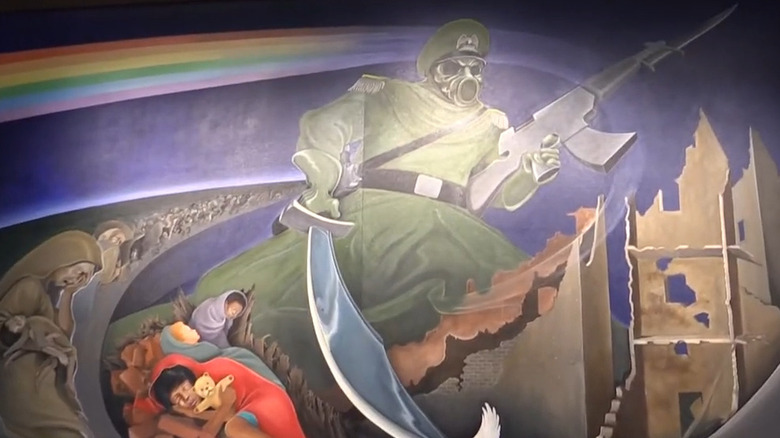
"Notre Denver" and "Mustang" are just two of several pieces of art on display in and around Denver International Airport. Some, like "Experimental Aviation," are brightly colored, whimsical, and full of hope. Others, like the murals titled "In Peace and Harmony with Nature" and "Children of the World Dream of Peace," are less so, with half of each large mural full of fire, despair, and the dead bodies of animals and people.
The artist of those pieces, Leo Tanguma, has stated that his DIA works are meant to show disturbing images coupled with more hopeful ones, with themes of human liberation and dignity appearing throughout the two-part pieces in the airport's throughways. But many travelers — often seeing only the creepier aspects of the paintings while walking to baggage claim areas — have complained about the frightening nature of the artwork. Petitions and websites have even been established to push Denver International Airport to remove the artwork permanently.
These murals are temporarily in storage because of DIA's Great Hall construction project, but they are scheduled to go back on display soon, terrifying and confusing unsuspecting travelers once again.