

Is It Legal To Pass On The Right In Florida? Here's What The Law Says
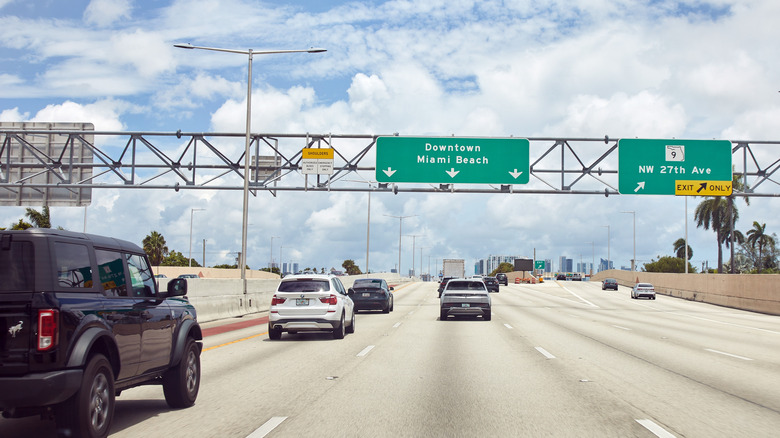
Florida is a state filled with beaches, sunshine, and a host of zany auto regulations, including weird stipulations wrapped around license plates and frames. To be fair, the other 49 states are not immune to bizarre driving rules, like a Nevada law that says you can't take a camel on the freeway or a rule in Arkansas that says you can't honk your horn after 9:00 pm near any place serving sandwiches. Weird, right?
All 50 states also have some kind of "keep right" law requiring drivers to pass another vehicle on the left, then return to the right lane to preserve a clear, viable passing lane at all times. But what about passing a car on the right side instead of the left? As it turns out, that's not as clearly defined. However, in the Sunshine State, passing on the right is legal only under very specific conditions as laid out in Florida statute 316.084.
Overtaking and passing on the right is permitted in the following scenarios: 1) the vehicle you're passing is making a left turn, 2) the street or highway you're traveling along has multiple lanes of traffic that are not blocked or occupied by parked vehicles, or 3) you happen to be on a one-way street or other thoroughfare restricted to one direction of movement and has two or more lanes of moving traffic. Clear as a dirty windshield with bad wipers, right? And here's another caveat — it can't be done if it's not "safe" to do so, which at best is an ambiguous term not worth gambling on.
Passing on the right could be risky

In Florida (and every other U.S. state), it's illegal to use the shoulder or leave the paved, main-traveled portion of the road to pass another vehicle because most states consider it an emergency-only zone to be used exclusively for first responder vehicles. It's also where pedestrians and bicyclists are likely to be, especially when no sidewalk or bike lane is available. Using the shoulder solely as a means to pass traffic is dangerous and unsafe, which might lead to significant injuries or fatalities. As such, the Sunshine State considers passing a vehicle on the right (when it's not safe to do so) a noncriminal traffic infraction and is punishable as a moving violation.
The U.S. isn't the only country that looks down on this practice. Many countries in the European Union (EU) have made it illegal to pass on the right, while others strongly discourage it. Obviously, countries like Britain, where they drive on the opposite side of the road, don't adhere to this law. Germany strictly forbids it and only has 4.2 traffic-related deaths per 621 million miles traveled, while the U.S. sits at nearly double that at 8.3 deaths for the same amount of miles traveled. Granted, Germany has about 1/4 the population of the U.S. (roughly 84 million compared to 343 million).
Florida statute 316.081 outlines the state's "keep right" law, which makes lingering in the left lane on a multi-lane highway an easy way to get a ticket. Violating this law, except to pass, move around obstructions, or while on one-way streets, is also considered a moving violation.