

New Road Stripes Are Confusing Drivers – But They Serve An Important Purpose
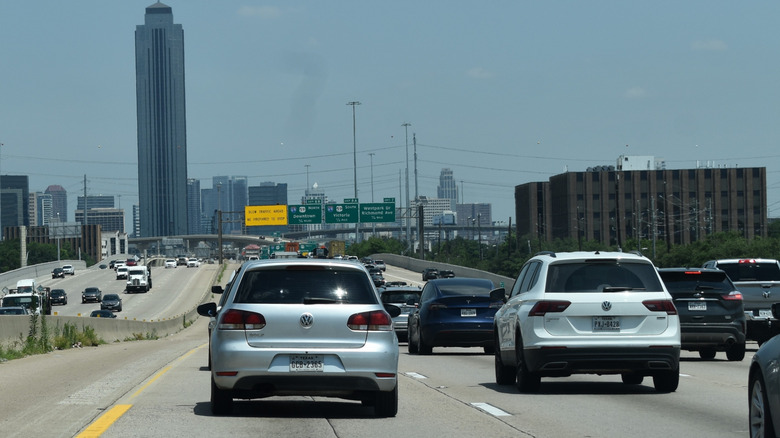
They say everything is bigger in Texas, and that seems to include the state's highways as well. Cities like Dallas and Houston aren't just known for having some of the widest highways anywhere in the world, but also some of the tallest highway overpasses as well. And with the massive scale of these highways and the high amounts of traffic that use them, you'll also find some innovative and forward-thinking solutions for traffic flow and safety as well.
The latest solution, though, has been confusing some drivers on Houston area highway connectors with its striking nature. But once you realize the purpose and how it works, it's a surprisingly simple idea that could have a big payoff when it comes to reducing accidents. While they can almost look like the decorative adornments that you sometimes see alongside freeways, that's not their purpose. What drivers are actually seeing are new reflective road stripes mounted on the side of highway barriers to make them stand out better at night and during poor weather. The hope is that making the barriers more visible to motorists will decrease accidents involving drivers misjudging their speed in curves, particularly those who aren't familiar with the busy and twisting connector layouts you find around the Houston area.
A simple but effective highway solution?
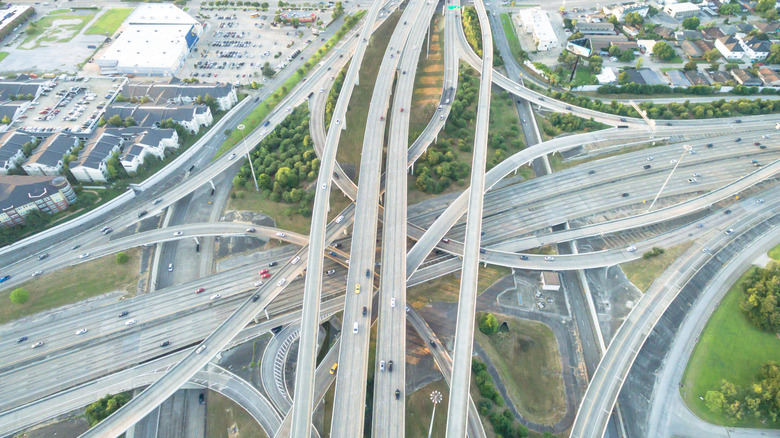
If you've ever driven on a busy freeway, even a relatively straight one, you've probably noticed that concrete barriers alongside the freeway are often covered in rubber marks, paint streaks, and other signs of vehicles hitting them or brushing against them. In Los Angeles, for example, it's not uncommon to see entire bumpers and other car parts lying against the barriers after cars have brushed them.
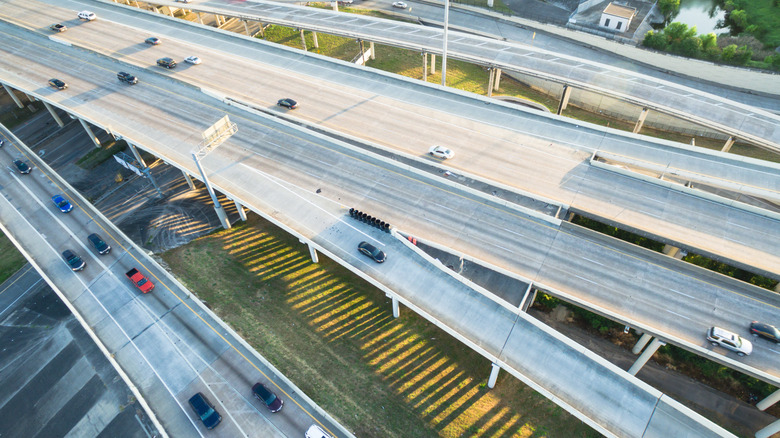
Obviously, the risk of striking the barriers rises when a highway lane or connector curves, so in hopes of reducing accidents, the Texas Department of Transportation has begun installing high-visibility reflective strips on the barriers on connectors around Houston's Loop 610, which encircles the inner parts of the city. The stripes use a special type of paint with glass beads to reflect headlights and give drivers a stronger visual point of reference when navigating the connectors.
The barrier lines serve the same purpose as the lines already in the road; it's just that these are mounted higher. And in keeping with the traditions of highway lines, white strips will be used on right side barriers, and yellow strips on left side barriers. Ultimately, the addition of these strips is a relatively minor upgrade to a Houston highway system that will be seeing some major layout changes in the coming decade.
Safety doesn't have to be difficult
Even though many incidents of cars striking the barriers go unreported, road crews regularly notice damage from vehicle impacts. In fact, the number of collision marks was one of the things used to determine which connectors needed the new strips first. TxDOT says it will be monitoring the striped connectors over the next year to see how effective they are at reducing collisions.
While the process began on some of the Loop 610's highest-traveled interchanges, this is just the beginning. There are already plans to expand the striping to more connectors on Texas highways, and, depending on their effectiveness, it's also a technique we could see being picked up by other states and cities across the country. Then again, it's not like barrier markings on highways are a new idea. Tokyo's Shutoko Expressway, for example, uses both red arrows and lights on the barriers of its notoriously sharp curves.
Recent rankings have shown Texas to have some of the safest cities for drivers anywhere in America, with even the large metro areas like Houston and Dallas showing safety improvements. And if these new stripes help prevent accidents in the way that officials and engineers hope they will, we wouldn't be surprised to see Houston ranked even higher next time.