

These Mods Could Make Your Car Too Loud To Be Legal
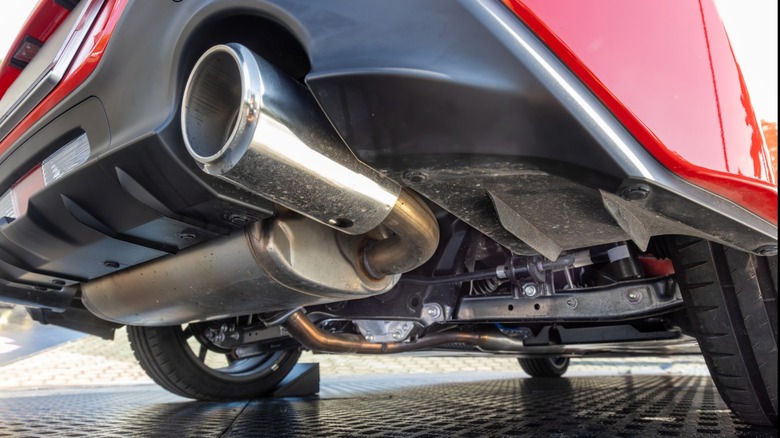
Customizing your car is a great way to make it feel more unique and true to your style. However, factory vehicle design is tightly regulated, and thus many car modifications are not street legal. For example, if you live in one of the very strict states that crack down on window tint, you could get a ticket if your car windows are too dark. It goes beyond that — if you modify your exhaust to make it louder or change your car's emissions profile, you could be violating motor vehicle law as well.
According to World Population Review's 2025 overview of U.S. state exhaust laws, the vast majority of states prohibit mufflers that create "excessive or unusual noise," as well as any mod that increases exhaust volume beyond factory-certified levels. Certain states such as California, Maine, and Montana use a decibel-based scale. Therefore, a modified exhaust louder than 95 dBA is illegal. Most others rely on a broader definition of loudness, without requiring formal decibel-based testing.
In practice, this often boils down to the "discretion" of the police officer, meaning that if they deem your exhaust to be too loud, it can get you into trouble. Granted, the standard is also upheld by many courts through the "reasonable person" principle, meaning an exhaust can be cited if it would unreasonably disturb an average member of the community. For these very reasons, most U.S. states, including Michigan, Maine, Pennsylvania, Nevada, Colorado, Delaware, New Hampshire, and Connecticut, outright ban the use of straight pipes, muffler cutouts, gutted mufflers, and bypass valves.
Banned exhaust mods and state standards

Although most state laws use broad, catch-all language to define illegal modifications, certain mods are mentioned by name. Straight pipes are, as the name might suggest, exhaust system mods that bypass anything that might block, muffle, or quiet engine sound. They get rid of catalytic converters and mufflers, and that makes them not only loud, but also extremely risky from an emissions-compliant perspective.
Muffler cutouts allow the driver to take control over the exhaust flow and volume. When it's open, it's not too dissimilar from a straight piped system, but when it's closed, it is difficult to gauge whether the exhaust is even modified. A bypass valve is similar to a muffler cutout, but is typically more advanced, electronically-controlled, and automatic. Meanwhile, "gutting" the muffler means taking out silencing materials in order to make it louder.
If you plan on doing an exhaust modification that isn't specifically noted as illegal in any of these codes and texts, you are still not in the clear to do so if it's too loud or disturbing. Other modifications such as removing catalytic converters, resonators, or adding performance mufflers can all make your car illegal if it's deemed too loud. If you want a loud but also street-legal vehicle, you do have options; our list of the 10 of the loudest cars ever made is a good, albeit expensive, place to start.
Consequences of illegal exhaust mods

State law varies, and different consequences await those who decide to modify. For example, in Arizona, mods such as these are subject to a civil penalty of at least $100. In New Hampshire, they are classified as civil violations with fines ranging from $100 for the first offense, $250 for a second offense, and $500 for a third offense. New York passed the SLEEP Act in 2021 which takes this to a whole new level — fines up to $1,000 and even possible imprisonment in some cases.
If you were never cited for a loud exhaust in your home state, but you decide to travel to a different state, you can still be held liable in the second state in accordance with officer discretion. Once again, this is because there are no nationwide standards on noise regulation, but rather a patchwork of 50 different state rules. The reality is nuanced and there are no guarantees. Emissions standards are also a big part of why exhaust modifications are often not allowed, and the legal basis for this is federal.
Specifically, under the federal Clean Air Act, tampering with or removing emissions equipment — something tuners often do when modifying the exhaust — is illegal. This very act requires nearly all cars to have a catalytic converter. Removing or bypassing this equipment, as would be required to straight pipe a vehicle, violates both the Clean Air Act and state laws regulating emissions and noise levels.