

China's 'Flying Aircraft Carrier' Just Took To The Skies For The First Time
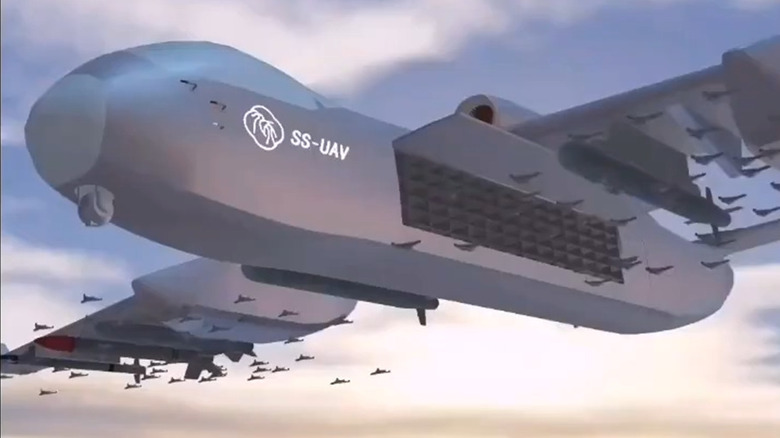
The world's first drone mothership, Jui Tian, took to the skies for its first-ever flight on December 11th, 2025, in the Pucheng region of Shaanxi province in China. The massive remotely piloted jet carries up to 100 drones, which it can launch while airborne to reach faraway targets. Able to take off with a payload over 13,200 pounds and with a wingspan of 82 feet, Chinese military aviation analyst Fu Qianshao noted that it can carry more weapons and equipment than modern fighter jets and bombers. It has designated hardpoints for guided missiles and bombs on top of the 100 drones.
Originally revealed at the Zhuhai Airshow in late 2024, the first flight over a year later carries a lot of possibilities for China's navy. With a focus on long-range ballistic missiles and a fighter fleet with the capabilities to operate deep in the ocean, China is looking for ways to improve the range of its aerial army. The incoming army of drones from multiple directions would prove difficult for the opposition to deal with. For now, however, the Jui Tian may take on a more supportive role within China, like transporting heavy cargo to remote locations and providing emergency support during natural disasters.
China expanding unmanned aerial combat concepts
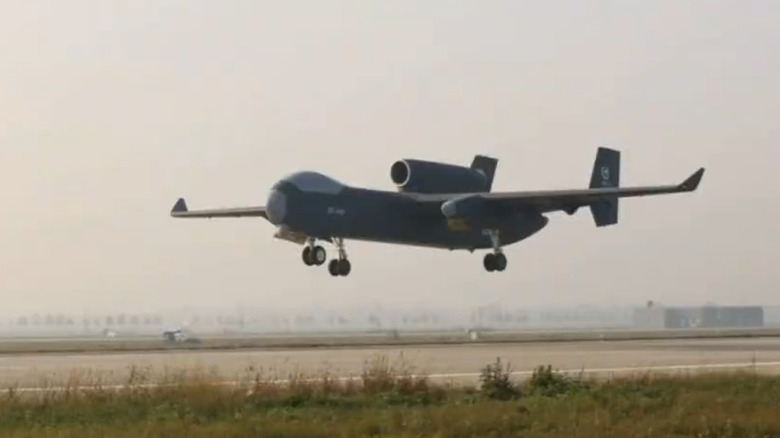
China has recently been expanding the use of unmanned aviation in various branches of the military. The Jui Tian is remotely piloted over a satellite data link, able to deliver drones or other payloads over short distances with a 12-hour endurance. However, China has a lot of long-range unmanned aircraft in testing stages that would further shake up aerial combat and defenses.
Concepts of the GJ-11 Sharp Sword, an unmanned stealth bomber, have been seen since 2018. The goal is for the aircraft to be fully autonomous over time. China has also been testing the CH-7 unmanned high-altitude stealth reconnaissance aircraft for a 2030s arrival, with the goal of supporting operations for both the Chinese People's Liberation Army Navy and the Air Force. Images were revealed earlier in the year of an unmanned range stealth aircraft that appears to be designed for penetration missions by expertly shattering radar signals. And it's not just the air — China recently revealed an unmanned underwater drone system meant to evade sonar detection.