

Why Are Some Ethernet Cables Yellow & What Does The Color Commonly Mean?

Just as an Ethernet port can have differently colored lights, the cables themselves can also come in an array of colors. It's tough to know what the colors mean, especially since it depends on the cable manufacturers themselves. For example, yellow Ethernet cables are often used for power over Ethernet (PoE). This means that the cable can provide power, while also supplying data. Security cameras for your home or garage are examples of devices that would utilize this connection. But yellow is just the color used, and its presence doesn't always guarantee a PoE cable.
The reason yellow appears to be an industry standard is that many manufacturers often use it for PoE connections. However, there isn't a universal guide that must be followed in regard to colors. This means that a yellow Ethernet cable could be PoE, or it could just be a standard data cable. Or perhaps the network installer that chose yellow did so simply because it stands out from the other colors. So if you come across a yellow Ethernet cable, don't assume its function.
The only way to know what the colors of your Ethernet cables represent is to have that specific information. Some companies physically label each cord with an identifier besides color, so that takes the guesswork out of it. Unfortunately, this isn't always the case, so you'll have to find another way to get the information. This means visiting the manufacturer's website for a labeling guide, or contacting the company directly.
Inside Ethernet cables and wiring standards
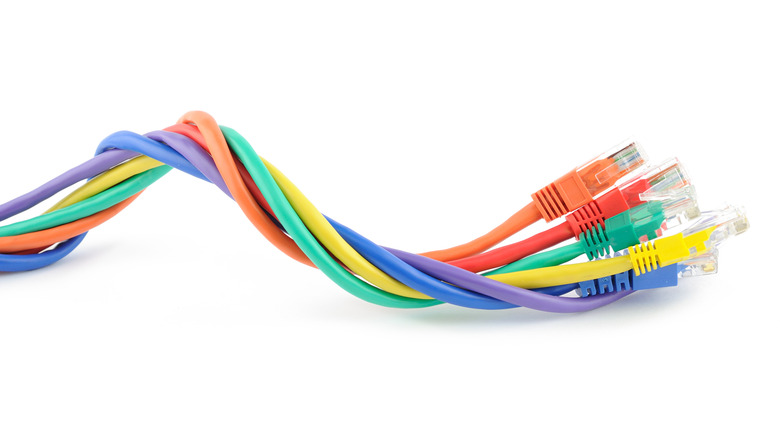
If you're trying to find the best Ethernet cable for gaming, it's important to know that while a universal color code doesn't exist, some companies do follow guidelines set by the Telecommunications Industry Association (TIA). The TIA recommends certain colors for labeling and identifying different components of a telecom system. For example, green is recommended for network connections, blue for horizontal cabling, and orange for connecting to outside services. But these colors are not required and the TIA's guidelines aren't mandated, because they couldn't easily be enforced.
However, the TIA does regulate the color coding of internal wiring in Ethernet cables. This standardizes setups that are followed by organizations across the industry. For example, the four twisted pairs inside the cable are blue, orange, green, and brown. Each pair also has a solid color wire and a white-striped wire. This standardized color combination and arrangement ensures that the wiring works as intended in every configuration, despite what the exterior color happens to be.
The benefit of standardized internal wiring is that troubleshooting, as well as network management, become much easier. Even though technicians can't see the wiring inside the cable, the wires are visible at the connectors, allowing for fast identification. This means those wires can easily be traced and tested, to find any problems that may exist. So even with multiple devices operating on a complex system, the internal wiring is the same every time.