

This Unassuming DC Building Is Powering America's AI Movement
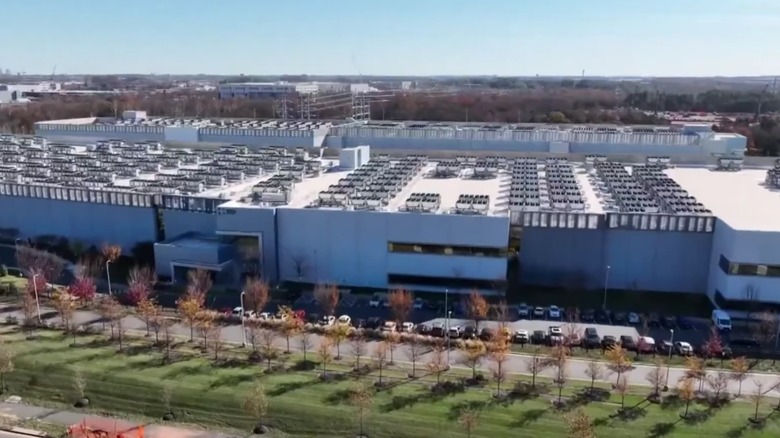
On our daily commutes and regular trips to the grocery store, we often don't take a moment to look at some of the buildings along the way. They just flash past along the side of the road. Usually, they'll be apartment buildings, office blocks, and other everyday sights. One particular building complex in DC (Virginia's Loudon County, to be precise) may not catch the eye as you pass, but the vast complex turns out to be the home of one of the most significant movements in technology today.
It seems to be a habit for some of the most important names in technology to house their headquarters and vital sites in seemingly ordinary buildings. Let's not forget, for instance, that one of the internet's most important websites works out of a former church in San Francisco. Now we have the story of this Virginia landmark, which doesn't look like anything extraordinary but, despite that, contains a lot of the technology required to keep the United States a global powerhouse in the field of AI — and to keep the internet (or much of it) functional.
This is the mighty Digital Realty Innovation Lab, the site of the largest group of data centers anywhere on Earth. In short, it's a real hub for the AI movement, and for the enormous amount of traffic that flows through the Internet's most popular websites every single day. Here's a closer look at this enigmatic facility.
The functions of the so-called 'AI Alley'
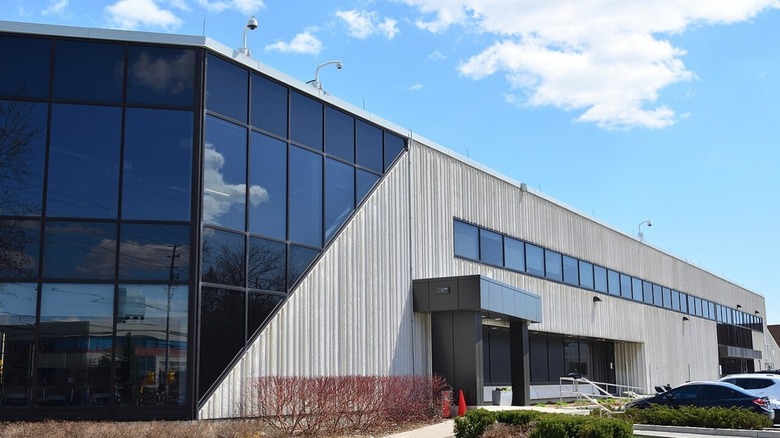
AI and the internet are not incorporeal entities that float around the world in the ether; instead, they demand physical servers, and lots of them. Both can be found in this huge complex referred to as AI Alley. In December 2025, TODAY reported on the absurd scale of this operation, noting that "two-thirds of the world's Internet traffic flows through Loudon County, Virginia." Virginia also, of course, happens to be the state that boasts the most data centers on Earth. The affordability of the land and the available space made this location ideal for the development of AI Alley, although Digital Realty has outposts elsewhere, including facilities such as the one pictured above in Ontario, Canada.
The Virginia complex is the largest in the world, hosting no less than 199 data centers. Its importance isn't without issues, though. This huge conglomeration of data centers is expensive to maintain, with the BBC reporting in October 2025 that AI Alley consumes 40% of the county's budget. The centers are also, as residents suggested to the outlet, discouraging wildlife from settling in the area as a result of the noise they emit and the sheer amount of land they occupy: approximately 485 million square feet. AI Alley also uses an enormous 800 megawatts of power. To put this number into perspective, one megawatt is potentially enough to power more than 600 homes.
The United States' place in the global AI push
The power of AI is undeniable, as is the impact it has had and will continue to have on the development of new technologies. It's a force that nations around the world are looking to harness, and in some key respects, the U.S. is far ahead in doing this. This is partially because its tremendous size (it's the third-largest in the world at 3,809,523 square miles) means that the U.S. has room to develop enormous data centers such as the one in Virginia's Loudon County. Virginia has the most such centers in the nation, at 643, with Texas' 395 a distant second.
The Pew Research Center notes that "a typical AI-focused hyperscaler annually consumes as much electricity as 100,000 households," adding, "the larger ones currently under construction are expected to use 20 times as much." This, in turn, means that facilities will need to be carefully planned, constructed, and maintained to ensure they (and power grids) can perform effectively given such enormous energy needs.
To balance the potential harm of huge energy expenditure in a changing world, though, it's vital to consider the benefits that the growth of these platforms will provide. Their construction not only provides the raw power required to handle enormous amounts of data that AI and the internet use, but also potentially galvanizes the local economy. This is why investment in such technology and the facilities that utilize it is so critical. The United States is far from the only country in the world to covet this technology, either: as of October 2025, Beijing, China, had the second-largest number of data centers globally, with Shanghai also in the top 10.