

Why Did Chevy Switch To A Flat Plane Crank In The Corvette?

Chevy switched to a flat-plane crank in the Corvette Z06 and ZR1 models, both of which are mid-engine, for many good reasons, all of them about improved performance. Flat-plane cranks help generate the maximum amount of power out of the fuel used by the engine, have lower rotational inertia, and weigh less. This makes a flat-plane engine very happy to rev up to much higher RPMs than your typical engine with a conventional cross-plane crank can.
Engines with flat-plane cranks do have the issue of secondary vibrations to deal with, vibrations that get worse with increases in engine speed. The Corvette's flat-plane crank V8 is part of an engine that was a clean-sheet design, unburdened by any previous requirements. What Corvette engineers were able to achieve with their flat-plane engine was a reduction in piston speed, which lessens these secondary vibrations. They did this by increasing the engine's bore and reducing its stroke, making it an oversquare design that slows the pistons to a peak speed at redline that is lower than those of either Porsche's or Ferrari's flat-plane engines. Using lightweight aluminum pistons and titanium connecting rods, combined with a harmonic balancer, lightens and smooths the operation of the engine's reciprocating parts.
The proof is in the performance — the 5.5-liter LT6 engine in the Corvette Z06 produces 670 naturally aspirated horsepower with an 8,600 rpm redline, while the 5.5-liter twin-turbo LT7 puts out a massive 1,064 horsepower with a top speed of 233 mph, making the Corvette ZR1 the fastest car produced by a U.S. manufacturer.
What else should you know about the Corvette's flat-plane crank engines?
Let's explain what a Corvette V8's flat-plane crank is. A flat-plane crankshaft has its 'pins,' or the places where the connecting rods attach, in a single (or flat) plane, making it appear much like a four-cylinder engine's crankshaft. This design provides a firing order in which each bank of the V8 fires alternately, providing benefits in exhaust scavenging, which increases both the efficiency of combustion and the car's performance. It is typically more expensive to create a flat-plane crank engine, another reason why you are unlikely to see such engines in mainstream vehicles in which cost is often an issue.
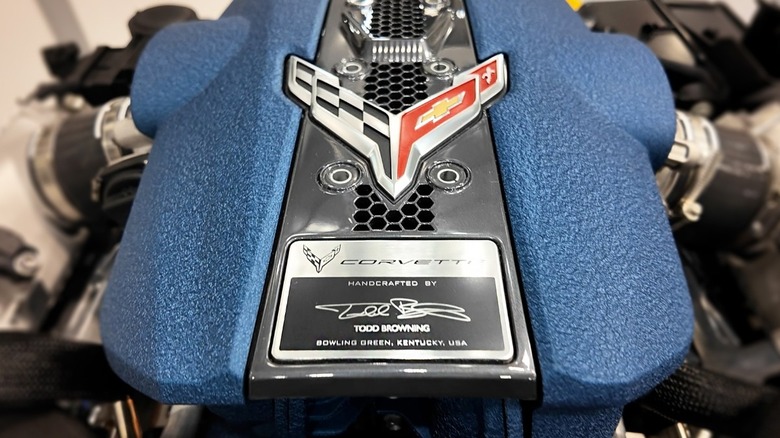
The Corvette's flat-plane V8 engines, as used in the Corvette Z06 and ZR1, are some of the most powerful V8 engines. This is due to its design, which features four valves per cylinder, dual overhead cams, plus variable timing for intake and exhaust. Each Corvette flat-plane crank engine is assembled at GM's Performance Build Center (PBC), which is a 20,000-square-foot area within General Motors' Bowling Green Assembly plant in Kentucky. The PBC is operated by 70 master engine builders, who assemble each of the PBC's low-volume engines by hand, attaching a signature nameplate like the one above upon completion.
You can also hear the difference that a flat-plane crank makes in the way that a car with such an engine sounds. Listen for things like quicker revving to higher RPMs than a conventional engine can, along with super-fast downshifts, slower upshifts, and a higher-pitched whining sound.
What's coming next for Corvette flat-plane crank engines?

The next chapter of Corvette flat-plane crank history has already been revealed at Monterey Car Week, held in August of 2025, and according to Chevrolet, "will be available by the end of 2025." We are referring to the Corvette ZR1X, which combines the 1,064-horsepower, twin-turbo, flat-plane crank engine of the Corvette ZR1 with an uprated electric-powered front axle that was based on the unit used in the current Corvette E-Ray. The 2026 Corvette ZR1X hypercar's total system horsepower is 1,250, calculated by adding the combustion engine's 1,064 hp to the e-axle's 186 horsepower, providing all-wheel drive traction. This gives the Corvette ZR1X the ability to accelerate from zero to 60 mph in under two seconds, with a top track speed of 233 mph, identical to the Corvette ZR1.
While the base price of the Corvette ZR1X has been announced as $207,395 MSRP including shipping for the 1LZ coupe and $217,395 MSRP for the 1LZ Convertible, Chevrolet also announced a special "exclusive, limited production Quail Silver Limited Edition package" aimed at collectors, shown above. This will be available only on the 3LZ Convertible and will have a $241,395 MSRP. The Quail Silver Limited Edition features the first factory matte-finish Corvette exterior paint in 60 years, based on the classic Inca Silver available on the 1957-59 C1 Corvette. Other standard equipment includes a new interior color palette in Sky Cool and Medium Ash Gray with Habanero accents, as well as carbon flash mirrors, black exhaust tips, and brake calipers painted orange.