

Can You Ride An E-Bike On The Sidewalk? Here's What Florida Law Says
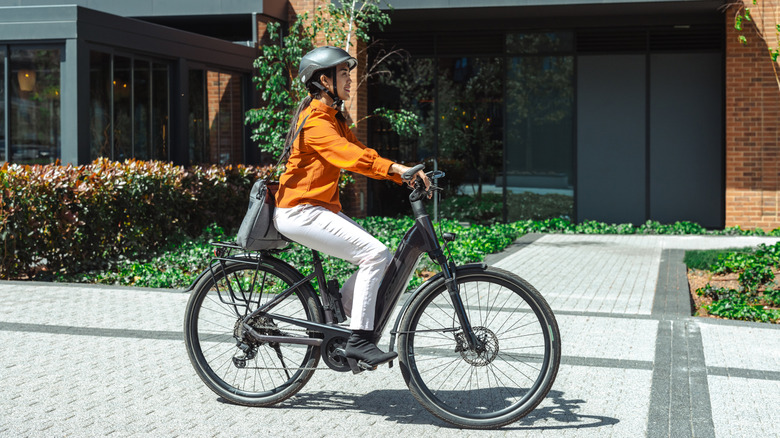
Florida Statute §316.20655 defines an electric bicycle as a vehicle, just as it does a bicycle, and thus the driver of said e-bike has all the same rights and privileges afforded to a rider of a regular pedal-powered bike. It also clearly states that e-bikes can be ridden in the same places as regular bikes, including highways, shoulders, streets, roadways, bike lanes, and multi-use paths.
In Florida, electric bicycles are those equipped with fully operable pedals, a seat (or saddle), and are powered by an electric motor with less than 750 watts. The three classifications of e-bikes each come with some rather tricky wording that determines which class they're lumped into. The motors allowed in Class 1 and 3 e-bikes provide assistance only while the rider is pedaling and stop working once they reach a certain speed. The motor on a Class 1 bike stops at 20 mph, while the motor on a Class 3 bike ceases operation at 28 mph. Class 2 bikes have a motor that powers the bike exclusively (sans pedals) and stops when it hits 20 mph.
So, can e-bikes be ridden on the sidewalk? We know in California (and 10 other states), it's a big no-no, but in Florida, it's okay as long as the local ordinance allows it. See, every county and municipality in the state has the authority to enact its own ordinances regulating when and where vehicles like golf carts, mopeds, motorized scooters, and electric bicycles can roll down the sidewalk (or other areas). The only restriction is that these modes of transportation can't exceed 15 mph while doing so.
Just because you can doesn't mean you should
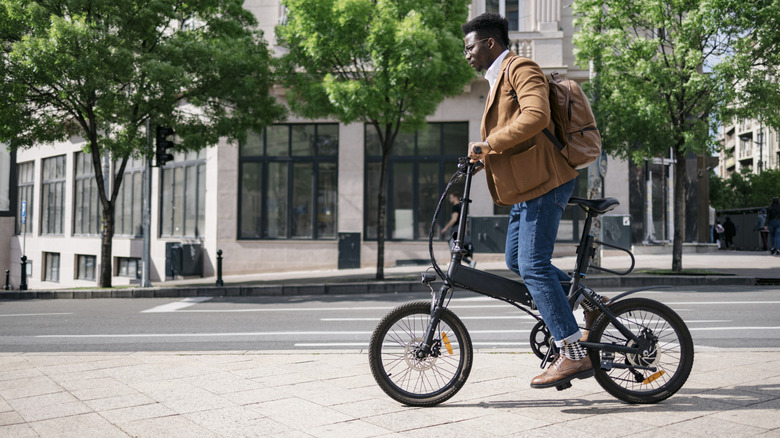
While it's all well and good to go about your merry way on the sidewalk, doing so does come with some risks. After all, these walking areas along the side of the road are meant for pedestrians who will always have the ultimate right of way. Not only must bicycle riders (of both the electric and non-electric persuasion) always yield the right of way to pedestrians while riding on them, but they must also give an audible warning that alerts the pedestrian they're rolling up behind them.
According to legal experts, riders should maintain a slow and steady speed so they can stop at any given moment, and keep their head on a swivel. Riders who pay attention to their surroundings at all times will help avoid running into pedestrians, baby strollers, or pets. Speaking of heads, kids under 16 in Florida must always wear a helmet while riding an e-bike. Adults should avoid drinking and driving an e-bike, as they can still get a DUI.
This defensive approach to riding can be difficult, especially on crowded sidewalks, so if a bike lane is available, it's best to ride in it instead. If there isn't a bike lane, riding in the road might be a better option because any collisions that might occur while riding on a sidewalk will, in all likelihood, be the fault of the e-bike rider. Ultimately, however, the responsibility will depend on whatever local ordinances are in place and how the rider was acting at the time of the accident.