

Do Speed Humps Really Slow Down Drivers? Here's What The Data Says
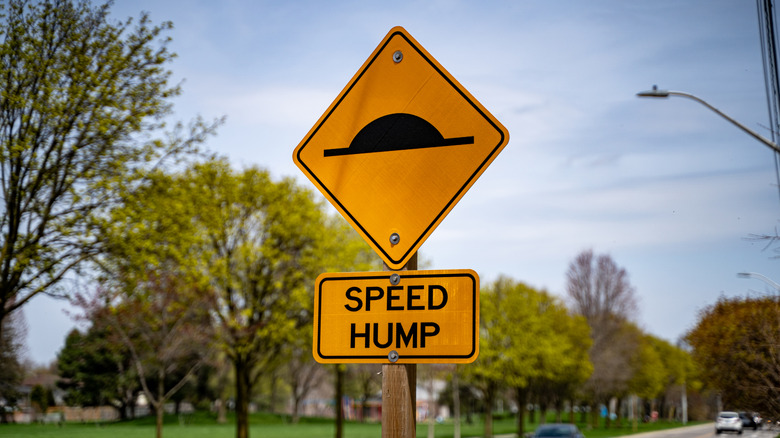
Carmakers and regulators have trialled a huge variety of ways to improve road safety over the decades, from the bizarre pedestrian scoop of the 1930s to the automatic emergency braking systems available on today's cars. As well as building cars with more safety features, authorities across the U.S. and beyond have implemented various design changes to roads in a bid to make them safer for all kinds of users, with speed humps being a common tactic.
The Department of Transport defines a speed hump as a "rounded, raised area placed across the roadway [which is] typically 12 to 14 feet long." They're distinct from speed cushions, which are smaller raised areas placed in the center of a lane that can be straddled by drivers who line up their vehicles correctly. They also shouldn't be confused with speed tables, which feature a longer flat section with a ramp at each end.
Speed humps are designed to reduce the speed of the vehicles crossing over them, and studies cited by the Department of Transport show that they do mostly work as intended. The department points to seven different studies published between 1999 and 2005 that each show a meaningful drop in the speed of the fastest drivers once speed humps were installed in a road. However, one of those studies suggested that the average speed of drivers might not decrease, even if the fastest drivers did slow down. It showed a small increase of 1 mph in cars' average speed after the humps were installed.
Humps, tables, and cushions
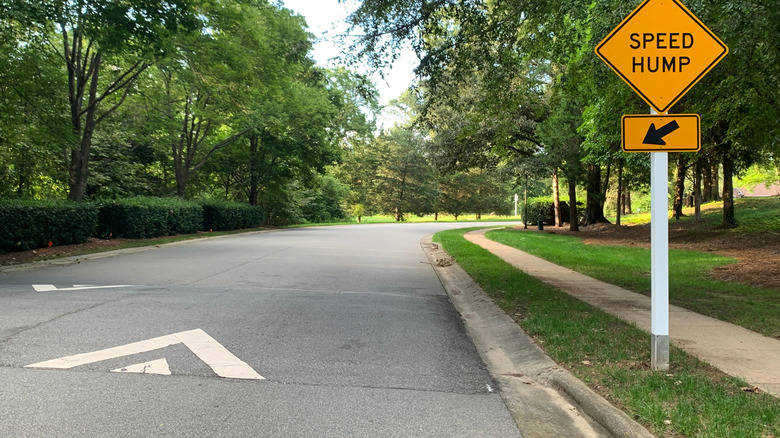
A recent review published in the Transportation Research Interdisciplinary Perspectives journal backed up the DOT's findings and also provided additional insight on how different types of speed calming measures affected drivers. The authors analyzed 52 different studies where speed humps, tables, and cushions of various kinds — referred to in the study as raised safety platforms, or RSPs — were installed on roads around the globe. They found that they did indeed slow drivers down overall, but that the size, shape, and location of the RSPs made a big difference to their effectiveness.
According to the review, the higher the height of the RSP, the more it slowed drivers down. However, placing them too close together had a negative effect on the flow of traffic on the road, and could also be uncomfortable for drivers. The slope of the ramp also affected driver behavior, with one of the cited studies showing an increase in unpredictable driving by cautious drivers if the slope of the ramp was too steep.
Making the ramps of speed humps and tables more gradual helped maintain a smoother-flowing road, but equally, it produced less of a reduction in average speeds. Several American cities are currently trialing longer, less abrupt speed tables rather than humps, with Cincinnati recently installing them in a bid to crack down on fast drivers.
Humps are more effective for certain types of vehicles
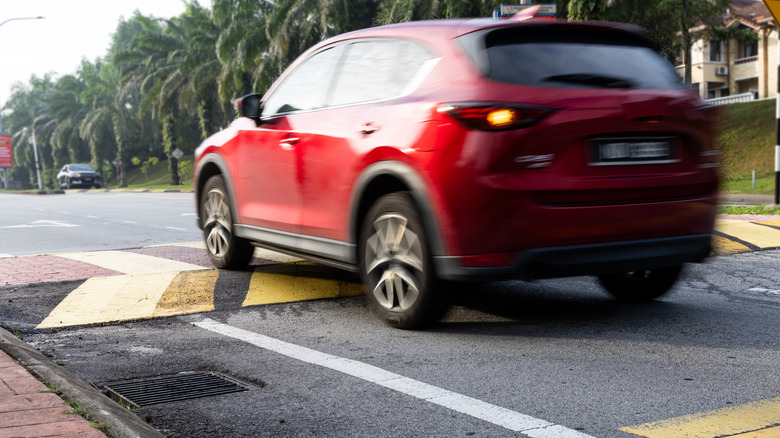
Another notable finding from the review was that humps, tables, and cushions slow certain types of vehicles down more than others. On average, buses showed the largest reduction in speed after these safety measures were installed in roads. On the other end of the spectrum, motorcycles were the least likely to slow down significantly. Implementing RSPs also led to several negative effects, with roads that carried high volumes of heavy vehicles seeing notable increases in road noise due to the braking and acceleration needed to get over the humps. Emergency vehicle response times were also slightly delayed by their presence.
They're not an ideal solution, but RSPs such as speed humps can consistently help reduce the speed that drivers travel down a road. Lower speeds might be an inconvenience to drivers in a rush, but they can help reduce the likelihood of serious injury if a pedestrian or cyclist collides with a vehicle. The U.S. government recently announced delays to its pedestrian safety program in response to pressure from carmakers, which makes RSPs like speed humps all the more important in helping to reduce injuries and fatalities caused by speeding drivers.