

Don't Get Trapped Out: Here's What To Do About A Frozen Car Lock
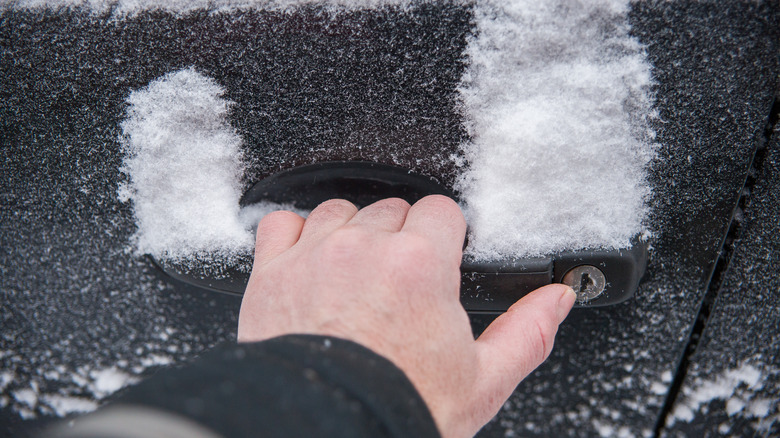
Winter conditions can cause all kinds of problems for travelers. Slippery roads and sidewalks are enormous hazards for drivers and pedestrians alike, and all too often, our cars struggle rather more in cold conditions more broadly. Letting your car warm up before driving during the winter just slightly during the winter is a critical practice.
Before getting to that point, however, there's another important danger posed by the weather, a frozen door lock. Even a tiny amount of innocuous ice can pose a huge threat if it prevents you from unlocking your car. Those who live in cold regions are probably familiar with the need to tackle this issue frequently, and the good news is that it's far from a rare occurrence.
Because of this, auto makers have developed some rather brilliant ways to circumvent this issue. Some BMW models, such as the E28 5 Series and E32 7 Series, had a very special feature: On the driver's side, the cylinders for the door locks were heated via a circuit on a delay activated by the handle.
As cars have evolved, though, manufacturers have begun adopting other solutions. Just as remote start is an invaluable feature to have during the coldest mornings, remote keyless entry is a real boon too. Though these systems are common, they're not ubiquitous, which is why it's important to know what you can do to defrost the locks on your car. From de-icer to hair dryers, here are some ways regain access to your car, and some potential methods to prevent freezing.
If you have dedicated ice-tackling products to hand

Those who live in cold climates will probably be familiar with the winter season's impact on drivers and their vehicles. As such, there are some garage essentials that they'll probably have in their box of tricks, such as the common de-icer. It can be very effective if used on the door lock itself, but it's important to do so gently and allow the product to work.
Sometimes, though, one of these unfortunate incidents can happen when you don't have your de-icer to hand. In instances like that, you can improvise. One suggestion from Terry Whin-Yates of the Mr. Locksmith is the simplest and least demanding of all: Simply use your own body heat. As Whin-Yates puts it, "if you have absolutely nothing, heat it with your hand... it takes a long time," he concedes, but if absolutely everything fails, holding your key can warm it to the point that it will be able to turn the lock.
Hopefully, though, this will only happen to your car when you're close enough to other options that can help with unfreezing that lock. A hairdryer, Whin -Yates adds, is very helpful in that it doesn't risk damaging anything on the exterior of the car. It's also possible that that the edges of your door may have frozen rather than the lock itself. In this situation, a hair dryer is an excellent way of resolving the issue with the use of directed heat. A very different type of tool, but with a similar effect.
Tackling the problem before it develops further

As we've seen, then, it's not strictly necessary to use specialized equipment to remove ice or other obstructions from a frozen keyhole. It's best to know a range of solutions, but especially ones that you can perform wherever you are without needing any products, because you can never quite be sure when one of the locks on your car door will freeze.
Of course, boiling water is often regarded as something of an arch-enemy of snow and ice, but there's one primary reason why you should never use it. Boiling water does not remain as such for long, and it's a very dangerous substance to work with. "Boiling water is the worst thing you could do," notes third-generation locksmith Terry Whin-Yates of the Mr. Locksmith YouTube channel. "Nowadays, a lot of cars, they have a lot of plastic parts inside. Soft rubber. You could wreck the seals ... a lot of electronics hanging off the back of the lock cylinder." There's a correct way to defrost your windshield, too.
There are other, more reliable ways to pre-treat your door locks against winter ice. One fascinating example is the magnet trick, which involves a small magnet positioned over the lock while your vehicle isn't in use, which seals and protects the lock. Should these methods not be successful, speak to your mechanic. It's a delicate matter, and though there's no doubt it's frustrating to be unable to resolve the issue, frozen locks are easily damaged, as are keys that are thrust haphazardly into them. A potentially easy fix for a professional can quickly become an expensive repair if drivers aren't careful.