

5 Modern Marvels Built By Samsung Heavy Industries
Think Samsung. Chances are a high-end Android phone like the Samsung Galaxy Z Fold 7, or a glimmering ultra-thin television spring to mind immediately. What probably doesn't spring to mind is an ultra-large liquid natural gas (LNG) carrier. However, as is the way with many Korean companies, Samsung likes to spread its wings far and wide. Although Samsung Heavy Industries (SHI) is not strictly the same company as Samsung Electronics, they're both part of the massive South Korean conglomerate, the Samsung Group.
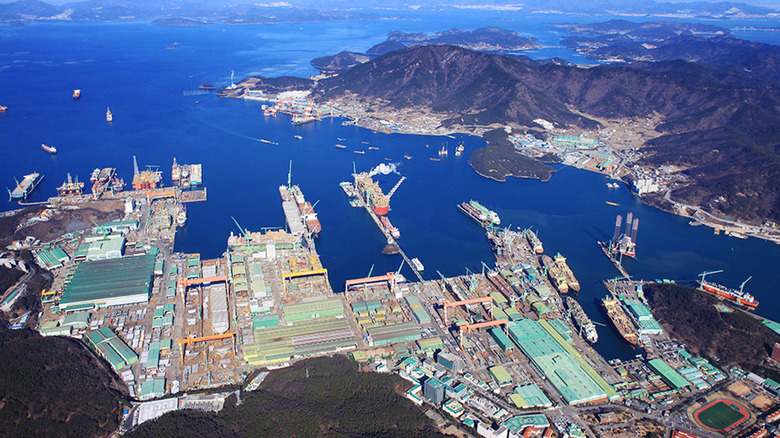
However, let's put the delicate electronics aside and focus on what the heavy engineering side of the Samsung Group produces. The company was founded in 1974 and is based in Geoje, South Korea. Its main expertise is in shipbuilding and offshore engineering, with its Geoje shipyard boasting the world's best "dock turnover rate" of 10. Basically, this means that the same dry dock can be used to build and launch ten complete ships per year.
In total, the shipyard typically launches thirty ships each year. This in itself makes the shipyard worthy of a place on our list of modern marvels built by SHI, but a better way to appreciate the capabilities of this yard is to look at some of the engineering heavyweights that it has produced. From one of the world's largest floating production, storage, and offloading vessels (FPSO) to massive LNG carriers that rank among the most complex ships ever built, these are some of the most impressive modern marvels to leave SHI's docks.
Egina FPSO

Nigeria is one of the world's biggest oil producers; in 2023, it exported $43.5 billion worth of oil. The Egina FPSO vessel currently plays a large part in keeping this river of black gold flowing. Indeed, the vessel produces nearly 10% of Nigeria's total production.
In terms of oil production, an FPSO can be thought of as an industry multi-tool. Operating in water depths of between approximately 4,600 and 5,600 feet, the Egina functions as an all-in-one floating oil production facility, processing plant, storage unit, and export terminal. It can store approximately 2.3 million barrels of oil and has a production capacity of 200,000 barrels per day, and perhaps more incredibly, it is simultaneously connected to 44 subsea wells.
Of course, with statistics like that, it won't be a surprise to discover that this is hardly modest in scale. The vessel weighs around 242,508 tons (220,000 metric tons), with the topside modules alone boasting a gross dry weight of 52,360 tons. The vessel's length is comparable to US Navy aircraft carriers, with its 1,083 feet length coming in just a few feet shy of the world's largest aircraft carrier – the USS Gerald R. Ford — although it does come in slightly wider, with a breadth of 197 feet.
Finally, it's worth noting that although much of the construction work was carried out at SHI's Geoje facility, six of the 18 modules were constructed in a shipyard in Nigeria, representing the first time such a complex project was undertaken in Africa.
Prelude FLNG
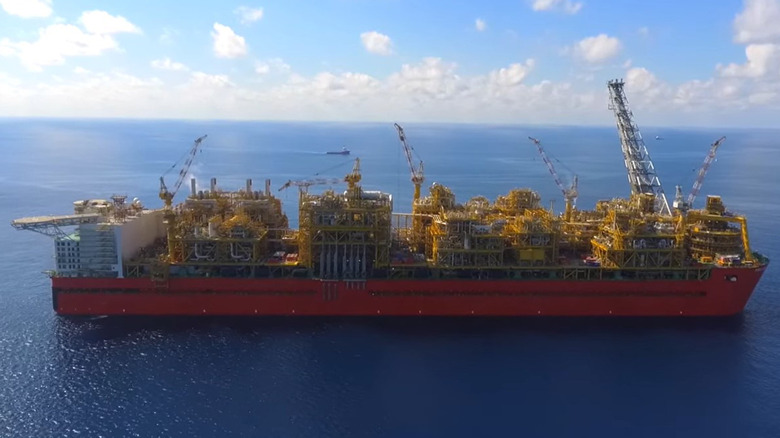
The awe-inspiring scale of ships like aircraft carriers or cruise ships is breathtaking, but there is one floating structure that dwarves these behemoths — the Prelude floating liquid natural gas (FLNG) platform. When it was launched in 2013, it was the largest floating facility ever built, a record it still holds to this day. Now, if you're not already sitting down, it might be an idea to do so now, because the size of this thing is truly staggering — the Prelude LNG is 1,601 feet long, 243 feet wide, and displaces over 660,000 tons. For comparison, the USS Gerald R. Ford displaces 100,000 tons.
The vessel was built at Samsung's Geoje shipyard, and it was officially built by the Technip Samsung Consortium as a joint project between SHI and Technip Energies. The project was undertaken on behalf of a joint LNG venture that includes petrochemical giant Shell as the main stakeholder.
It's designed to extract, liquify, store, and, ultimately, deliver LNG to customers. The ship was delivered to a natural gas field situated 295 miles north-east of Western Australia. The Prelude delivered its first gas in June 2019, and can produce 3.6 million tons of LNG annually, or enough to power a city the size of Hong Kong. It's expected to operate in its current location for about 25 years. There aren't many vessels afloat that an aircraft carrier has to look up to, but the SHI-built Prelude is truly a modern marvel that's more impressive than just sheer size.
Mozah (Q-Max LNG carrier)
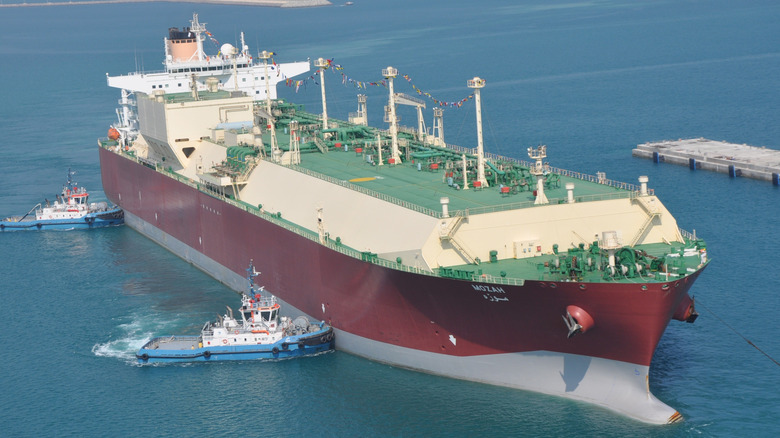
Samsung Heavy Industries has already shown us its capabilities when building engineering marvels that can extract, process, store, and distribute LNG — the next marvel on the list shows us it can also build the vessels that transport LNG. In this case, we look at the Mozah, although we could have picked any one from the Q-Max class of LNG-carrier. The Mozah, along with its sister ships are the largest LNG carriers currently sailing the oceans.
Mozah was the first of the Q-Max class to roll from the SHI shipyard and was specifically designed to transport unprecedented volumes of LNG efficiently and safely. As a comparison, most modern LNG carriers carry up to about 175,000 square meters of LNG — Q-Max ships carry an enormous 266,000 cubic meters, or almost 10 million cubic feet. The ship is over 1,100 feet long and stands about twenty stories high from keel to masthead.
Perhaps more impressive than these stats, though, is the technology and engineering required to manage the cargo. LNG needs to be carried at cryogenic temperatures of -161 degrees Celsius — or about -260 degrees Fahrenheit, if you'd prefer. At this temperature, the volume of the gas shrinks by a staggering factor of 600. Storing gas under such circumstances is impressive enough on dry land, but LNG carriers have to do this while absorbing the worst the oceans can throw at them. Finally, in performance terms, all this scale and engineering make the Mozah highly efficient, using approximately 40% less energy per unit of LNG carried, relative to traditional carriers.
MSC Gülsün

When the MSC Gülsün entered service in 2019, it sailed straight into the record books as the world's largest container ship at the time. Built by SHI at its Geoje shipyard, the MSC Gülsün can carry an incredible 23,756 twenty-foot equivalent units (TEU), which remains one of the largest numbers of containers carried by a cargo ship. The ship was the first in a new generation of ships that broke the 23,000 TEU benchmark and ultimately created a class of ultra-large container ships that were designed for high-volume cargo.
In physical terms, this is another one of a scale that is difficult to grasp. The Gülsün is 1,312 feet long, 202 feet wide, and just under 100 feet high. The ship was the first to be delivered from an order of 11 placed by the Switzerland-based Mediterranean Shipping Company.
In total, SHI received an order to build six of the ships, with the remaining five going to another well-known South Korean conglomerate — Daewoo Shipping Marine Engineering. Interestingly, SHI has also said that the ship is constructed in such a way that it can easily be converted into an LNG carrier at a later date. The MSC Gülsün may have lost its crown as the world's largest container ship, but it was the first ship to break the 23,000 TEU barrier, and that's a record that can never be broken.
Ichthys Central Processing Facility
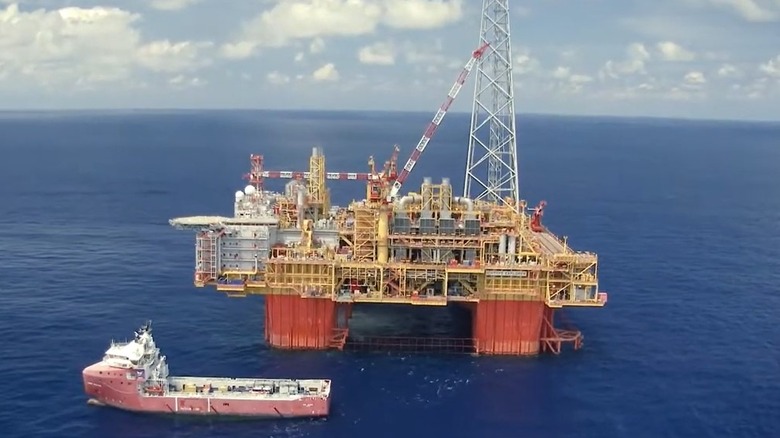
Despite sounding like a character from "Unreal Tournament," the Ichthys Central Processing Facility is a floating offshore industrial plant that is designed to perform complex gas processing tasks. It's also the least ship-like marvel among these, although it still hails from SHI's Geoje Shipyard.
It sits at the heart of the industrial machine that's extracting gas from the Ichthys natural gas field in Australia's Browse Basin. This enormous energy resource covers over 300 square miles and is thought to contain over 12 trillion cubic feet of gas.
The Central Processing Facility part of the engineering marvel's name is the biggest clue to its purpose. Essentially, the Ichthys CPF processes the LNG by removing impurities and water before the gas is pumped down a 553-mile pipeline to the city of Darwin. The whole facility has the capacity to process about 9.3 million tons of gas per year. The Ichthys CPF is expected to remain on-site for the expected 40-year duration of the project.
The engineering marvel is the world's largest semi-submersible production platform, with a deck size of 427 x 394 feet, with the topsides alone weighing in at 78,000 tons and a total weight of about 120,000 tons. After SHI completed the building work, the vessel was towed 3,480 miles to its final location, a journey that took 34 days to complete. Collectively, these engineering marvels show how a company best known for consumer technology also lends its name to some of the most impressive shipbuilding and offshoring engineering projects.