

Ford Confirms Gas Engine For New F-150 Lightning (But It's Probably Not What You Think)
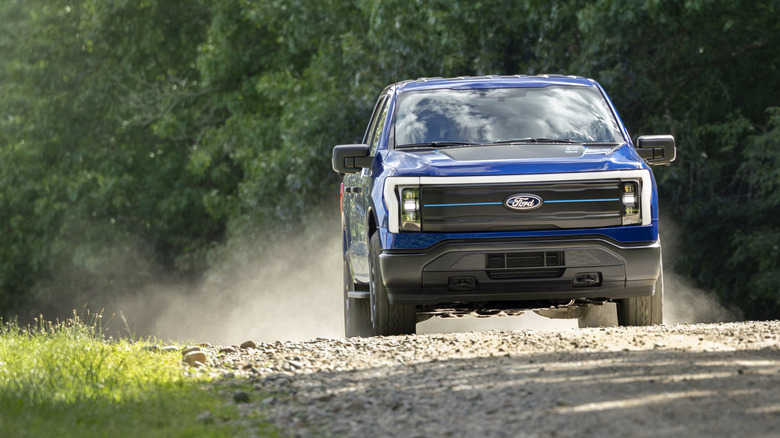
Ford's introduction of its all-electric F-150 pickup truck in 2021 was an ambitious new chapter in the history of the F-Series, but also came with quite a storied name — the F-150 Lightning. For older enthusiasts, it was a name that brought to mind the Ford Special Vehicles Team (SVT) F-150 Lightning of the '90s and early 2000s, a short-bed, single-cab, V8-powered muscle truck that could be considered a Mustang Cobra with a bed.
But the 2020s version of the F-150 Lightning was not that. It was an all-electric version of the normal F-150, introduced at a time when automakers were going all-in on electric vehicles. It wasn't a V8-powered sport truck, but at least the name made sense given the powertrain. Now, however, the all-electric F-150 Lightning is dead, and a gasoline engine is returning to the F-150 Lightning — just not in the way old school SVT fans may have been hoping.
Instead, Ford has announced that the next-generation F-150 Lightning will use a gasoline engine as a range extender, combining EV performance with the flexibility of an internal combustion pickup truck. Details are scarce right now, but it looks to be another big leap for America's best-selling pickup truck.
EVs out, hybrids in
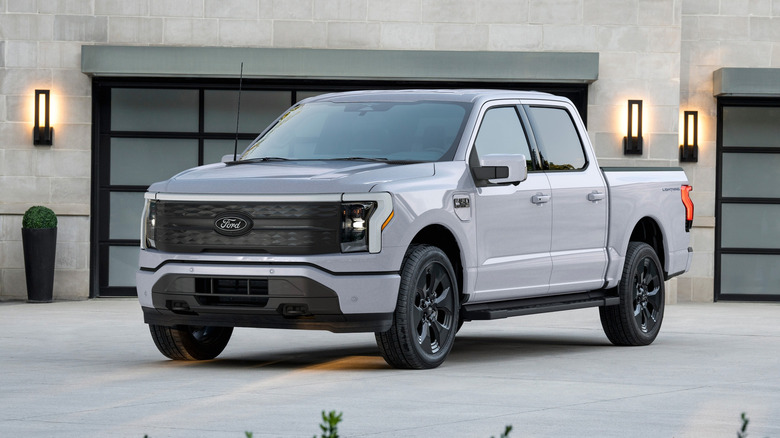
It's hard to call the current F-150 Lightning either a definitive failure or a success. It certainly proved the concept that Ford could build an electric F-150, for one. It didn't have the divisive looks of a Tesla Cybertruck or even a Chevy Silverado EV either, and it was always a strong performer thanks to its massive and instant torque, as we found out when we reviewed a 2025 Ford F-150 Lightning Pro.
Instead, the F-150 Lightning was simply limited by its EV nature. Yes, it was silent, could be extremely fast, and had great towing capabilities. In the real world, though, being an EV took away the flexibility that a lot of pickup buyers want. Few people wanted to drive long distances in one because of poor charging infrastructure, and while the Lightning could tow well, the distance it could tow before needing to be recharged was another matter entirely.
The inherent compromises of being electric were hard to overcome, and the F-150 Lightning became a hard sell to buyers who could spend the same amount of money (or less) on a proven and dependable internal combustion F-150. And that's probably why Ford is looking to split the difference with the next-generation Lightning. The move also comes as part of a larger strategy shift in Ford's truck and van segments, with a move away from pure EVs and into hybrids.
EV power without range anxiety
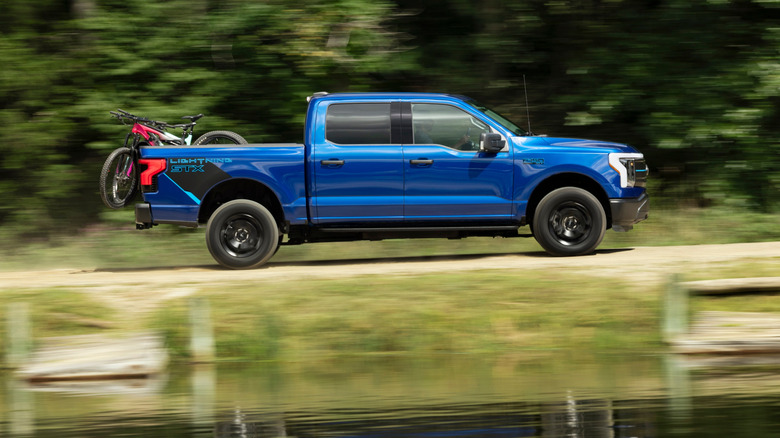
At the time of writing, Ford hasn't revealed many details about the next-generation hybrid F-150 Lightning beyond the fact that it will have a driving range of over 700 miles and massive towing capability. Ford isn't the only automaker to announce a range-extended electric pickup, either. Ram announced the Ramcharger 1500 pickup two years ago (though it's yet to reach production), and the F-150 Lightning EREV, as Ford is calling the next-gen truck, seems like it will use a similar powertrain.
That means it will be 100% propelled by electric motors, giving EV-like performance, but with an onboard gasoline-powered generator to recharge the motors. The Ramcharger has a 3.6-liter V6 as its generator, but Ford has not confirmed what size or type of gasoline engine the F-150 EREV will use. Ford's initial press release says it will reveal more details of the new truck later, but it's probably safe to assume that the Lightning EREV will offer the performance of the current F-150 Lightning without the all-electric compromises that make the truck difficult to use in the real world.
Unfortunately for sport truck enthusiasts, the F-150 Lightning's new gasoline engine does not mean a return to the fire-breathing, SVT hot rod pickup of the '90s and '00s. But compared to the current, all-electric F-150 Lightning, it should make the truck appealing to a much wider customer base, and potentially serve as a much more enticing alternative to the traditional F-150.