

How Iconic 'Battle Of Midway' Japanese Aircraft Carriers Were Finally Found
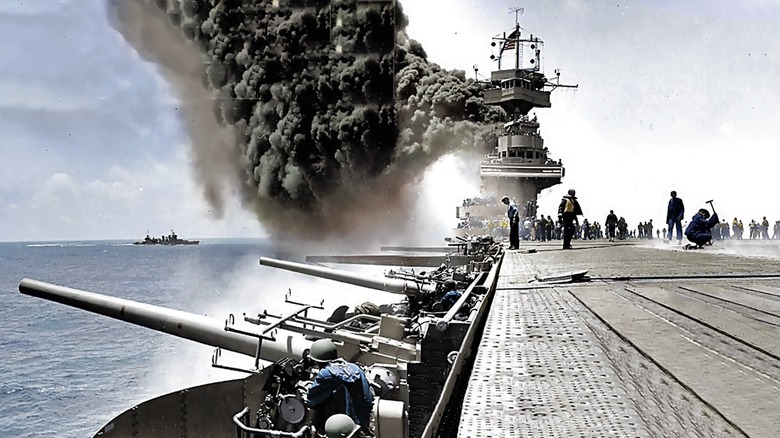
On December 7, 1941, the Empire of Japan launched a sneak attack on Pearl Harbor, bringing the United States into World War II. The attack resulted in the damaging and loss of the Pacific Fleet's battleships, but fortunately, its aircraft carriers were elsewhere. In an effort to draw them out, Admiral Isoroku Yamamoto launched an attack against the Midway Atoll from June 4-7, 1942. The battle was a decisive victory for the U.S., helping to turn the tide in the war.
The losses for Japan were immense, as the Battle of Midway saw the most aircraft carriers sunk during the war. Japan lost all four of its carriers: Akagi, Kaga, Sōryū, and Hiryū. As of writing, the Sōryū and Hiryū remain lost to history, as their locations remain a mystery. The other two, the Akagi and Kaga, were found relatively recently. It was no easy task, requiring years of research and work that scanned and documented more than 500 square miles of the ocean floor.
The first discovered was the Kaga, found on October 16, 2019. The second, the Akagi, was located a couple of days later, which came more than 77 years after they sank. The Kaga's discovery is notable, as it's the first Japanese aircraft carrier wreck to be found, making the Akagi the second. Both were located and identified by the research vessel Petrel, which used an autonomous underwater vehicle (AUV) to find the wrecks. The carriers settled on the ocean floor at a depth of 17,717 feet, while the Akagi sits 5,249 feet away from the Kaga.
The wrecks of the Akagi and Kaga
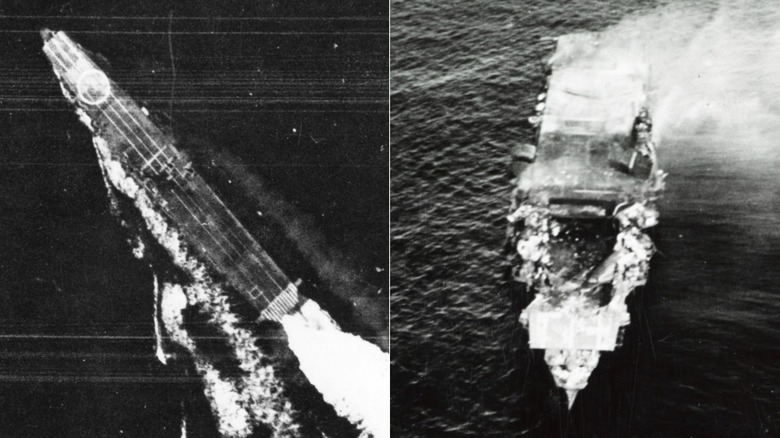
What made locating the two vessels so challenging was the battle itself, which initially featured engagements separated by more than 170 miles. The carrier-on-carrier combat left wreckage strewn all over the ocean floor for thousands of square miles, and each piece of debris that was identified helped slowly piece together the puzzle of where the vessels finally settled. The debris and wide area of the conflict made finding anything a puzzle, requiring an analysis of the battle, as well as picking up clues on the ocean floor to find the wrecks.
Their depth presented a considerable challenge, as the Akagi and Kaga are the fourth-deepest shipwrecks of WWII. To image the wreckage, the research team aboard the Petrel used a sonar-equipped AUV. This is how they confirmed the identity of the ships, as the wreckage aligned with the dimensions of each vessel. Their first imagery was low-resolution, so another pass was made to acquire higher-quality renderings of the wrecks.
The Akagi and Kaga both sit upright on their keels, with much of the flight decks destroyed. The Battle of Midway saw seven ships sink on both sides, but four remain lost due to the depths of the area and how scattered they are. Japan lost several aircraft carriers during WWII, but those lost at the Battle of Midway were the most impactful. It truly turned the tide, putting Japan on the defensive as the Allies began their island-hopping campaign throughout the Pacific, ultimately leading to Japan's doorstep.