

Toyota's New Concept Pickup Is As Barebones As A Truck Can Get
Toyota has been making a lot of waves lately with its dirt-cheap, bare-bones $13,000 Hilux Champ pickup truck, which unfortunately doesn't seem likely to come to America anytime soon. There are lots of reasons people are excited about a truck like the Hilux Champ, not just because of its low price, but because it represents a return to the small, stripped-down, workhorse pickups of past decades.
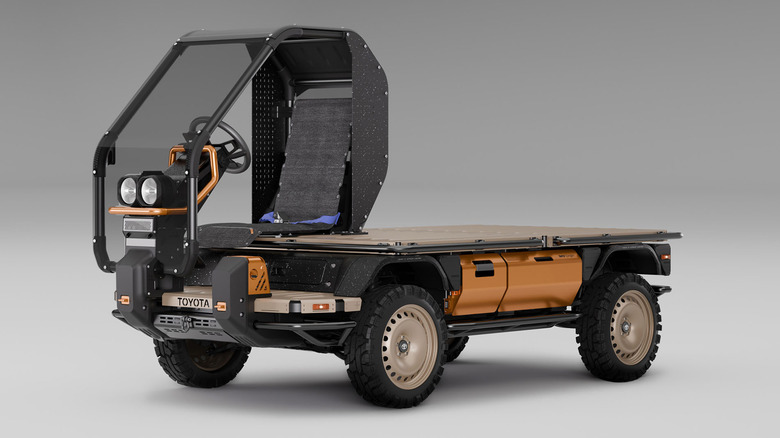
But what if we told you Toyota just unveiled another small truck concept that makes the Hilux Champ look like a luxury vehicle in comparison? Well, that's exactly what they did at the 2025 Japan Mobility Show with a concept called the Toyota IMV Origin. Vastly different from a pickup, or even a truck as we know it, the IMV Origin would be one of the simplest vehicles Toyota has ever produced, redefining not just the idea of a truck but the way in which a Toyota could be shipped, delivered, and customized.
The automaker imagines the IMV as a vehicle that's intentionally shipped incomplete, with final assembly and customizations to be completed locally. And though Toyota specifically targeted Africa as one of the key markets for the IMV Origin, it's a product that could potentially be in big demand all over the world, including in the United States, where the interest in tiny trucks seems to be growing as of late.
The IMV Origin, shipped deliberately incomplete
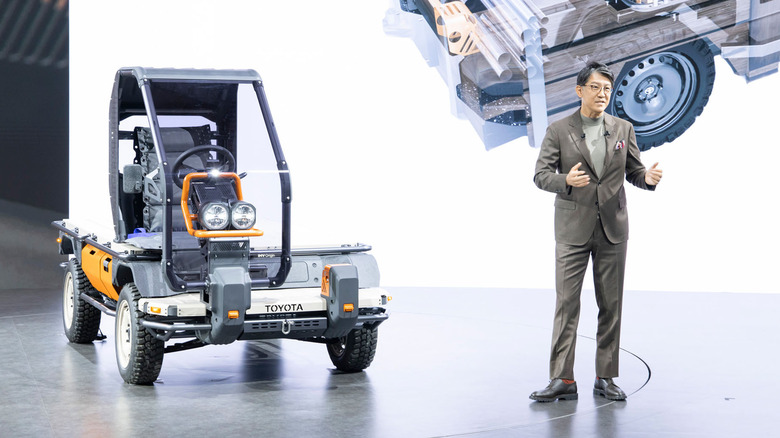
Size-wise, the IMV Origin is actually more like a golf cart or small utility vehicle than it is a road-going pickup truck — even the once-dominant small single-cab pickups that were common on America's roads in the 1980s are plush compared to this thing. And as you can see from the concept's single-seat, doorless design, this probably isn't anything you'd want to take onto an American highway, nor would it come close to meeting our federal safety standards.
But that's not what Toyota designed the IMV Origin for. It's just not that this tiny truck is aimed toward villages in Africa; it's the unique idea that Toyota has for shipping the vehicle in an unfinished state and having locals complete assembly to their own design. Not only would this lower costs and make shipping easier, but it could also provide jobs and boost the local economies where the assembly is done.
With a single driver's seat and an otherwise flat chassis, the Origin would be configured locally to carry people, cargo, or a combination of both, with either an enclosed or an open bed — or whatever else could be fitted to the chassis. It's designed from the start to be a blank canvas of a vehicle, with a hint of your favorite flat-packed, self-built Ikea bookshelf to it as well.
The IMV Origin's potential as more than just a cheap truck

While the IMV Origin is a fascinating and forward-thinking concept from an industry titan like Toyota, does a vehicle like this mean anything for people in markets like North America? Even though it makes the Hilux Champ look like a fully-loaded Tundra in comparison, there's certainly potential here. As an actual highway-going small truck it'd be unlikely to meet normal motor vehicle regulations, but what the IMV Origin (or a similar vehicle) could do in the American market is serve as a modern, Toyota-built competitor to off-highway utility and recreation vehicles, as well as to the surprisingly popular Kei trucks that many American enthusiasts import into the country as used vehicles.
Even if Toyota were to forgo the whole "build it yourself" part and produce a turnkey, ready-to-run version, we could absolutely see the appeal of a tiny, cheap Toyota truck like this for use by businesses, local governments, farmers, or even recreationists. Whether it's an old, imported Kei truck or a side-by-side UTV like the Polaris Ranger, there is already a sizable market in America for tiny trucks that are used differently from modern pickups. Seeing a major player like Toyota with its outstanding truck reputation jump into this market could be a very big deal — and it's something the Japanese automaker is currently planning for the not-so-distant future. However, for now, it's just a concept aimed at developing markets, but Toyota could very well be on to something even bigger here.