

All About The World's Largest Aircraft Carrier (And How Many Planes It Can Hold)
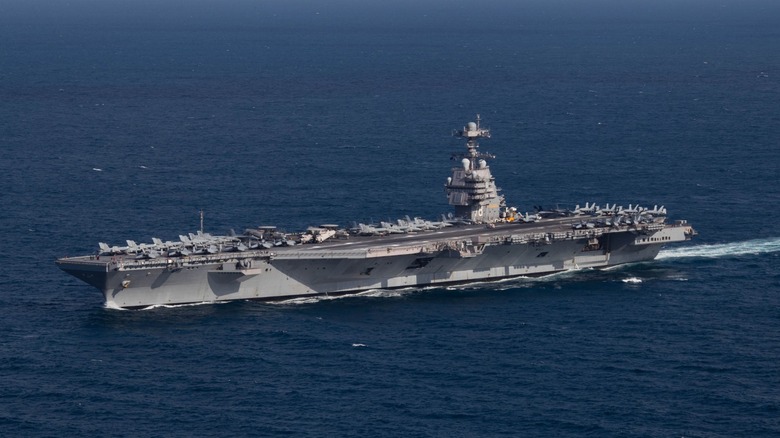
Since 1911, when Eugene Burton Ely, the renowned American aviator, became the first person to take off from and land on a naval vessel, the use of aircraft carriers in naval warfare has become much more organized and mainstream. Today, the largest aircraft carrier in the world, the USS Gerald R. Ford (CVN 78), is 1,100 feet long, weighs over 100,000 tons, and can carry more than 75 aircraft at a time.
The ship carries a wide range of aircraft, including a squadron of F/A-18F Super Hornet two-seat fighters and three squadrons of F/A-18E Super Hornet single-seat fighters. While the Ford cannot currently operate the latest fifth-generation fighters, the F-35C, reports suggest that it will eventually be retrofitted to handle the technology and intelligence these modern aircraft demand.
The USS Gerald R. Ford is the first and only operating carrier of its kind, but other Ford-class carriers, the USS Enterprise and the USS John F. Kennedy, are being constructed at the time of this writing. The Ford's manufacturer, Huntington Ingalls, projects that the ship will save the US Navy up to $4 billion. The Ford-class carriers were created to support and ultimately replace the Nimitz carriers that will begin retiring in 2026.
Can't talk about the USS Gerald R. Ford without mentioning EMALS
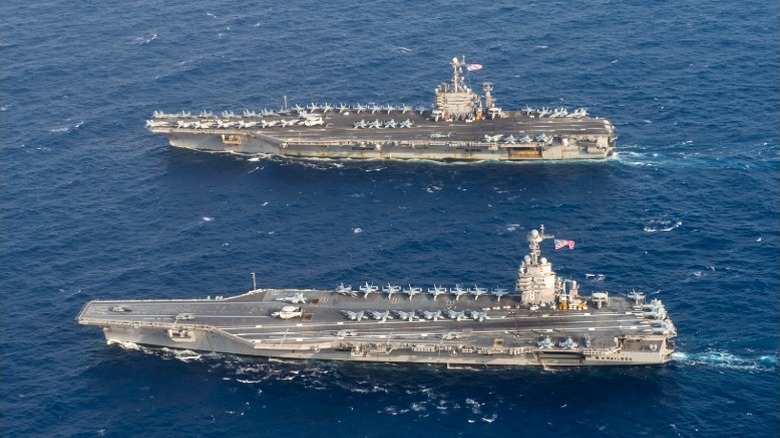
Older aircraft carriers, such as those in the Nimitz Class, used steam-powered catapults for launching aircraft. The Nimitz's A4W Westinghouse steam-powered reactor, however, takes up a lot of space inside carriers, and that's just one of its demerits. The reactor design also requires more operation personnel, demands more maintenance, and still produces 25 percent less thermal power than the twin A1B reactors used in the USS Gerald R. Ford.
As such, the most important innovation in the USS Gerald R. Ford is the Electromagnetic Aircraft Launch System (EMALS). EMALS uses stored energy from power sources in the ship and converts it to adjustable frequency through a power-conversion subsystem. This controlled, adjustable energy is then used to drive the Linear Induction System (LIM), which creates electromagnetic forces that act on a shuttle attached to the aircraft, launching it along the flight deck.
EMALS also makes for smoother takeoffs as it can modify the power from the ship's propulsion to a broader aircraft range, including lightweight unmanned vehicles and heavy strike fighters, making military operations more adaptable and flexible. Other advantages of this new technology are reduced costs from lower maintenance requirements and reduced manning, more reliable maintenance software, and better living conditions for sailors aboard Ford-class carriers.
What other revolutionary tech makes the Gerald R. Ford special?
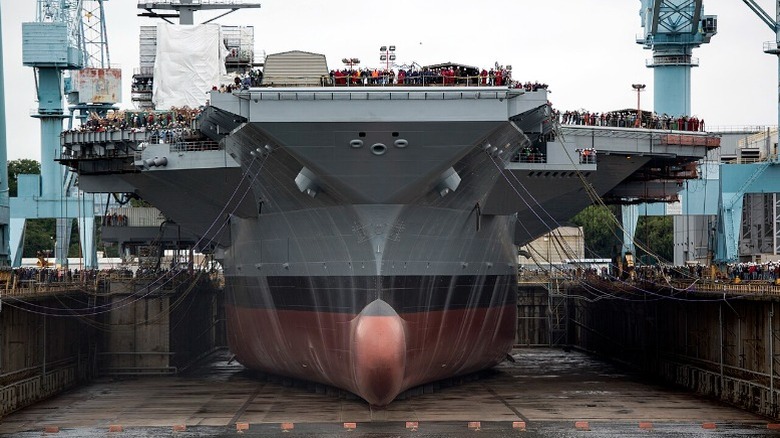
Apart from EMALS, Advanced Arresting Gear (AAG) is another new system in the first Ford-class carrier; it is used to catch and decelerate aircraft landing on the carrier deck. AAG uses electromechanical energy absorption, unlike the traditional hydraulic arresting gear used in Nimitz carriers (Mk-7 Mod 4 and Mk-7 Mod 3). This allows it to recover both heavy strike jets and light unmanned aircraft with smoother, more controlled deceleration, reducing stress on airframes. According to the Navy, AAG will "provide higher safety and reliability margins."
The Advanced Weapons Elevators (AWE) system represents another important technological innovation. The carrier possesses 11 weapons elevators that use electromagnetic/motor-driven systems (instead of older hydraulic systems) to move bombs, missiles, and other ordnance from storage magazines to the flight deck. This allows more efficient weapons handling, as the Advanced Weapon Elevators significantly increase the ship's weapons-throughput capacity while reducing the number of sailors needed to move ammunition.
The Gerald R. Ford is powered by two AB1 nuclear reactors, which can serve the power needs of every household in, say, Syracuse, New York. This power reserve enables the carrier to use EMALS and other such power-intensive tech. Lastly, the Ford's Dual Band radar, a modern radar system comprising the S-Band Volume Surveillance Radar and the X-band AN/SPY-3 Aegis radar can detect hostile aircraft and respond with Evolved Sea Sparrow Missiles (ESSM) for interception.