

When Was The World's First Speeding Ticket Issued And How Fast Was It For?
The first automobile is generally accepted as the Patent-Motorwagen, built by Carl Benz in 1885, a two-seat, 0.75-horsepower, single-cylinder, four-stroke engine with three wheels. In July of 1886, newspapers reported that it'd been seen for the first time on the streets around Mannheim, Germany. On September 21, 1893, brothers Frank and Charles Duryea drove what many considered to be the first automobile in America — an old horse-drawn wagon fitted with a four-horsepower, single-cylinder gasoline engine.
The automobile boom was off to the races, so to speak, and the world was forever changed. However, by all accounts, there were very few cars on the road in the late 1890s because each one had to be hand-built. This was still years before the Curved Dash Oldsmobile was first mass-produced in 1901. Until then, cars were, by and large, considered high-end luxury items (toys, if you will) for the rich and famous. Still, someone had to be the first person to get a speeding ticket, right?
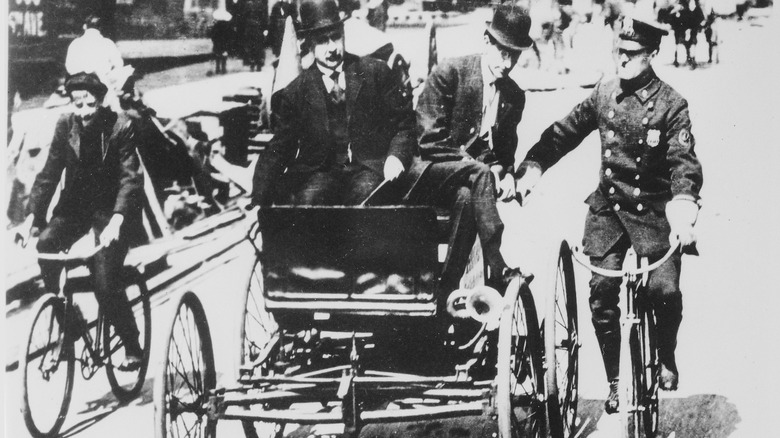
That honor goes to Walter Arnold, who on January 28, 1896, was tearing through the streets of Paddock Wood in Kent, England, at a blistering speed four times the legal limit – of two miles per hour. Keep in mind that three miles per hour is considered a brisk walking pace, so someone could literally walk faster than the law allowed motor vehicles to go. Even funnier, it took the constable who bravely chased him on his police-issued bicycle, five miles to catch up and, for lack of a better term, "pull him over."
A relatively small fine for such wonderful publicity
Arnold fell squarely into the rich and famous category, as he was not only the local provider of German-made Benz vehicles in the region but also one of the first "car dealers" in all of England. In fact, for three short years between 1896 and 1899, Arnold's own auto manufacturing company, Arnold Motor Carriage, built cars based on the world's first vehicle powered by a gas engine, which had been patented by Benz only a decade before, on January 29, 1886.
According to The London Daily News, which called Arnold's contraption a "horseless carriage," he was cited on four different counts. Since there were no laws on the books yet regarding these "horseless carriages," the courts referred to the laws that had been established for, believe it or not, locomotives. So, Arnold was quite literally charged with operating a locomotive without a horse on a public road, doing so with fewer than three people, and for not clearly displaying his name and address somewhere on said locomotive. The fourth and final count was for exceeding the posted 2-mile-per-hour speed limit.
Ironically enough, he wasn't charged with violating another odd locomotive law that required someone to walk ahead waving a red flag to warn pedestrians of its impending approach. Arnold was found guilty on all counts on January 30 and was subsequently fined an amount that was less than five British pounds (less than $25 U.S. dollars at the time). Let's just say that, being the car dealer that he was, Arnold probably thought the publicity was worth every penny.