

Yes, You Can Lock Your Helmet To Your Motorcycle - Here's How Bikers Prefer To Do It
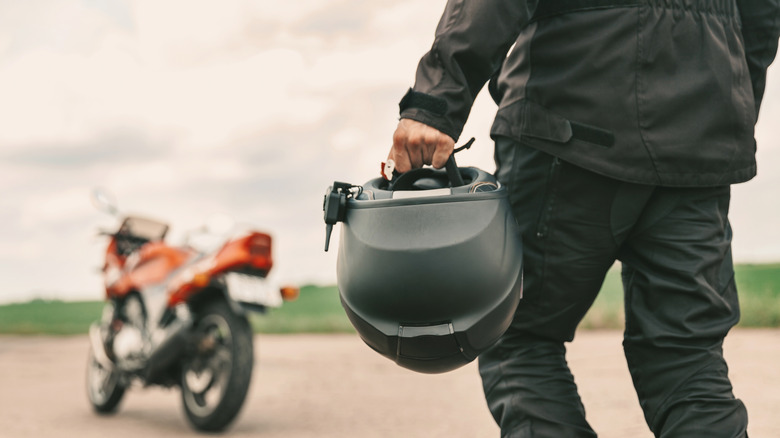
The problem of what to do with your helmet when parked is a frustrating one for motorcycle riders. Toting one of the best helmets for new riders around all day is inconvenient, but leaving it with your bike exposes it to damage or theft. Accessory makers and riders have converged on a few solutions that minimize inconvenience and risk, including a few different lock formats. Many riders use a padlock in tandem with a chain or cable to attach their helmet to the motorcycle; bicycle locks like the Linka bluetooth lock from Shark Tank Season 7 work well for this. Some bikers thread the cable or chain through the chin strap on their helmet, but a thief could cut the strap and swipe the now-damaged helmet. Cables and chains can also be severed with bolt cutters or an angle grinder, meaning someone with the right tools and a little time won't be deterred by these devices.
If you opt for a cable or chain lock, go with one that provides good cut protection. Choose the thickest cable or chain that is convenient to carry, and look for one with a tamper-resistant sheath around the metal. Some would-be thieves will be scared off completely by a substantial chain or cable, and those who still try to cut them will have a hard time doing so quickly or quietly. The Kryptonite 1016 evolution lock has a chain that's 10 millimeters (almost 1/2 inch) thick and over 5 feet long, so you can use multiple passes through your helmet to secure it. It's made of manganese steel and has a tamper-resistant key cylinder, although its nearly 10-pound weight is a potential drawback for some.
Other ways to secure your motorcycle helmet
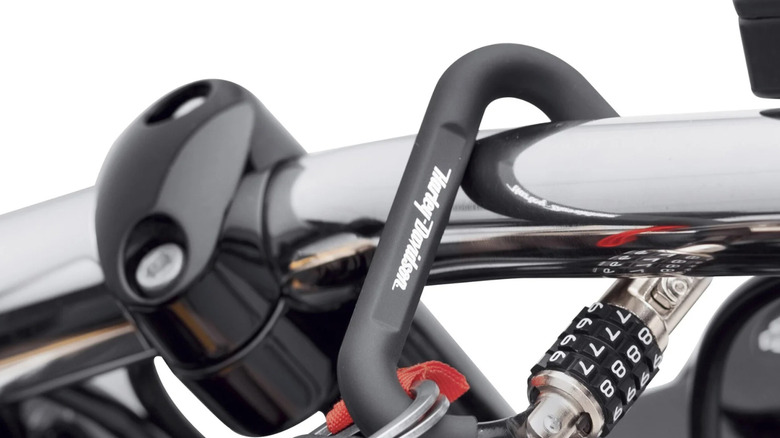
There are some purpose-built helmet locks that have their own pros and cons. Harley-Davidson sells a four-digit combination lock that goes through the D-rings on your helmet's chin strap and attaches to your handlebars or engine guard. A thief could still cut the strap and take your helmet, but they'll have trouble using or selling the damaged accessory. Full-face helmets with hard chin guards can be secured with a chain or cable around the guard, although this could damage a helmet's finish or lining. Perhaps the best solution is to lock your helmet inside a hard saddlebag or trunk box.
Many motorcycles come with locking compartments that are big enough to hold one or two helmets, and aftermarket solutions like the Kemimoto 45-liter locking top case protect your helmet and gloves from theft and the elements. Even with these available solutions, some bikers just leave their helmets on the seat or hanging from the handlebars. Banking on the honesty of strangers might be fine at times, but an unlocked helmet won't always be there when you return to your bike. A surefire "better safe than sorry" tactic is to take your helmet with you; that ensures it's back on your head when you need it again.