

What It Means When A Ship Is Scuttled (And Why It Happened So Often In WWII)
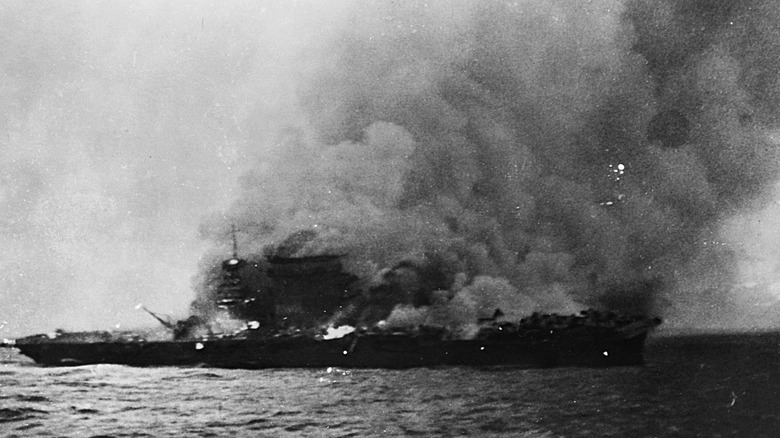
Warships being hit by enemy fire and sinking to the bottom of the sea is, as you may have gathered, a big part of naval combat. And it's been that way throughout its entire history, even as some revolutionary warships changed it forever. For sailors and officers, few things are more triumphant than sending an enemy ship to the bottom of the sea, but many sunken ships (including some of the famous ones ever to go down) were actually scuttled rather than directly sunk by enemy fire.
Scuttling is when a navy or owner deliberately sinks its own vessel. Though ships of all types have been scuttled for a variety of reasons, the practice was especially prominent during WWII, given the scale and ferocity of naval battles in both the European and Pacific theaters. From the legendary Bismarck to American aircraft carriers and even an entire French fleet, the prevalence and individual circumstances of these scuttlings are one of the most fascinating parts of World War II naval history.
Desperate times, desperate measures
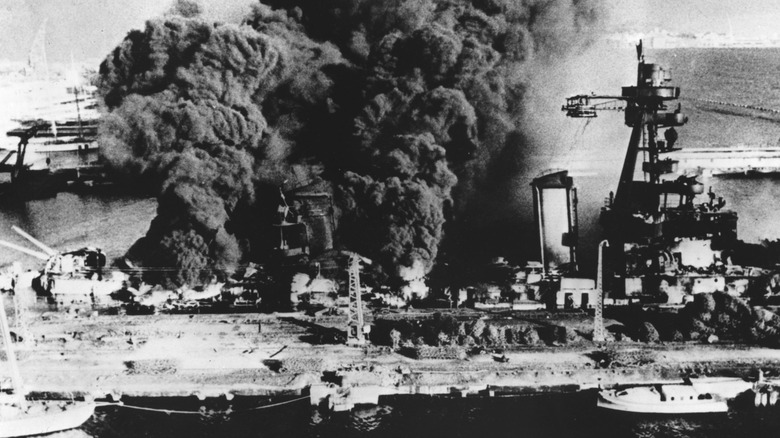
Why would a navy want to sink its own ship? A lot of reasons, actually, some more straightforward than others. In traditional naval combat, even catastrophic damage to a warship doesn't necessarily mean that it's going to sink quickly — or even sink at all. Even heavily damaged vessels can float for a very long time. So, not wanting the ship to fall into enemy hands, to either be taken over and used, or just studied for secrets, a decision will be made to have friendly forces torpedo or shell an abandoned ship, sinking it and denying access to the enemy.
One example was the fearsome German battleship Bismarck from WWII. Although there is some debate about what finally caused her to go down, it is believed that the crew was ordered to scuttle their own ship once it had been crippled by the British Navy in 1941. Given both the military and symbolic might of the ship, it makes complete sense that the Germans didn't want the Bismarck's technology (and its own symbol of naval power) to fall into British hands. At another point, in 1942, an entire French fleet was scuttled at the Port of Toulon — not because it was damaged beyond repair from combat, but because it and the port were about to be captured by the Germans. In denying spoils to the enemy, more than 60 ships were purposely sunk.
Scuttled aircraft carriers
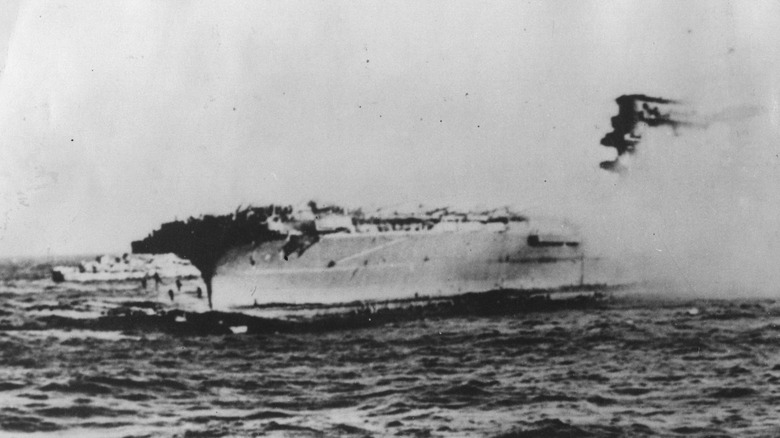
In the Pacific Theater, the Battle of the Coral Sea and the Battle of Midway featured the first battles between aircraft carriers, changing not just the path of the Pacific War, but the face of naval warfare itself. These massive battles in the Pacific theater would see several aircraft carriers scuttled on both sides, including the USS Lexington, which had to be scuttled following critical attacks from Japanese aircraft during the Battle of the Coral Sea. In the decisive Battle of Midway that happened the following month, the Japanese would lose four carriers, with the Akagi and Hiryu among the ships ordered to be scuttled as the fleet retreated from battle.
Then there was the carrier USS Hornet, which was catastrophically damaged during the Battle of the Santa Cruz Islands. U.S. Navy destroyers attempted to scuttle the abandoned Hornet, but the ship kept floating; it was finally sunk by Japanese submarines a day later.
While we've primarily focused on wartime scuttling of ships, it needs to be said that not all ship scuttling happens under such stressful conditions. Many retired ships, both military and civilian, have been scuttled in peacetime and turned into environmentally friendly artificial reefs.