

What Does Harley-Davidson's FXR Model Code Mean?
Ask most Harley riders what they're on and the chances are you'll hear a familiar model name — Street Glide, Road Glide, and the iconic Softail design. However, what all but the most ardent of enthusiasts might be unaware of is that every Harley-Davidson carries an internal alphanumeric code. The code has been used ever since Harley was founded in 1903; it's used to identify platforms, engines, and trim variations. Indeed, for decades, these codes were the primary way to distinguish one model from another. Understanding these codes and how to interpret them became something of an enthusiast's badge of honor.
Although these alpha-numeric designations began with a logical approach, this was soon lost. Early Harleys often took their prefixes directly from engine characteristics, using letters to indicate displacement or valve design. other letters referenced new features or mechanical updates, like the hydraulic forks introduced in 1949. Confusingly, these were designated Hydra Glide — which, despite sounding like a model name, is actually a description of a feature, which was then followed by an E or an F depending on engine displacement. Over the years, many letters have been reused or reassigned entirely, which is why even long-time Harley fans sometimes find the company's alphabet soup hard to follow.
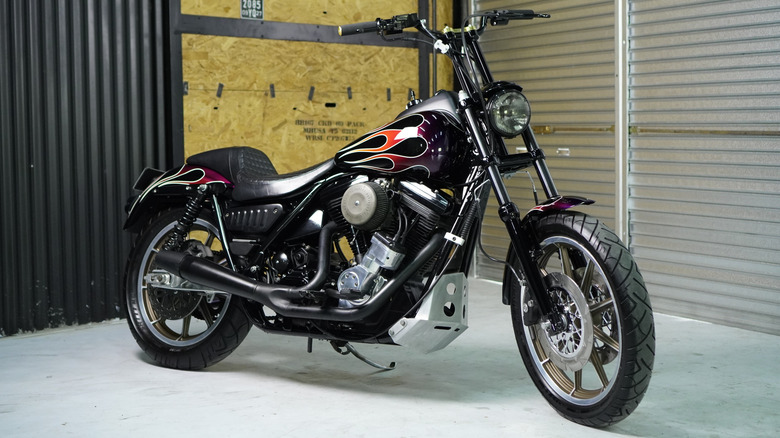
Against this backdrop, the FXR designation fits into Harley's tradition of combining platform identifiers and model traits to label its bikes. In this instance, the FXR denotes a Big-Twin platform, with sport-influenced styling, and a rubber-mounted frame.
What the FXR code actually represents
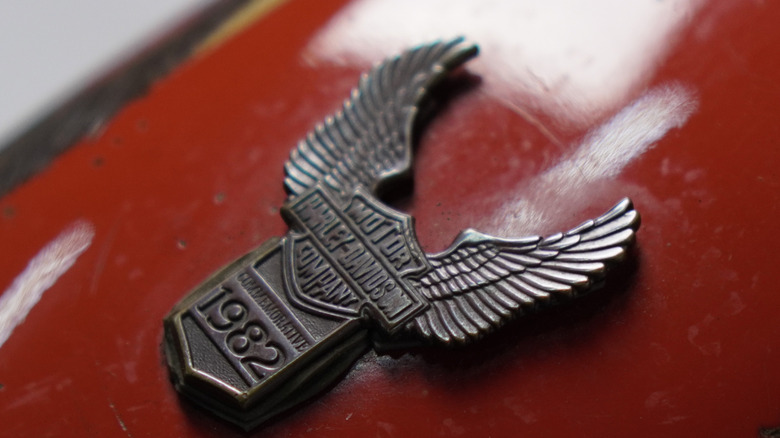
The FXR range was first introduced in 1982. The F identifies a bike from Harley's Big Twin lineup, a long-running family of large-displacement V-twin machines. The X refers to the bike's construction, more specifically, it tells us that the motorcycle has a sports or special construction. Finally, we come to the R, which tells us that the bike is fitted with a rubber-mountings. However, the latter isn't always the case, a point demonstrated by the fact that rubber-mountings first appeared in the FLT model, introduced in 1981.
The FXR used the same 80 ci (1300cc) engine and transmission found in Harley's touring models. This gave it similar vibration control in a noticeably lighter platform. Harley moved away from heavy cast frame components with the FXR. Instead, it used welded, stamped-steel sections arranged in a triangulated pattern to improve rigidity.
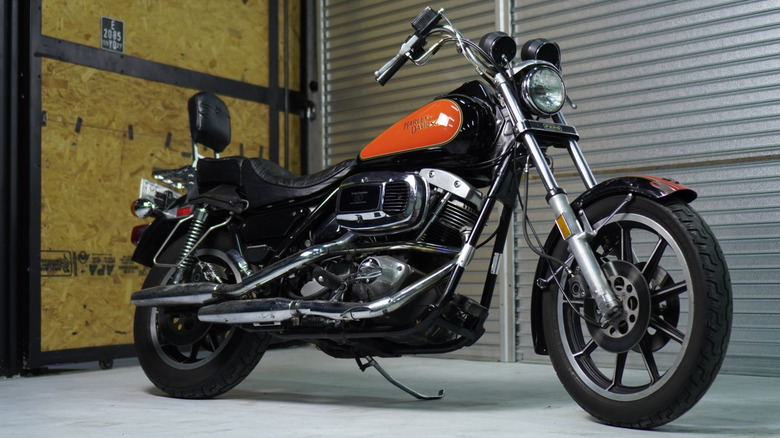
Another-performance enhancing feature of the FXR was the seating position — Harley engineers raised the seat and positioned the footpegs higher to improve lean angle and cornering performance. Ultimately, the FXR platform introduced a range of models, including the FXRT Sport Glide, the FXRP police model, the FXRS Low Glide, and one of the best handling Harleys ever — the FXRS Low Rider.
Why Harley's naming convention can get confusing
To be fair to Harley-Davidson, it's worth noting that these internal model codes were never meant to be customer-facing. This helps to explain why they've evolved into a collection of seemingly random letters and numbers. In other words, it wasn't designed to offer a perpetual challenge to Harley enthusiasts.
The approach created a flexible system, but one that could be hard to interpret and could feel inconsistent, especially when looked at from the outside. The same letter might refer to a particular fairing on one model, a certain engine on another, or the presence of sidecar gearing in a previous generation. As Harley admits, the system can be confusing — the company specifically offers a 2005 example where the R can refer to either Roadster, Road King, or Racing models, and the C suffix can denote either Classic or Custom.
It's this mix of heritage, engineering changes, and long-running platform names that makes Harley's internal designations seem so cryptic. Yet within this jumble, the FXR stands out because it's a designation that mirrors the bike's engineering intent — a Big Twin, with a sportier look, and a rubber-mounted frame. It might not be one of the most important events in Harley-Davidson's history, but FXR is a name that has become a Harley-Davidson legend in its own right.